Recognizing shapes Math Worksheets for Ages 4-9 - Page 2
35 filtered results
-
From - To
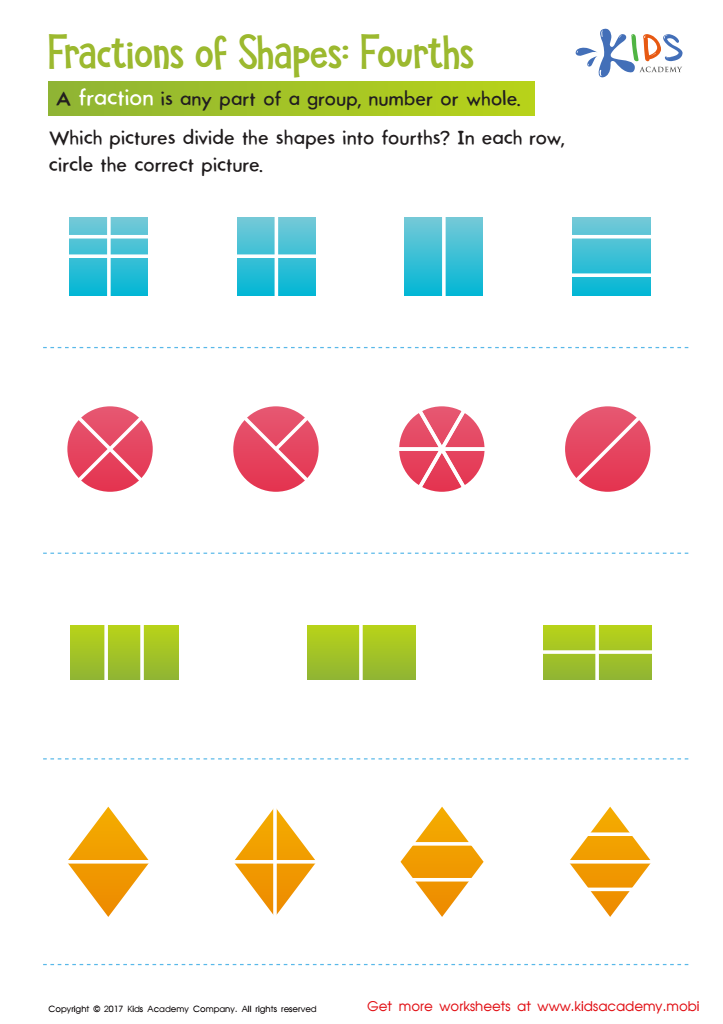
Fractions of Shapes Worksheet
 Assign to My Students
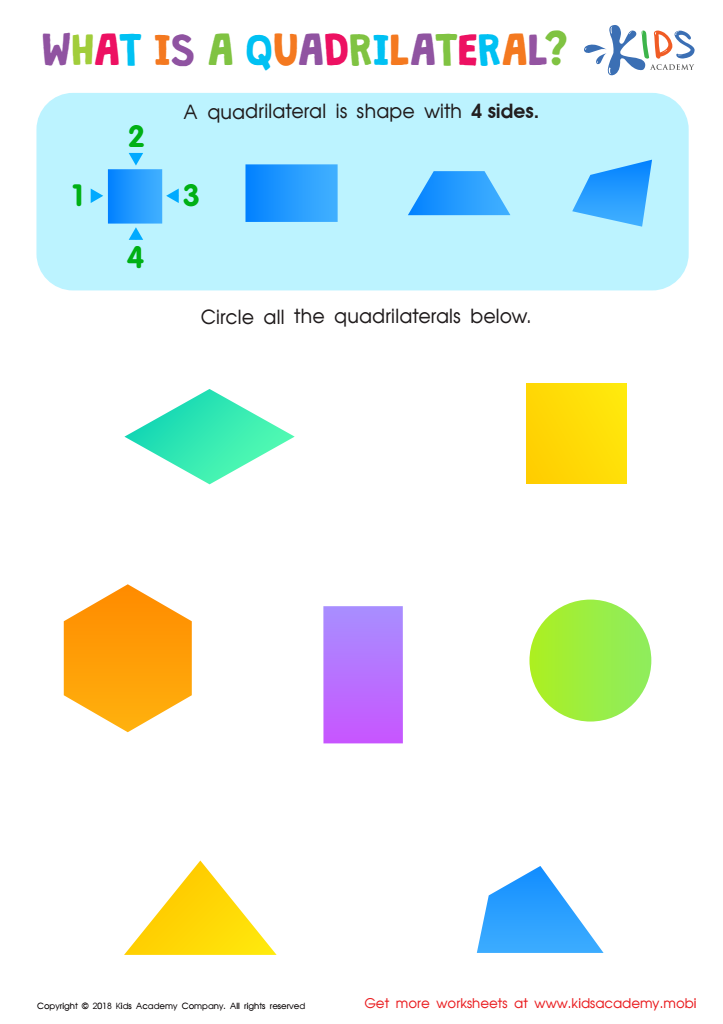
What Is a Quadrilateral? Worksheet







Recognizing shapes is a fundamental aspect of early childhood education and serves as a building block for a range of cognitive and developmental skills. For ages 4-9, the ability to identify and differentiate between shapes is crucial for several reasons.
Firstly, it enhances spatial awareness. By understanding shapes and their properties, children can navigate and interpret the world around them more effectively. This spatial reasoning is essential for tasks such as reading maps, understanding geography, and even in art and design.
Secondly, recognizing shapes supports language development. As children learn the names and characteristics of different shapes, they expand their vocabulary and improve their descriptive language skills. This ability to communicate clearly and accurately is fundamental to all areas of learning.
Thirdly, shape recognition is directly linked to mathematical concepts. For instance, understanding geometric shapes lays the groundwork for more advanced math topics like fractions, symmetry, and geometry. Kids who are comfortable with shapes are better prepared to tackle these concepts as they progress in school.
Lastly, recognizing shapes promotes problem-solving skills and logical thinking. When children sort, classify, and organize different shapes, they learn to make comparisons, identify patterns, and develop critical thinking skills.
In summary, prioritizing shape recognition for children aged 4-9 fosters essential cognitive, linguistic, and mathematical skills, setting the stage for future academic success.








