
Recognize shapes Worksheets for Ages 5-7
12 filtered results
Difficulty Level
Grade
Age
-
From - To
Subject
Activity
Standards
Welcome to our "Recognize Shapes" worksheets designed for children ages 5-7! These engaging activities help young learners identify and distinguish various shapes, enhancing their visual recognition and cognitive skills. Our worksheets feature colorful illustrations and interactive exercises, making the learning process enjoyable and effective. Children will explore common shapes like circles, squares, and triangles, while practicing essential skills through fun exercises such as tracing, matching, and coloring. Perfect for classroom use or at-home learning, these resources are designed to foster creativity and reinforce foundational math concepts. Download our "Recognize Shapes" worksheets today and watch your child's confidence soar!
Favorites
With answer key
Interactive
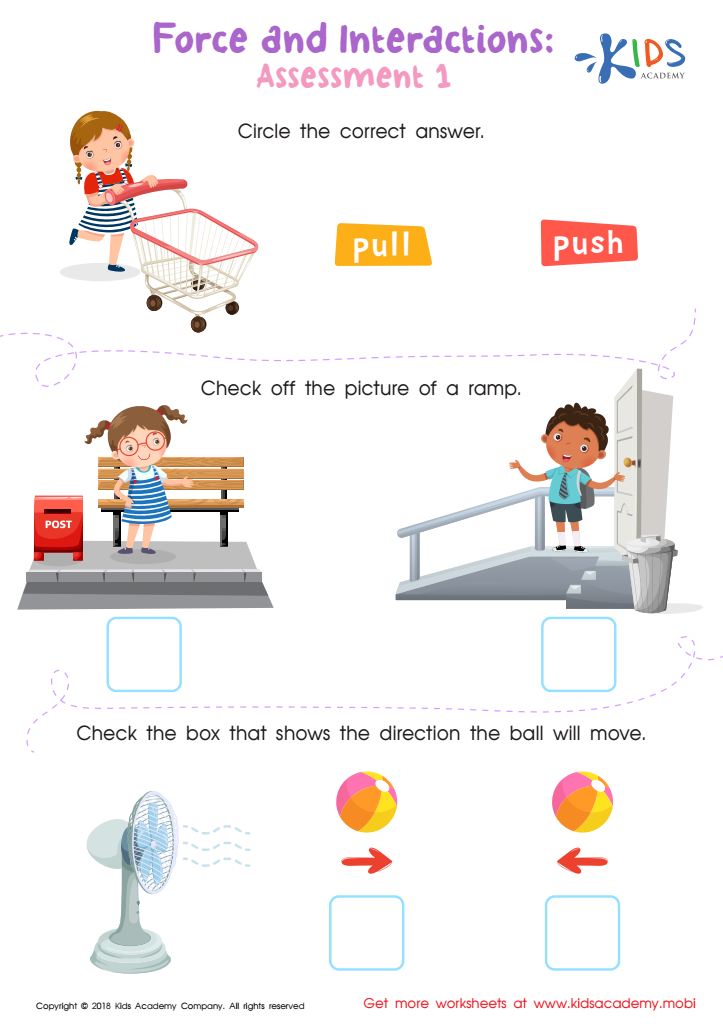
Force and Interactions: Assessment 1 Worksheet
Test your students' knowledge of pushing, pulling, ramps and wind with this worksheet. The first task requires them to identify push or pull pictures. The second asks them to identify a ramp and the third to explain which direction a ball will move when exposed to wind.
 Assign to My Students
Force and Interactions: Assessment 1 Worksheet
Worksheet
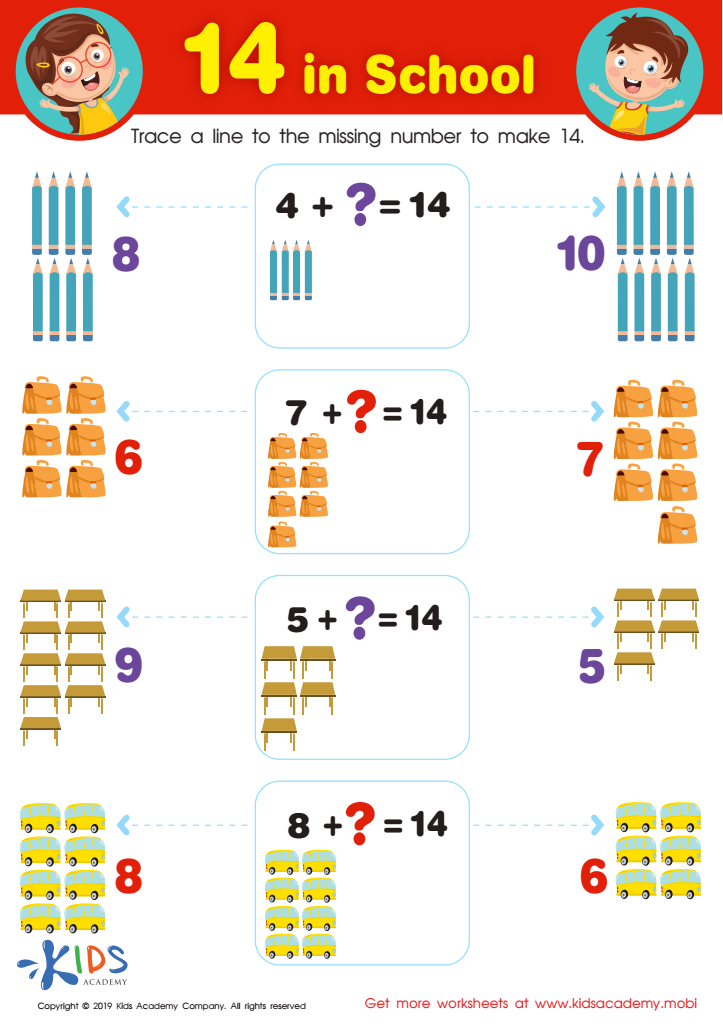
14 in School Worksheet
Remind your kids that adding different sets of numbers can give the same total (e.g. 2+3=5, 4+1=5). Ask them for more examples. Afterwards, work through the exercise. Help them count the objects and trace a line to the missing number that makes the total 14.
14 in School Worksheet
Worksheet
Join Kids Academy for Free
Who is primarily going to use this learning content?







Recognizing shapes is a foundational skill critical for young children aged 5-7 as it serves as a stepping stone for their cognitive development, problem-solving abilities, and future mathematical learning. When parents and teachers prioritize shape recognition, they aid in the enhancement of children's spatial awareness and visualization skills. This understanding of shapes not only ties into math-related tasks such as geometry but also enhances literacy, as children relate certain letters and numbers to their basic shapes.
Moreover, engaging children in shape activities fosters critical thinking as they categorize objects and navigate their environment more thoughtfully. These experiences foster creativity through art, helping children recognize and replicate various forms in their artwork and imaginative play. Encouraging shape recognition also nurtures fine motor skills as children manipulate, trace, and create shapes.
Finally, by incorporating shapes into fun, interactive games and activities, parents and teachers help build children's confidence through mastery of this essential skill. Such playful learning creates a strong foundation for lifelong learning, encouraging a positive attitude towards education. Ultimately, emphasizing shape recognition not only lays the groundwork for academic success but also cultivates curiosity and exploration in young minds.








