Solve word problems Worksheets for Ages 5-7
3 filtered results
-
From - To
Explore our “Solve Word Problems Worksheets for Ages 5-7,” designed to engage young learners in critical thinking and problem-solving. These interactive worksheets incorporate fun scenarios that help children grasp basic math concepts while strengthening their reading and comprehension skills. Each exercise promotes analytical thinking as kids learn to interpret questions and visualize solutions. Perfect for homeschoolers and classroom use, our worksheets cater to varying skill levels, ensuring each child can progress at their own pace. Ignite your child's love for math with appealing graphics and relatable situations that make learning enjoyable! Download your worksheets today and watch them thrive!
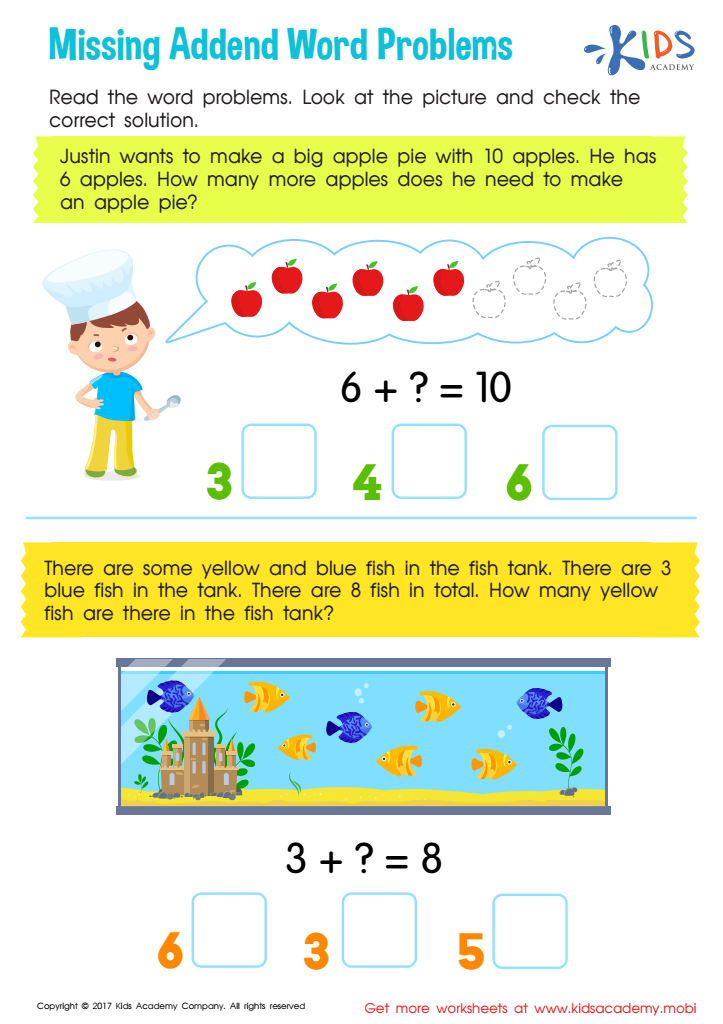
Missing Addend Word Problems Worksheet
 Assign to My Students




.jpg)



Parents and teachers should prioritize solving word problems for children aged 5-7 because this skill establishes a strong foundation for critical thinking and literacy in mathematics. At this developmental stage, children are learning to both read and understand numerical concepts; word problems bridge these two areas by requiring young learners to decipher information and translate it into mathematical operations.
Engaging with word problems fosters cognitive skills, encouraging children to analyze scenarios, identify relevant data, and employ reasoning strategies to find solutions. This process enhances their comprehension, collaboration, and communication skills, essential for success in academic and real-world situations.
Moreover, solving word problems promotes a positive attitude toward math by contextualizing it within everyday life. Children see that math extends beyond abstract numbers and equations, enabling them to appreciate its practical applications.
Additionally, tackling word problems helps bolster resilience. Children learn that encountering challenges is a part of the learning process; over time, they develop persistence in problem-solving, an invaluable life skill.
By fostering an environment where playful exploration of word problems occurs, parents and teachers can significantly contribute to their students' overall success, self-esteem, and love for learning, laying the groundwork for future academic achievement.








