Fine motor skills development Addition & Subtraction Worksheets for Ages 5-7
3 filtered results
-
From - To
Boost your child's learning with our "Fine Motor Skills Development Addition & Subtraction Worksheets" tailored for ages 5-7. Designed to seamlessly blend math practice with fine motor skills enhancement, these engaging worksheets help young learners master basic addition and subtraction while strengthening their hand-eye coordination. Perfect for kindergartners and first graders, each worksheet encourages precision and control through fun activities, such as tracing numbers and solving simple equations. Foster foundational math proficiency and essential fine motor skills all at once, ensuring your child develops the confidence and abilities needed for academic success. Download now to support their educational journey!


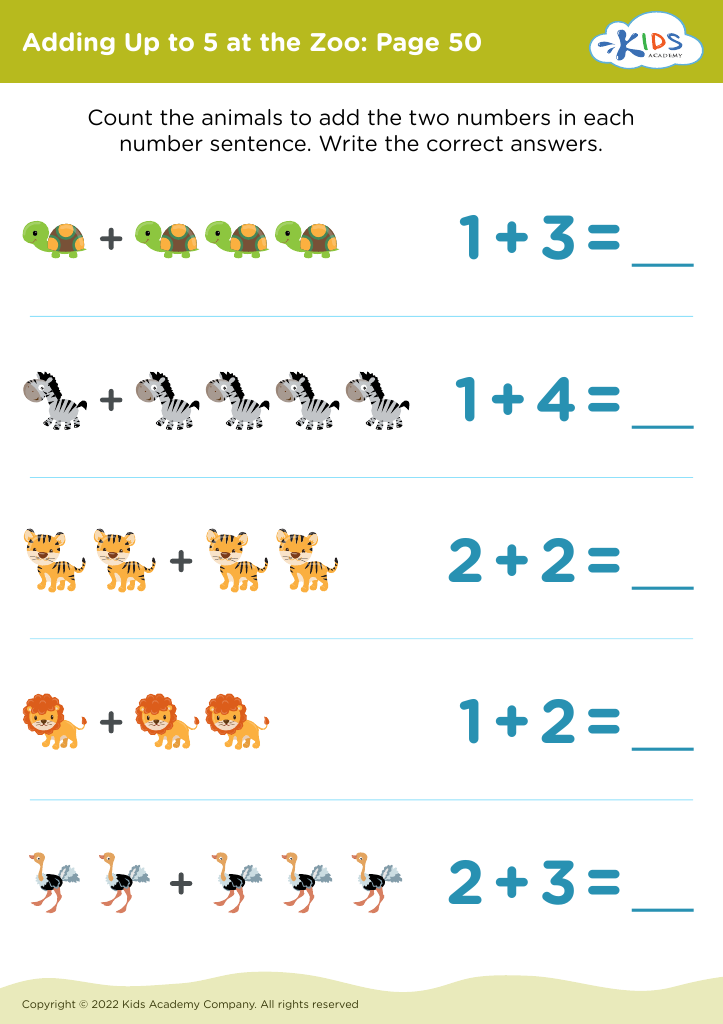








Fine motor skills are crucial for children aged 5-7 as they lay the foundation for essential daily and school-related tasks, such as writing, cutting with scissors, and manipulating small objects. Developing these skills at an early age enhances a child’s hand-eye coordination, dexterity, and precision, which are vital for academic success.
Basic arithmetic, like addition and subtraction, is also fundamental for children within this age group. It builds the groundwork for future mathematical understanding and problem-solving abilities. Mastering these operations not only boosts numerical literacy but also helps develop logical thinking and concentration.
The link between fine motor skills and math learning is significant. Fine motor proficiency supports the physical act of writing numbers and equations, forming the basis for how children represent and solve math problems on paper. Strengthening these skills through activities like playing with building blocks, drawing, and interactive math games can lead to better academic performance and self-confidence.
Parents and teachers should, therefore, prioritize the development of both fine motor skills and basic arithmetic in early childhood education. It ensures children are well-prepared for more complex tasks and subjects, fostering overall cognitive development and academic readiness. Investing in these areas ultimately contributes to a child's long-term success and love for learning.








