Understanding equality Addition & Subtraction Worksheets for Ages 5-7
4 filtered results
-
From - To
"Understanding Equality Addition & Subtraction Worksheets for Ages 5-7" provide young learners with crucial skills to grasp the concept of equality in math. These engaging worksheets are designed to make addition and subtraction fun and interactive, helping children understand that both sides of an equation must balance. Tailored for ages 5-7, these activities focus on foundational math skills, offering step-by-step practice to build confidence and competence. Perfect for both classroom settings and homeschooling, these worksheets ensure kids develop a strong mathematical foundation while enjoying their learning journey. Let's make equality a piece of cake with these delightful, educational worksheets!
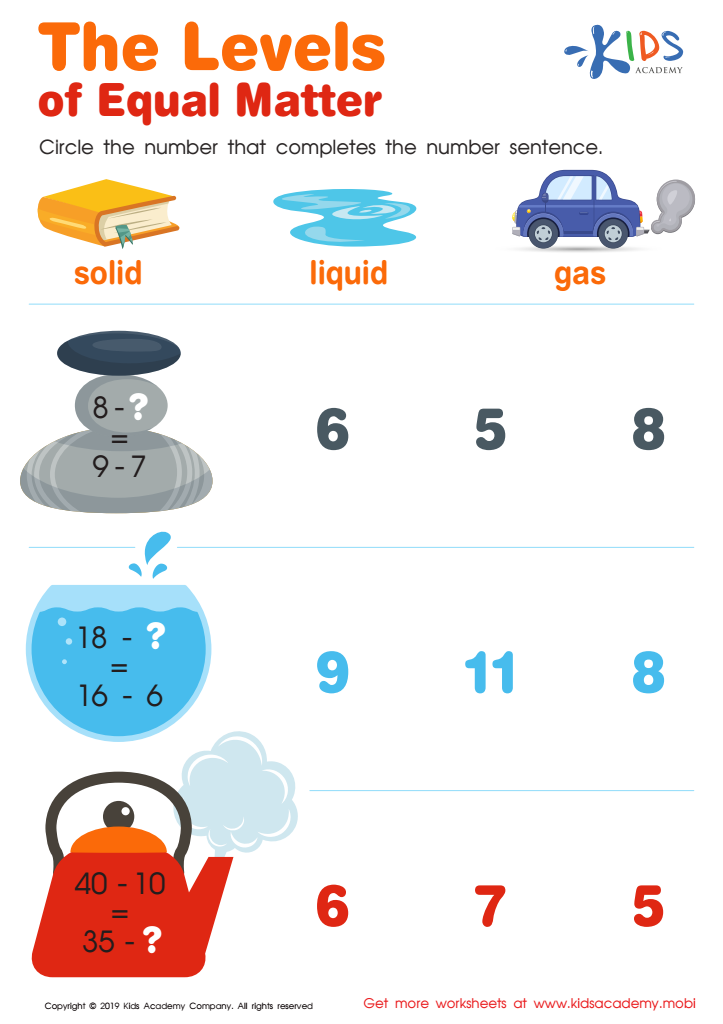
The Levels of Equal Matter Worksheet
 Assign to My Students








Understanding equality in addition and subtraction is fundamental for children ages 5-7 as it sets the stage for all future mathematical learning. At this early age, kids are starting to recognize numbers and their relationships, and grasping the concept of equality can significantly enhance their mathematical reasoning and problem-solving skills.
Equality means understanding that two expressions represent the same quantity. When children learn that the equation 3 + 4 is the same as 7, they are not just memorizing an answer but are understanding the intrinsic relationship between numbers. This comprehension aids in developing number sense, an essential skill that allows children to perform mental calculations and corroborate their answers.
Moreover, a robust understanding of equality aids in preventing misconceptions in later years. For example, acknowledging that the equals sign (‘=’) signifies “the same as” rather than just an operation to run facilitates a deeper cognitive connection with math. It encourages critical thinking, as students learn to see the equal sign as a balance that needs both sides to be balanced, not just a precursor to the solution.
Finally, early mastery of these concepts contributes to building confidence and reducing math anxiety. When children feel competent in foundational math skills, they are more likely to approach complex problems with a positive mindset, setting them up for long-term success in mathematics and beyond.








