Spatial understanding Geometry Worksheets for Ages 5-7
3 filtered results
-
From - To
Nurture your child's spatial awareness with our engaging Geometry Worksheets, tailored for ages 5-7. These worksheets support young learners in grasping essential geometric concepts through fun and interactive activities. Our expertly designed materials help children identify shapes, understand spatial relationships, and develop critical thinking skills. Perfect for budding mathematicians, these resources provide a solid foundation for more advanced geometry studies. Encourage your child's enthusiasm for learning with hands-on exercises that make geometry both accessible and enjoyable. Dive into the world of shapes, patterns, and spatial reasoning today with our dynamic, child-friendly worksheets.
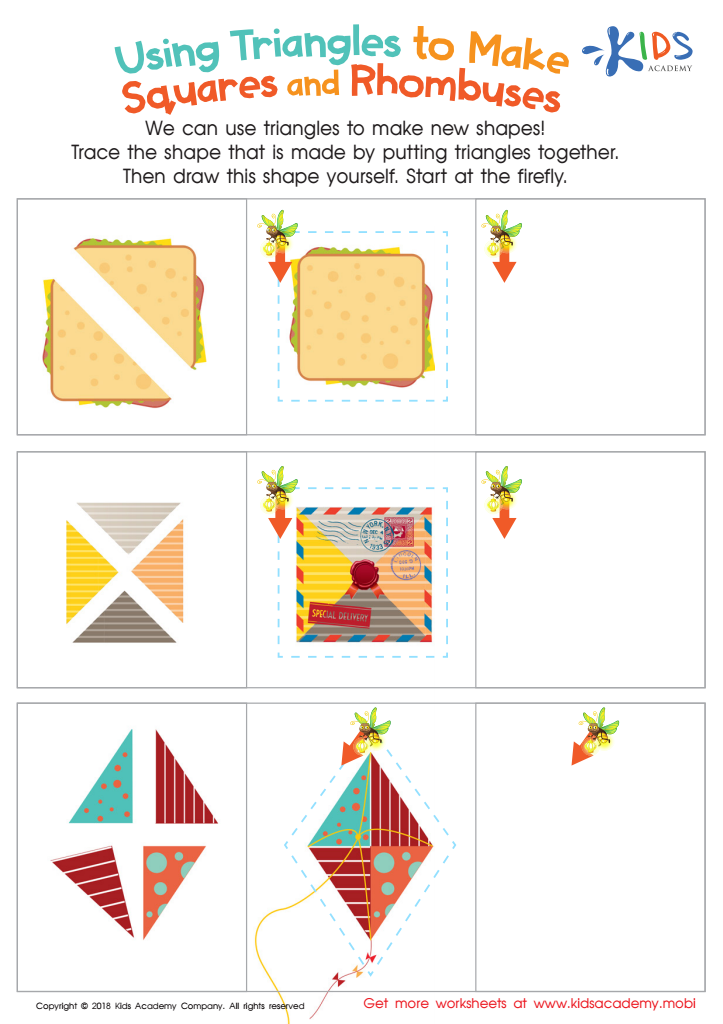
Using Triangles to Make Squares and Rhombuses Worksheet
 Assign to My Students











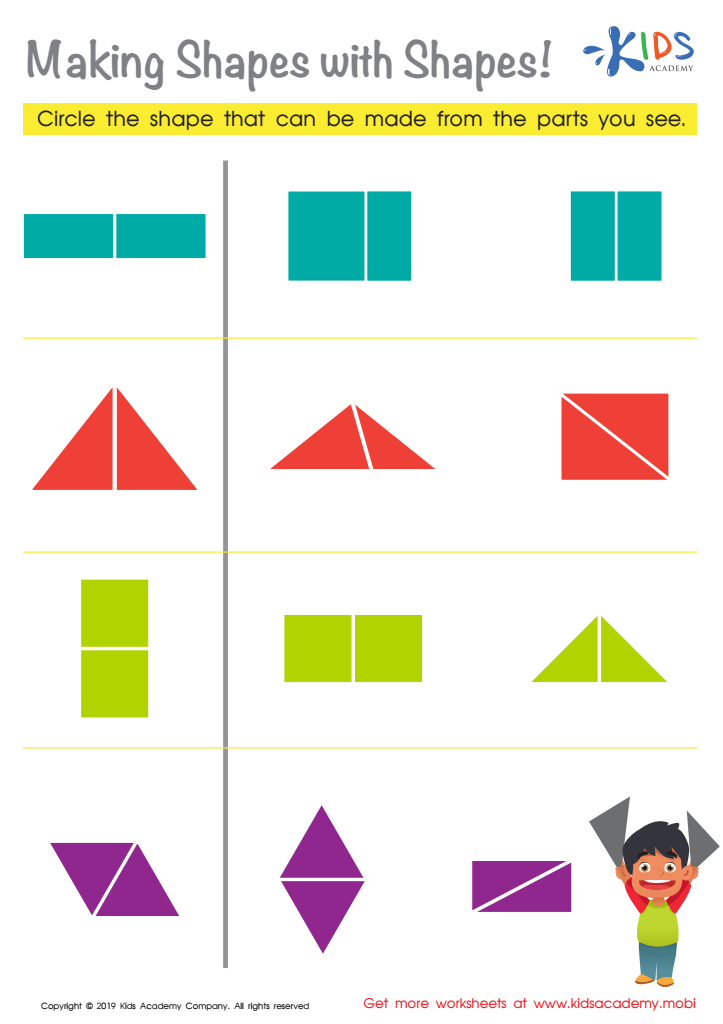
Making Shapes with Shapes Worksheet
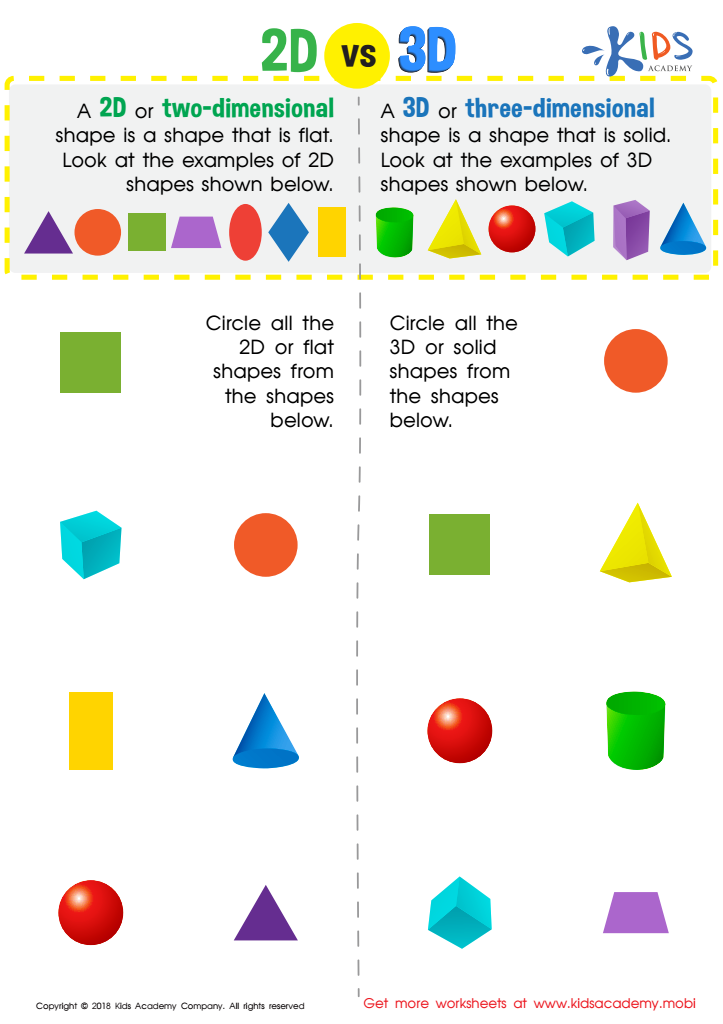
2D vs 3D Shapes Worksheet








Parents and teachers should prioritize spatial understanding and geometry for children aged 5-7 because these foundational skills are crucial for cognitive development and everyday problem-solving. At this formative stage, children’s brains are highly receptive to learning concepts that will underpin future academic and real-life skills. Spatial reasoning—the ability to think about objects in three dimensions and to draw conclusions about those objects from limited information—is linked to success in science, technology, engineering, and mathematics (STEM) subjects. Engaging young minds with geometry helps improve visualization skills, which are essential for understanding and interacting with the physical world.
Activities involving shapes, sizes, patterns, and the relationships among different objects promote logical thinking and analytical skills. These experiences can foster self-confidence as children view and solve problems from multiple perspectives. Furthermore, spatial understanding enhances motor skills as kids learn to manipulate objects and navigate their environments, benefiting hand-eye coordination and overall physical development.
In a nutshell, introducing spatial and geometric concepts early not only solidifies mathematical foundations but also encourages comprehensive cognitive and motor development. This holistic growth supports children in becoming insightful, versatile thinkers who can tackle a variety of challenges creatively and effectively. Thus, giving attention to these topics is an investment in a child's future readiness for more complex academic subjects and real-world tasks.








