
Fraction identification Math Worksheets for Ages 5-7
6 filtered results
Difficulty Level
Grade
Age
-
From - To
Subject
Activity
Standards
Discover our engaging Fraction Identification Math Worksheets designed especially for ages 5-7! These worksheets help young learners explore the fundamental concepts of fractions through fun, interactive exercises. Kids can practice identifying, comparing, and working with fractions in a vibrant and supportive environment. Each worksheet encourages critical thinking and problem-solving skills, making math enjoyable and accessible. With clear instructions and a variety of activities, our resources are perfect for at-home learning or classroom use. Help your child build a solid foundation in math with our Fraction Identification worksheets and watch them gain confidence in their abilities while enjoying the process of learning!
Favorites
With answer key
Interactive
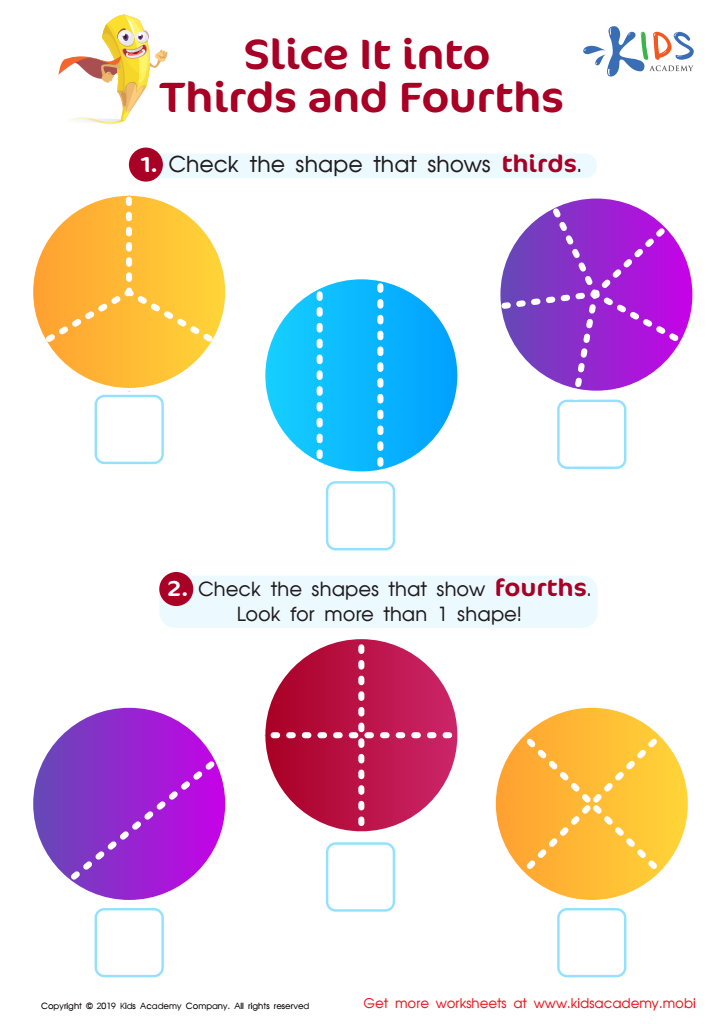
Slice in Thirds Fourths Worksheet
This worksheet helps kids learn fractions visually by dividing circles into thirds and fourths. They will learn that fractions must be equal parts, not just sets, by choosing the right colorful circles. It's an easy way to master fractions and have fun doing it!
 Assign to My Students
Slice in Thirds Fourths Worksheet
Worksheet
Join Kids Academy for Free
Who is primarily going to use this learning content?







Understanding fraction identification is crucial for children aged 5-7, as it lays the foundation for their future success in mathematics and critical thinking. At this age, children are developing their mathematical reasoning and problem-solving skills. Introducing fractions, even at a basic level, enhances their ability to grasp more complex concepts later on, such as addition, subtraction, and even algebra.
Fractions help students learn about parts of a whole, promoting not only mathematical skills but also an understanding of proportions and relationships in their everyday lives. By engaging with fractions, children can learn to compare amounts, share fairly, and understand dividing items into equal parts—important concepts that extend beyond math.
Furthermore, the experience of recognizing and working with fractions plays an essential role in cognitive development. It encourages logical reasoning and helps children develop spatial awareness, which is useful not just in mathematics but in science and art as well.
Parents and teachers who prioritize fraction identification in early education nurture a child's curiosity and confidence. This foundational work opens doors to advanced mathematical concepts and supports lifelong skills in critical thinking and problem-solving, preparing children for a successful educational journey ahead.








