
Understand number sequencing Worksheets for Ages 5-8
3 filtered results
Difficulty Level
Grade
Age
-
From - To
Subject
Activity
Standards
Unlock your child's potential with our "Understand Number Sequencing Worksheets for Ages 5-8." These engaging, age-appropriate worksheets are designed to help kids grasp the fundamental concept of number order effectively. Each worksheet is filled with interactive activities and colorful illustrations that make learning both fun and educational. Perfect for building key math skills, these resources are ideal for use at home or in the classroom. Boost your child's confidence and proficiency in numerical sequencing today with Kids Academy's expertly crafted worksheets. Give your youngster the head start they deserve in mastering early math concepts!
Favorites
With answer key
Interactive
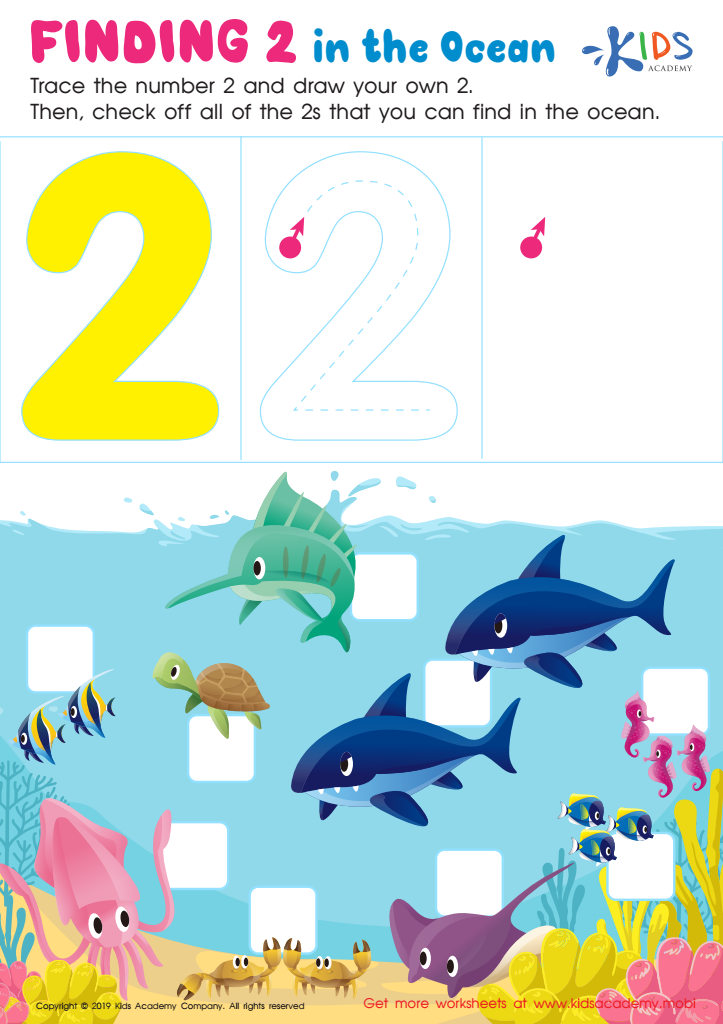
Finding 2: In the Ocean Worksheet
Kids start their math journey with basic numbers. Finger counting, number representation with pictures and this worksheet help build number sense. Kids trace lines and dots to write the number two and identify groups of two sea creatures for easy success and to feel proud of their math skills.
 Assign to My Students
Finding 2: In the Ocean Worksheet
Worksheet
Join Kids Academy for Free
Who is primarily going to use this learning content?




.jpg)



Understanding number sequencing is crucial for children aged 5-8 as it forms the foundation for all future mathematical concepts. Number sequencing helps children grasp the idea of order and the consistent increase or decrease in values, which is essential for addition, subtraction, and other arithmetic operations. For example, knowing that after 3 comes 4 and after 4 comes 5 allows children to count objects, understand quantities, and perform simple calculations confidently.
In addition to facilitating arithmetic skills, number sequencing sharpens cognitive abilities like memory and pattern recognition. Recognizing sequences helps children predict what comes next, a skill used not only in mathematics but in everyday life and other academic subjects. It also paves the way for understanding more complex concepts such as times tables, place value, and skip counting.
Parents and teachers who emphasize the importance of number sequencing engage children in activities that make learning fun — such as number games, puzzles, and counting songs. This playful yet educational approach cultivates a positive attitude toward math, reducing anxiety and building a solid numerical foundation. In sum, understanding number sequencing is a gateway to academic success and critical thinking, making it a vital learning objective for young children.








