
Understanding number lines Worksheets for Ages 5-8
3 filtered results
Difficulty Level
Grade
Age
-
From - To
Subject
Activity
Standards
Explore our "Understanding Number Lines Worksheets for Ages 5-8," designed to make math fun and engaging for young learners. These vibrant and interactive worksheets introduce children to the concept of number lines, helping them to visualize numbers, improve counting skills, and enhance their understanding of basic math operations. Perfect for kindergarten through second grade, these printable resources are carefully crafted to suit different learning styles and developmental stages. Build your child's mathematical foundation with activities and exercises that are both educational and entertaining. Visit Kids Academy today for worksheets that turn number learning into an adventure!
Favorites
With answer key
Interactive
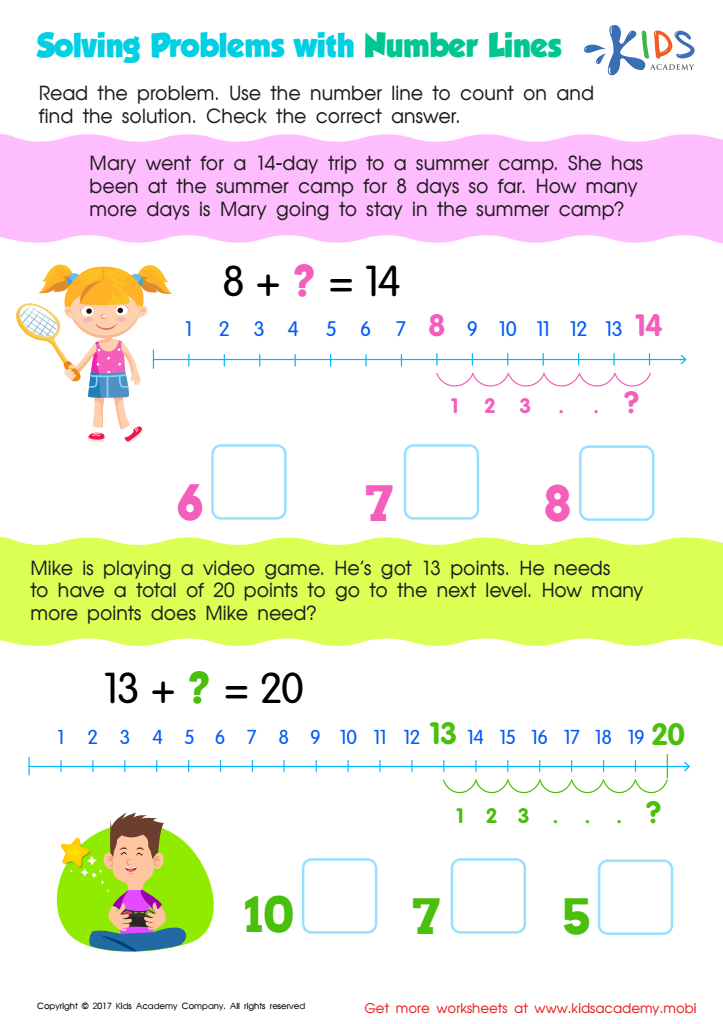
Solving Problems: Number Lines Worksheet
Number lines are fun and help build number sense and reasoning. This worksheet uses them to help students count on to find a solution to an equation. They'll have fun counting with familiar numbers and 10-bases, while also working on algebraic reasoning.
 Assign to My Students
Solving Problems: Number Lines Worksheet
Worksheet
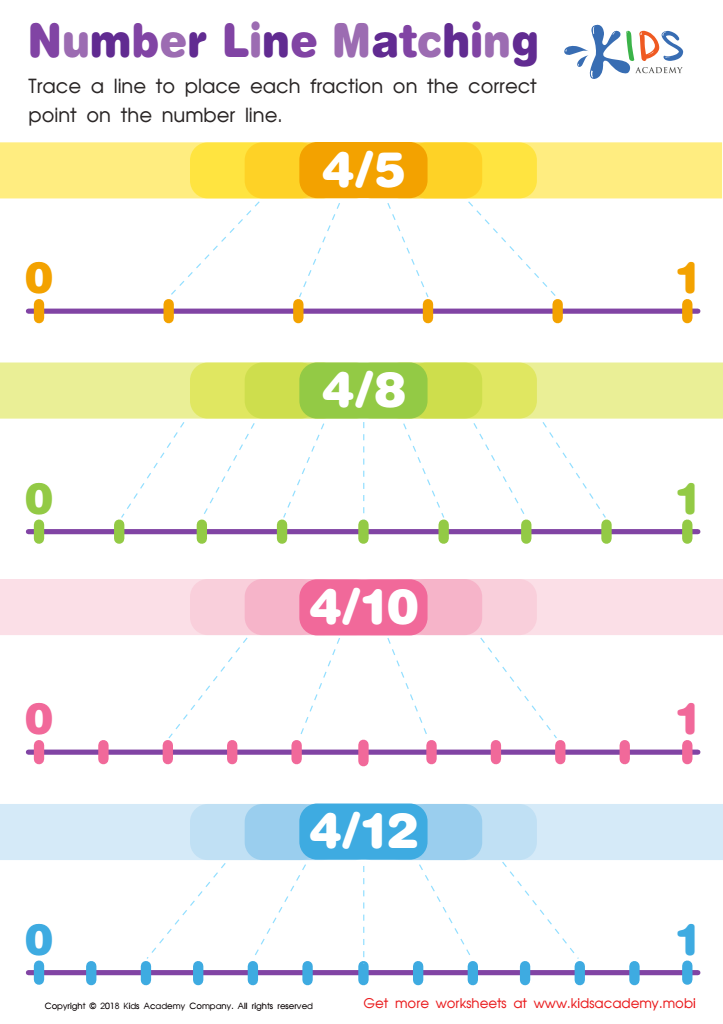
Number Line Matching Worksheet
Math can be fun! Have your child count points on the number line, then identify and trace fractions above it. It's a great way for them to learn and have some fun!
Number Line Matching Worksheet
Worksheet
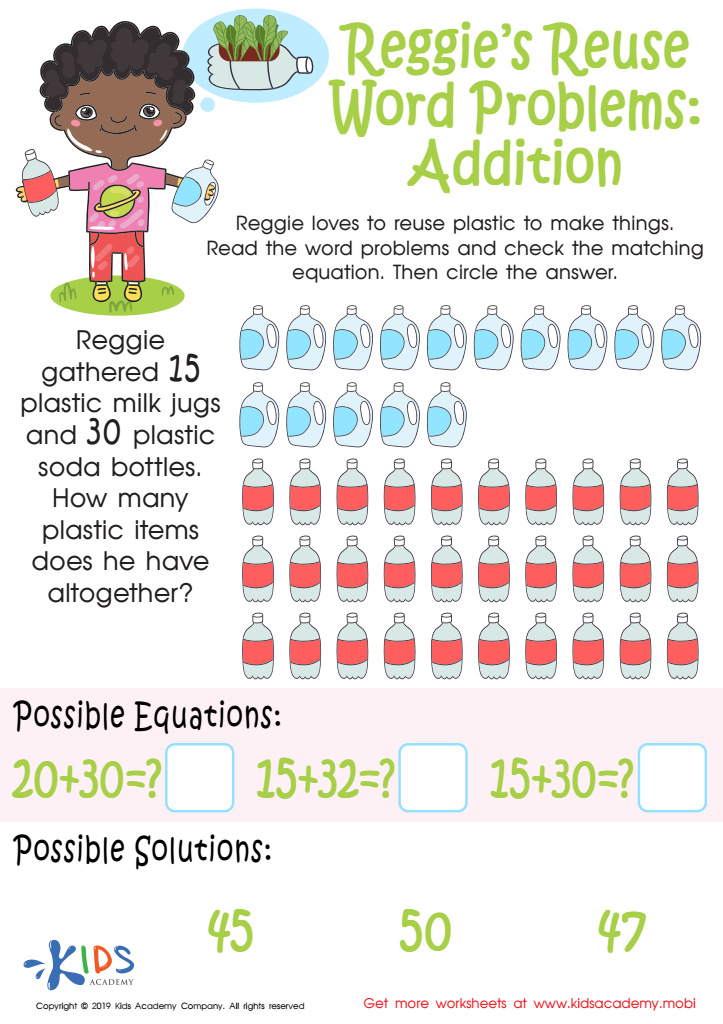
Reggie's Reuse Word Problems: Addition Worksheet
Help Reggie and your child save the planet by using this free worksheet! It reinforces addition word problems using one-to-one picture representation, and helps them pick out the correct number sentence and possible solutions. It's an easy way to help the planet and practice math!
Reggie's Reuse Word Problems: Addition Worksheet
Worksheet
Join Kids Academy for Free
Who is primarily going to use this learning content?








Understanding number lines is fundamental for children ages 5-8 because it lays the groundwork for essential math skills they will need throughout their education and daily lives. Number lines provide a visual and tangible way to grasp numerical concepts, helping young learners to see and understand the relationship between numbers and their order. This understanding is pivotal as children start learning to count, add, and subtract, which are core components of early math education.
Firstly, number lines help children with number sequencing and recognizing patterns, which are foundational skills for more complex operations like multiplication and division. By visualizing numbers on a line, children can intuitively grasp that numbers are interconnected and not isolated entities. For example, finding the difference or sum of numbers becomes clearer when children can see it visually.
Secondly, fostering an early comprehension of number lines enhances problem-solving abilities. For example, if children understand that 5 is less than 7 because it is to the left on the number line, they can apply this logic to solve real-world problems involving distance, time, and quantity.
Moreover, a strong grasp on number lines can build children’s confidence and pave the way for future success in subjects like algebra and geometry. Thus, parents and teachers should prioritize number lines in early education, ensuring children build a solid numerical foundation that will support their continued academic growth.








