Understanding Perimeter Worksheets for Ages 5-8
3 filtered results
-
From - To
Unlock the world of geometry with our "Understanding Perimeter Worksheets for Ages 5-8". Designed specifically for young learners, these engaging worksheets help children grasp the basic concept of perimeter through fun, interactive activities. Featuring visually appealing illustrations and step-by-step exercises, kids will easily learn to measure the distance around various shapes. These printable worksheets foster essential math skills, build spatial awareness, and support early problem-solving abilities. Perfect for classroom use or home practice, our perimeter worksheets make learning math enjoyable and accessible for children, setting a strong foundation for future mathematical success.
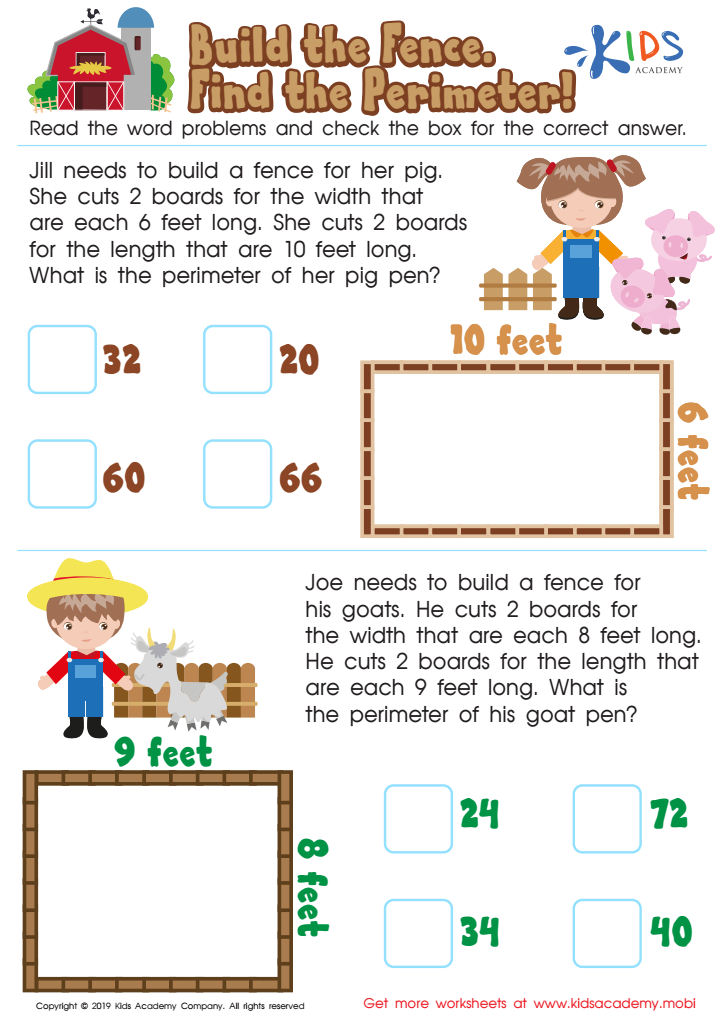
Build the Fence, Find the Perimeter Worksheet
 Assign to My Students
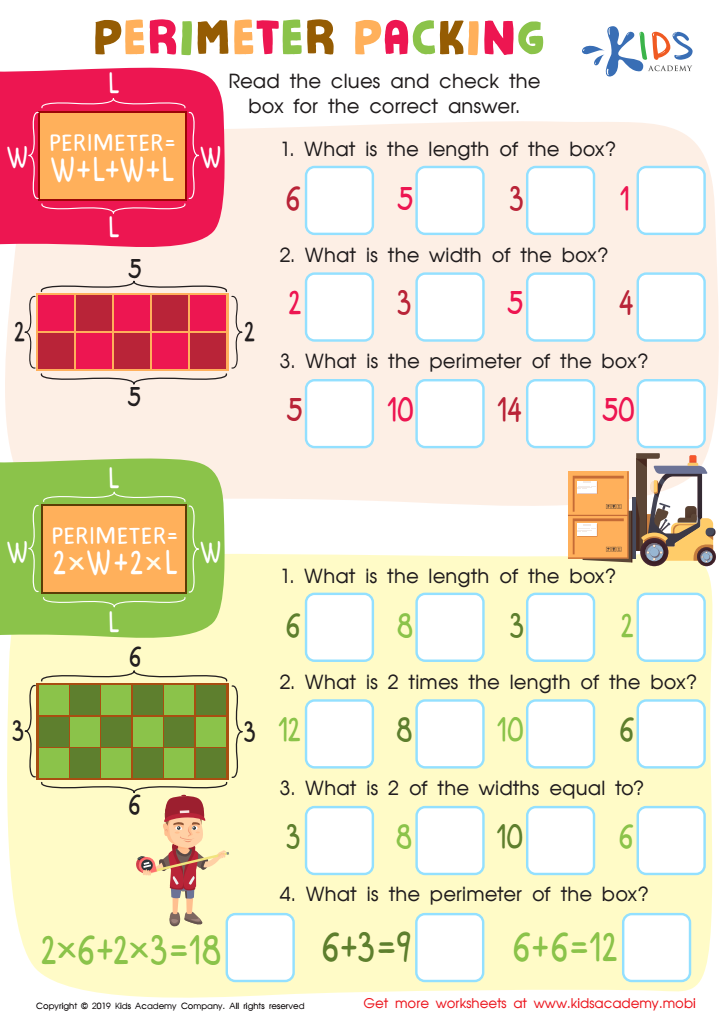
Perimeter Parking Worksheet
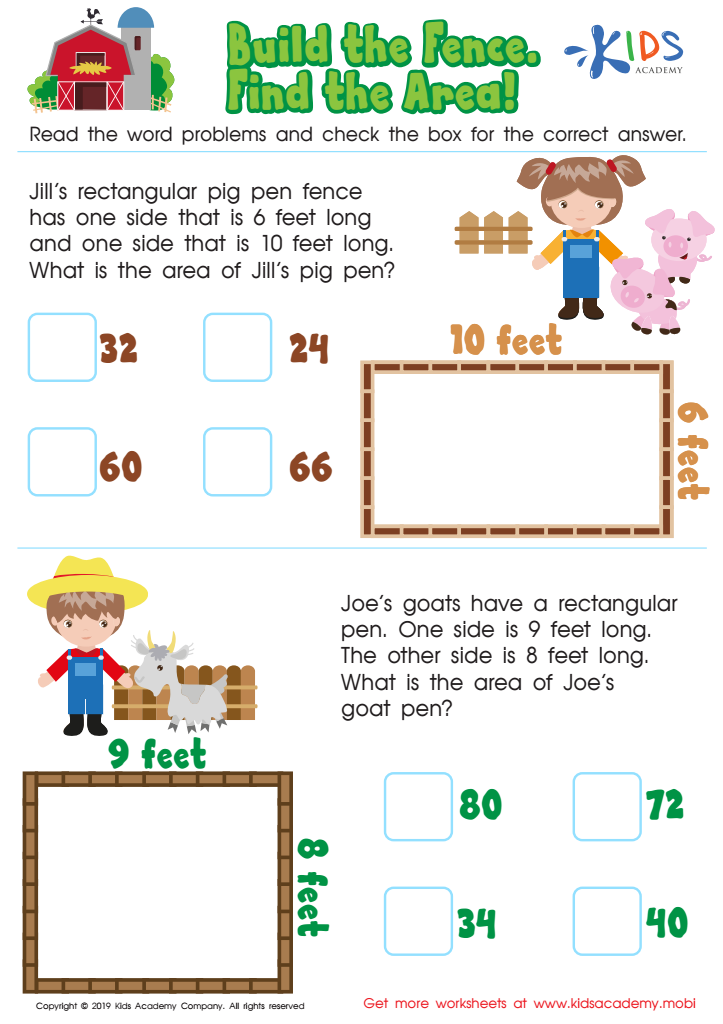
Build the Fence, Find the Area Worksheet






Understanding perimeter is an essential mathematical concept that young children ages 5-8 should grasp. For parents and teachers, teaching this topic helps children to enhance their spatial awareness and problem-solving skills, which are critical for comprehending more advanced math topics in the future.
Perimeter is simply the measurement around the boundary of a shape, and learning to calculate it introduces children to fundamental arithmetic operations like addition and multiplication in a tangible way. For example, when children measure the perimeter of their classroom or a playground, they see a practical application of math, making it more engaging and relevant.
Moreover, understanding perimeter fosters a child's ability to measure correctly, compare different lengths, and organize spatial representations. This lays the foundation for geometry and helps children apply logical reasoning in various situations. For instance, when they plan how much fencing is needed for a garden, they are both applying math skills and critical thinking.
Additionally, teaching perimeter promotes patience and attention to detail. As children measure and add individual side lengths, they learn the importance of precision, fostering a disciplined approach to their work. Overall, an early grasp of perimeter supports a child's mathematical growth and prepares them for more complex problem-solving tasks, creating a strong foundation for their academic journey.








