
Mathematical skills Addition & Subtraction Worksheets for Ages 5-8
3 filtered results
Difficulty Level
Grade
Age
-
From - To
Subject
Activity
Standards
Enhance your child’s mathematical abilities with our engaging Addition and Subtraction worksheets designed specifically for ages 5-8. These worksheets provide a fun and interactive way for young learners to grasp essential math concepts. With various exercises, including colorful illustrations and relatable scenarios, children will develop their skills in counting, basic arithmetic, and problem-solving. Our resources cater to different learning styles, ensuring that every child can master addition and subtraction at their own pace. Easily accessible and printable, these worksheets are perfect for home practice or classroom use. Start building a strong math foundation today with our carefully crafted materials!
Favorites
With answer key
Interactive
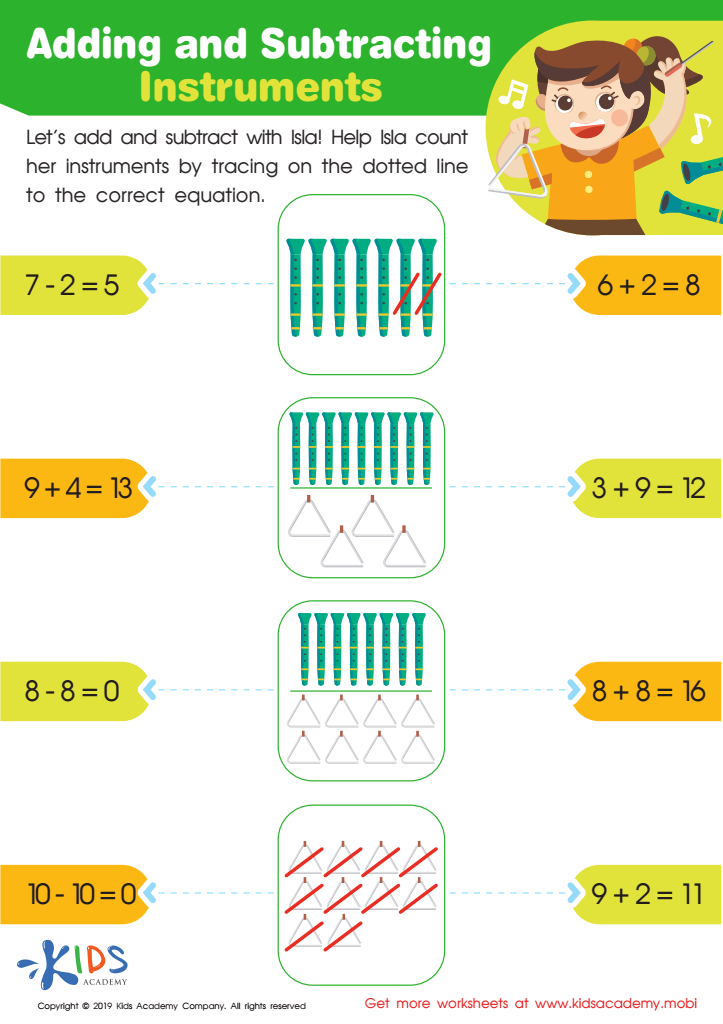
Adding and Subtracting: Instruments Worksheet
Children can help Isla count her musical instruments with this fun worksheet. The downloadable PDF gives them a chance to practice addition and subtraction by connecting pictures to equations. It's also a great way to learn the order of operations.
 Assign to My Students
Adding and Subtracting: Instruments Worksheet
Worksheet
Join Kids Academy for Free
Who is primarily going to use this learning content?








Mathematical skills, particularly addition and subtraction, are fundamental for children ages 5-8, as they form the backbone of more advanced mathematics. Understanding these concepts cultivates critical thinking and problem-solving abilities essential for success in various aspects of life.
At this age, children are developing their cognitive skills and learning to make sense of the world around them. Mastering addition and subtraction not only helps them perform basic calculations but also fosters a sense of confidence and independence. These skills are important for everyday activities, such as handling money, telling time, and measuring ingredients while cooking.
Moreover, early mathematical competence is linked to future academic achievement. Children who grasp these foundational skills are more likely to thrive in math-related subjects in later years. Their understanding also promotes a growth mindset, encouraging them to embrace challenges and learn from mistakes.
For parents and teachers, fostering these skills through engaging activities and meaningful context can make learning enjoyable. Collaboration on math-related tasks enhances parent-child or student-teacher relationships and provides a supportive atmosphere for exploration and discovery. By prioritizing addition and subtraction, caregivers can significantly enhance children’s overall cognitive development and lifelong learning trajectories.








