
Observational skills Addition & Subtraction Worksheets for Ages 5-8
5 filtered results
Difficulty Level
Grade
Age
-
From - To
Subject
Activity
Standards
Enhance your child's mathematical journey with our engaging Observational Skills Addition & Subtraction Worksheets, designed for ages 5-8. These worksheets not only focus on fundamental arithmetic but also develop critical observational skills needed to analyze and interpret visual information. Kids will practice addition and subtraction through fun, interactive exercises that encourage them to observe patterns, shapes, and quantities. Perfect for homeschooling or classroom use, our resources help children strengthen their math foundation while honing their attention to detail. Download these worksheets today to inspire young learners and make math an exciting adventure!
Favorites
With answer key
Interactive
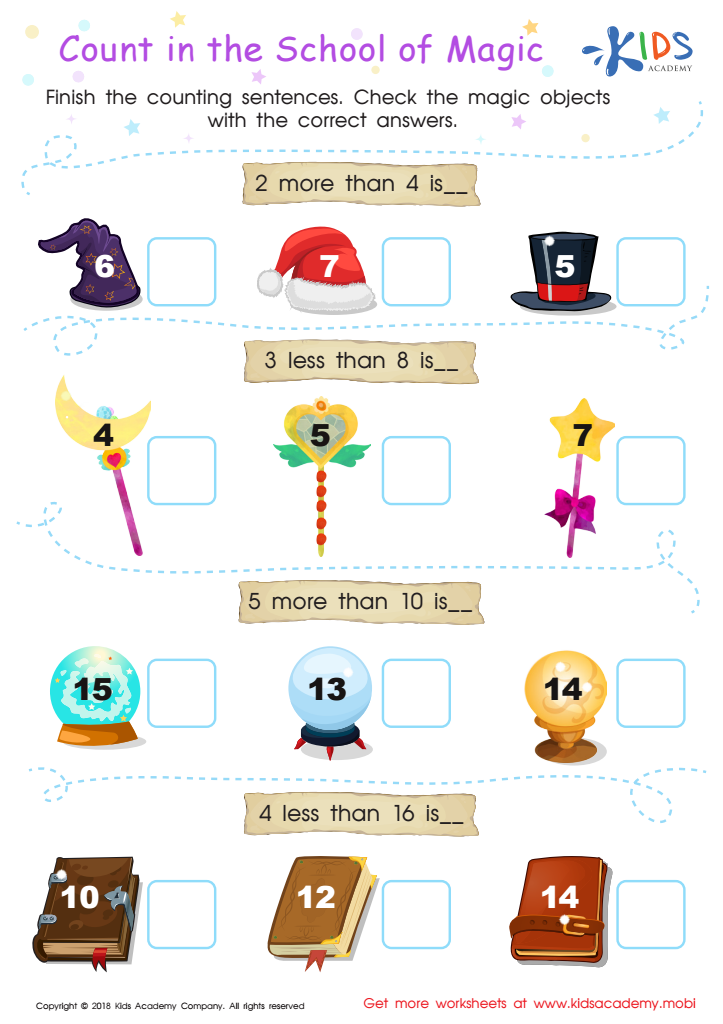
Count in the School of Magic Worksheet
Your math learners can explore the School of Magic with this worksheet. They'll read equations with addition and subtraction numbers under 20, count back and forth to find the answer, then complete the counting sentences. Fun pictures and easy accuracy make it an enjoyable and successful learning experience.
 Assign to My Students
Count in the School of Magic Worksheet
Worksheet
Join Kids Academy for Free
Who is primarily going to use this learning content?








Observational skills in addition and subtraction are essential for children aged 5-8 as they develop foundational math concepts. These skills help young learners notice patterns, relationships, and changes in quantities, fostering a deeper understanding of mathematical operations. By observing their surroundings and engaging in hands-on activities, children can connect abstract concepts with real-world situations, making learning more relevant and enjoyable.
For parents and teachers, nurturing these skills lays the groundwork for more complex problem-solving abilities, enhancing critical thinking. When children practice observation alongside addition and subtraction, they learn to compute and reason logically in everyday contexts, whether they're counting toys, sharing snacks, or playing games.
Encouraging kids to use their observational skills promotes a proactive learning environment where curiosity thrives. For instance, during grocery shopping, parents can invite children to count items or calculate the total cost—turning everyday tasks into interactive lessons. Engaging in these experiences not only boosts math confidence but also develops resilience and persistence when faced with challenges.
Ultimately, supporting observational skills in addition and subtraction aids in the overall cognitive development of children, preparing them for future academic success while building a love for learning that lasts a lifetime.








