
Understanding fact families Addition & Subtraction Worksheets for Ages 5-8
6 filtered results
Difficulty Level
Grade
Age
-
From - To
Subject
Activity
Standards
Discover our engaging "Understanding Fact Families Addition & Subtraction Worksheets" designed for children ages 5-8. These worksheets focus on the essential concept of fact families, helping kids grasp the relationship between addition and subtraction. With a variety of exercises, children can practice and reinforce their understanding of numbers and their connections, building a solid foundation for future math skills. Our resources promote critical thinking and encourage independent learning, making math enjoyable and rewarding. Perfect for classroom use or at-home practice, these worksheets are a great tool for young learners to master fact families and enhance their overall mathematical fluency.
Favorites
With answer key
Interactive
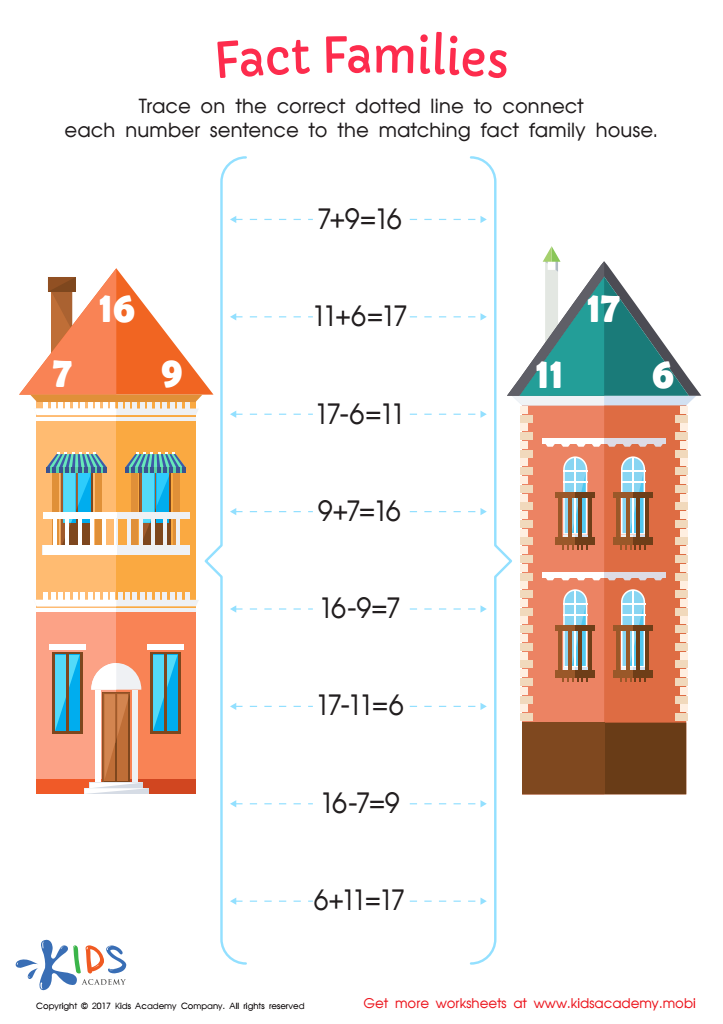
Fact Families — Add and Subtract Worksheet
Kids will love seeing how families of numbers "live" in their own houses!
 Assign to My Students
Fact Families — Add and Subtract Worksheet
Worksheet
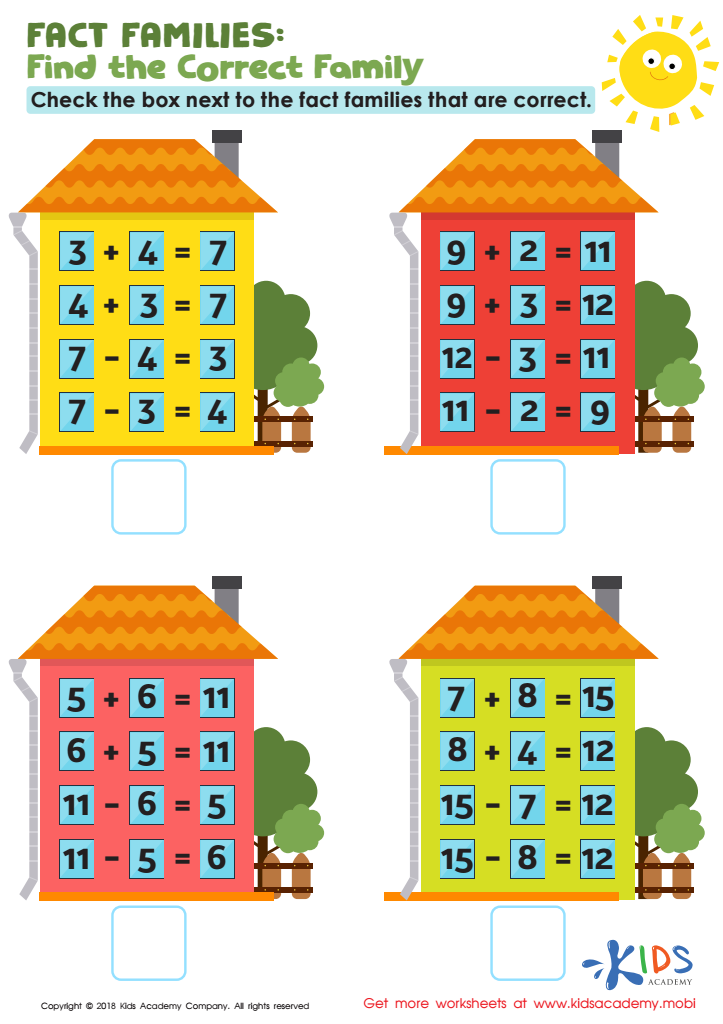
Fact Families: Find Correct Family Worksheet
Test your students' math and reasoning skills with this worksheet. It features 4 houses, each with a group of fact families on it. Some are correct, some are wrong - help students identify which are correct and circle the box next to them. This will help them progress in school.
Fact Families: Find Correct Family Worksheet
Worksheet
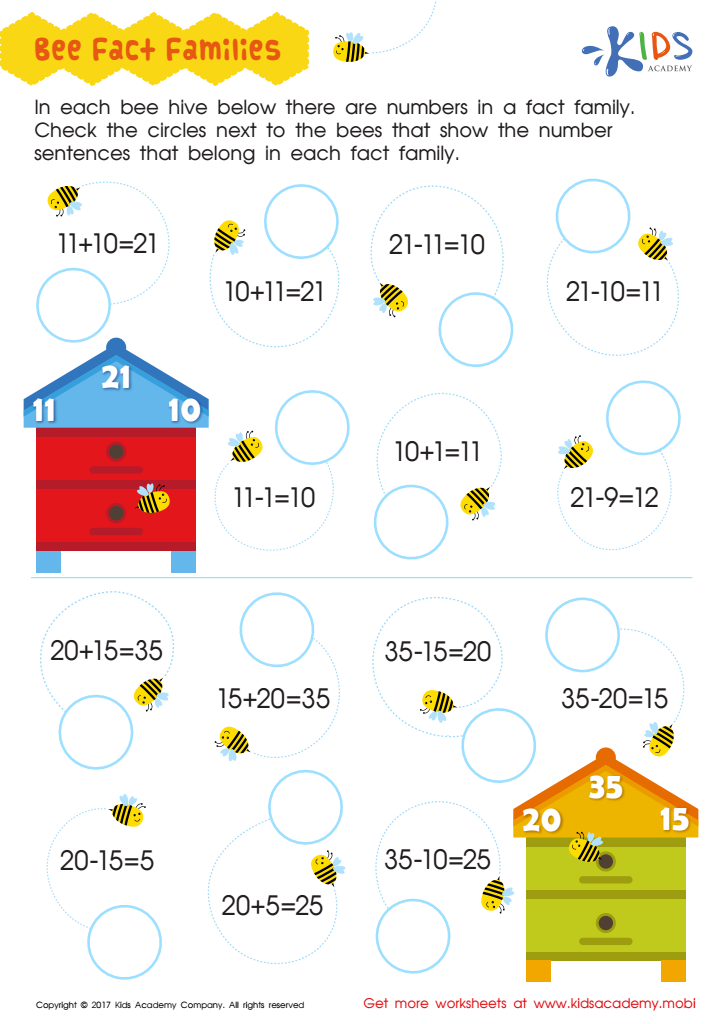
Fact Families Worksheet
Your 2nd grader will love this engaging activity.
Kids will buzz about fact families with this fun worksheet! Images of bees and their hives make learning numeracy enjoyable. Engaging and entertaining, your 2nd grader will love this activity.
Fact Families Worksheet
Worksheet
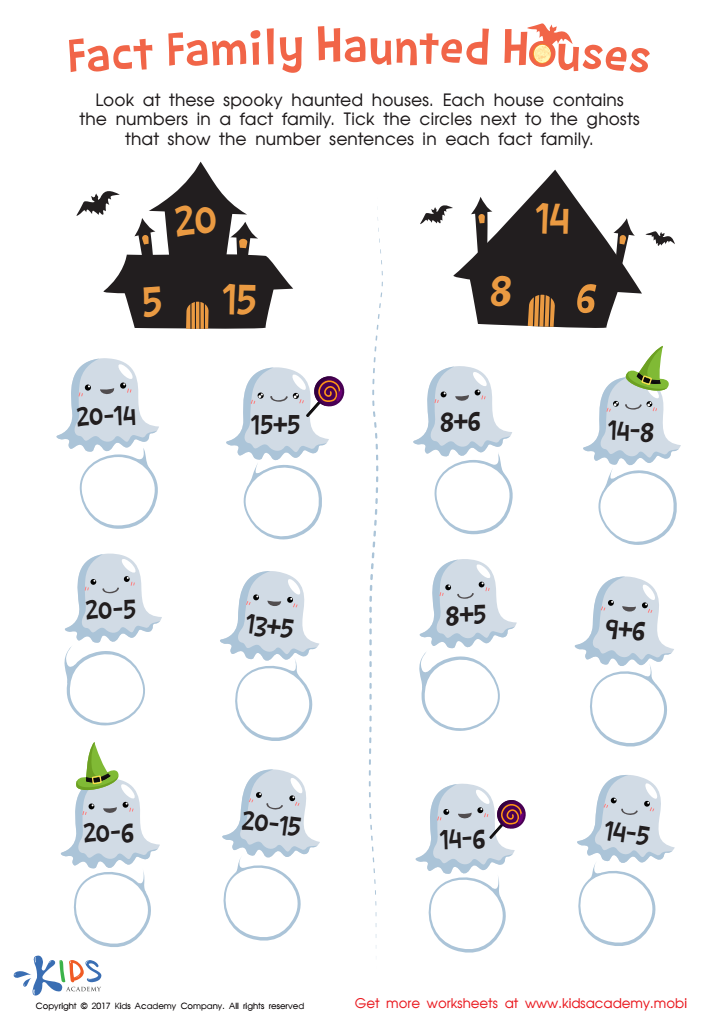
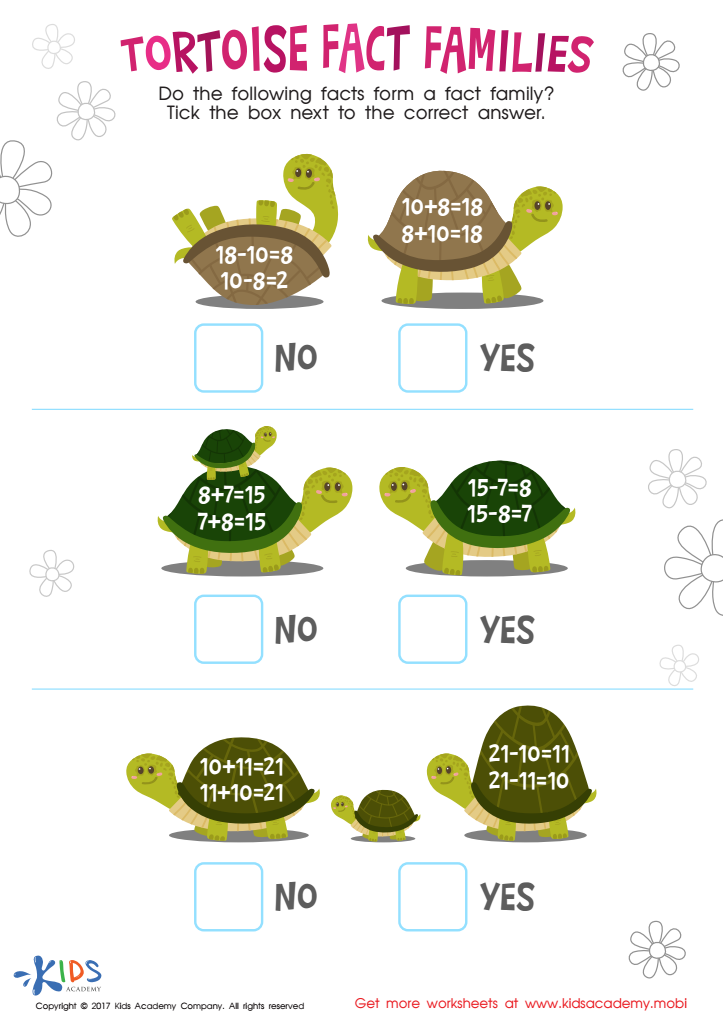
Tortoise Fact Families Printable
With 1st grade add & subtract tortoises, kids can improve their math understanding and skills. Enjoy fun, hands-on practice with fact families and strengthen logical reasoning and critical thinking!
Tortoise Fact Families Printable
Worksheet
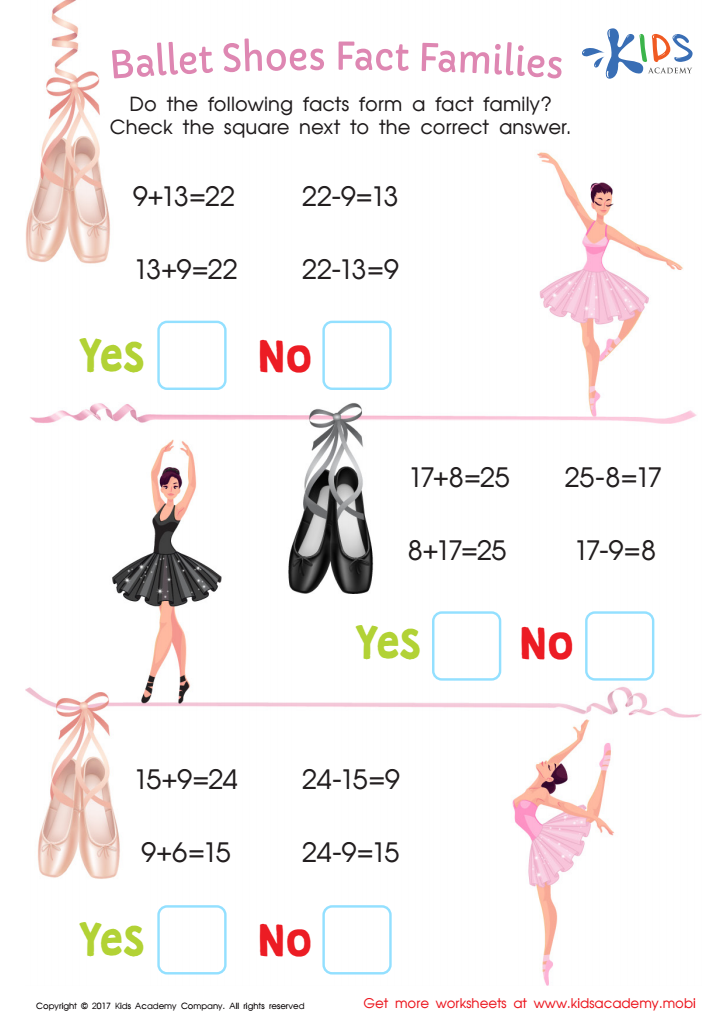
Ballet Shoes Fact Family Printable
Have them observe the equations and determine which groupings are fact families for a delightful learning experience. It encourages critical thinking, showing how addition and subtraction are related.
Ballet Shoes Fact Family Printable
Worksheet
Join Kids Academy for Free
Who is primarily going to use this learning content?








Understanding fact families for addition and subtraction is crucial for children aged 5-8 as it lays a strong mathematical foundation. Fact families teach students the relationship between numbers, enabling them to see patterns that simplify problem-solving. For instance, if children know that 2+3=5, they also learn that 5-3=2 and 5-2=3. This interconnectedness enhances number sense and boosts fluency in math operations.
Moreover, grasping fact families helps students become more confident in their math abilities. When they can identify these relationships, they are more likely to approach problems creatively rather than resorting to rote memorization. This understanding fosters critical thinking skills, encouraging kids to tackle more complex math concepts as they progress in their education.
For parents and teachers, promoting the importance of fact families can facilitate collaborative learning environments that emphasize exploration and inquiry. Engaging children in activities that require them to fill in missing numbers or create their fact families nurtures a love for math and enhances collaborative skills. Overall, by focusing on fact families, adults play a vital role in building young learners' confidence and competence in mathematics, promoting lifelong skills they will need in everyday life and future academic pursuits.








