Shape Recognition Area and Perimeter Worksheets for Ages 5-8
3 filtered results
-
From - To
Boost your child's spatial awareness and mathematical skills with our Shape Recognition Area and Perimeter Worksheets designed for ages 5-8. These engaging activities help young learners identify and differentiate shapes while mastering the concepts of area and perimeter. Our expertly crafted worksheets offer a blend of fun and education, ensuring kids grasp essential geometry skills through colorful exercises and hands-on learning. Perfect for both classroom use and at-home practice, these worksheets will foster a strong foundation in math, critical thinking, and problem-solving abilities. Unlock your child's potential today with our comprehensive Shape Recognition Area and Perimeter Worksheets!
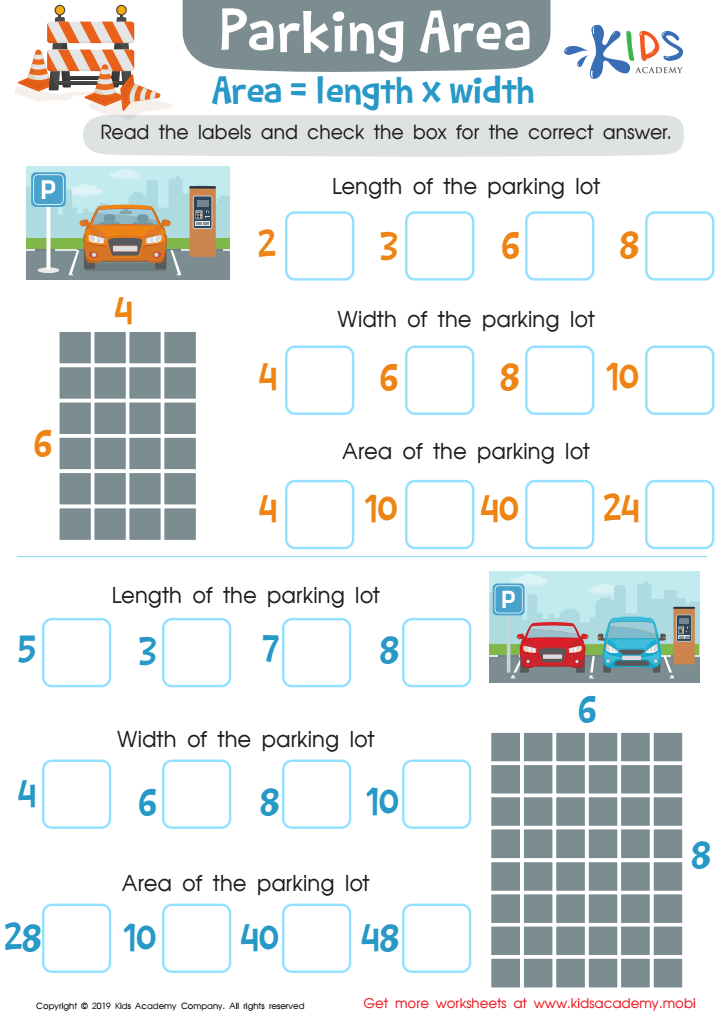
Parking Area Worksheet
 Assign to My Students
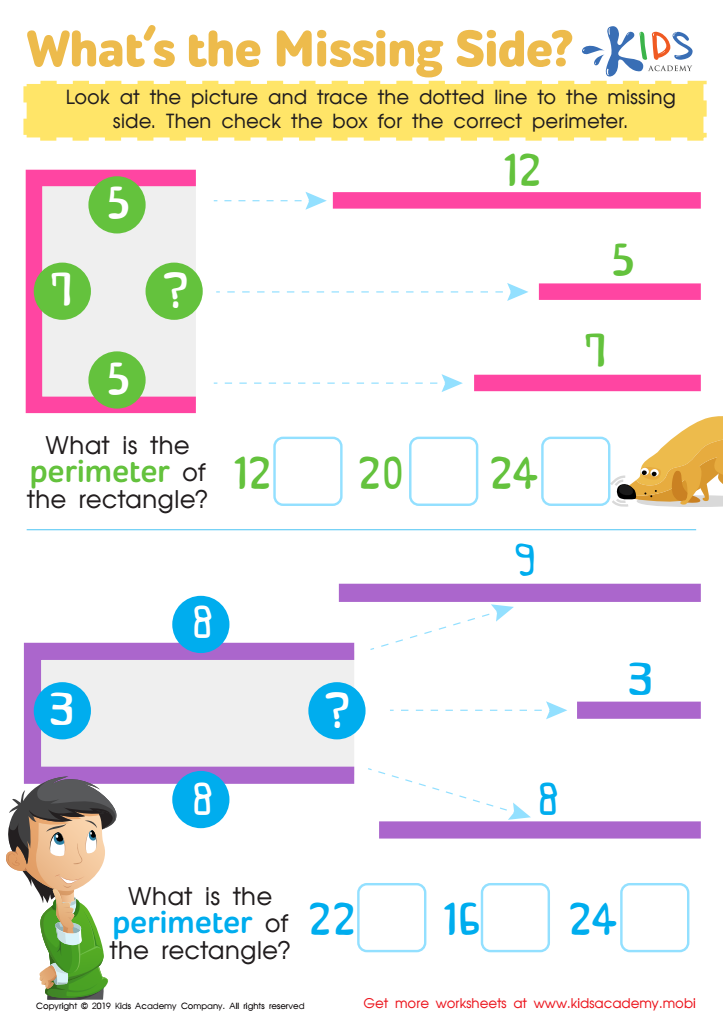
What's the Missing Side Worksheet
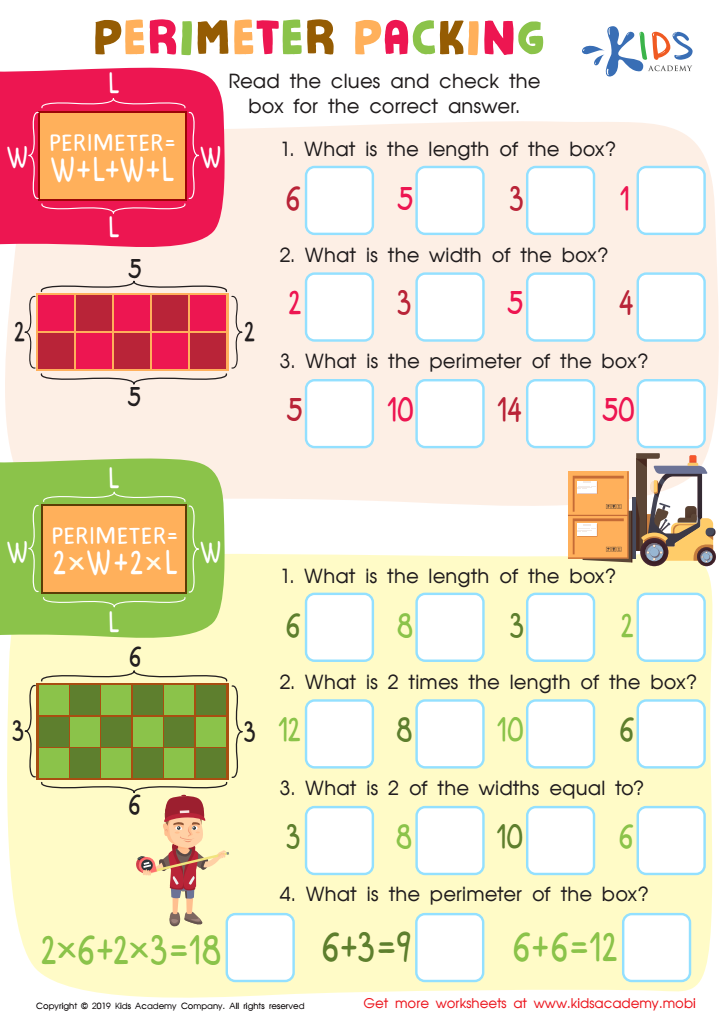
Perimeter Parking Worksheet








Understanding shape recognition, area, and perimeter at an early age is crucial for young learners, providing the building blocks for many essential life skills and future educational success. For parents and teachers managing five to eight-year-olds, integrating these concepts nurtures spatial awareness, which is foundational for mathematics and problem-solving abilities.
Shape recognition helps children categorize and describe the world around them, enhancing their observational skills and cognitive development. For instance, recognizing that a triangle has three sides or that circles are round becomes a basis for more intricate geometry in later years. This recognition fosters logical thinking and the capacity to differentiate shapes in the environment.
Knowing the concepts of area and perimeter introduces children to measurements and magnitudes. While a young child may not yet grasp complex units of measure, understanding these properties promotes geometric intuition and gives concrete meaning to abstract concepts like size and boundary. This navigational skill becomes particularly useful in real-life applications, such as determining space needed for objects or renovations.
Overall, integrating these foundational concepts into early education encourages a robust mathematical mindset, promotes critical thinking, and instills confidence in young learners, paving the way for advanced STEM concepts and practical decision-making skills in their everyday lives.