
Comparing heights Math Worksheets for Ages 5-8
3 filtered results
Difficulty Level
Grade
Age
-
From - To
Subject
Activity
Standards
Discover our engaging Comparing Heights Math Worksheets designed specifically for children aged 5-8! These interactive worksheets help young learners grasp fundamental measuring concepts by comparing the heights of various objects and characters. Through fun activities, students will enhance their understanding of sizes while developing essential math skills. Our colorful, visually stimulating materials not only captivate attention but also promote critical thinking and reasoning as kids categorize and analyze different heights. Perfect for classroom use or at-home learning, these worksheets provide a seamless blend of education and enjoyment, making math an exciting adventure for young minds. Start measuring up today!
Favorites
With answer key
Interactive
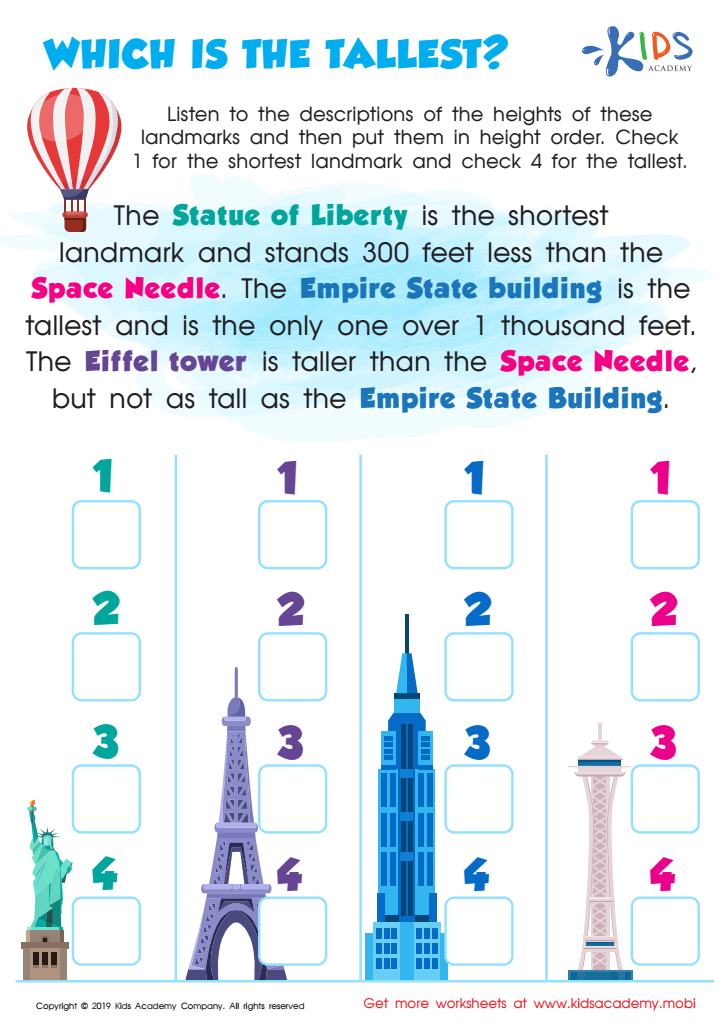
Which is the Tallest? Worksheet
Help your kids arrange the buildings in order of height: highest (4) to lowest (1). Ask them if they can think of other ways things can be measured. Read the texts describing the buildings and check 4 for the tallest and 1 for the shortest.
 Assign to My Students
Which is the Tallest? Worksheet
Worksheet
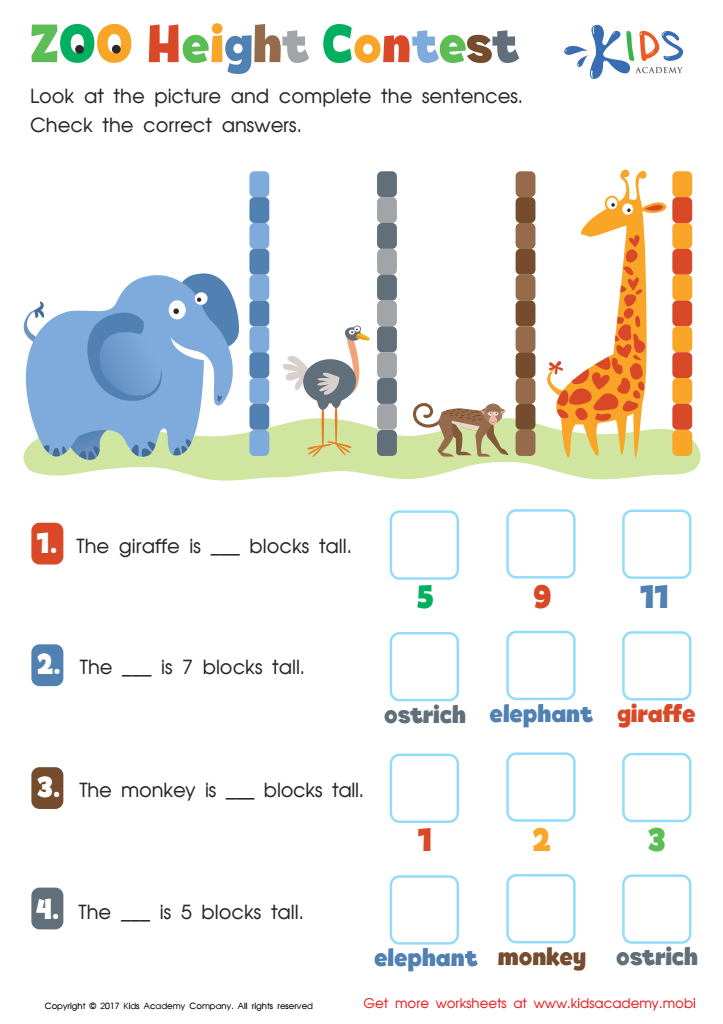
Zoo Height Contest Worksheet
Let's head to the zoo and use colorful blocks to measure your child's favorite animals! With this Kids Academy worksheet, help them practice and prepare for learning measurement. Guide them in looking at the zoo animals and counting blocks to find the height. Then, read the questions and check the box next to the correct answer.
Zoo Height Contest Worksheet
Worksheet
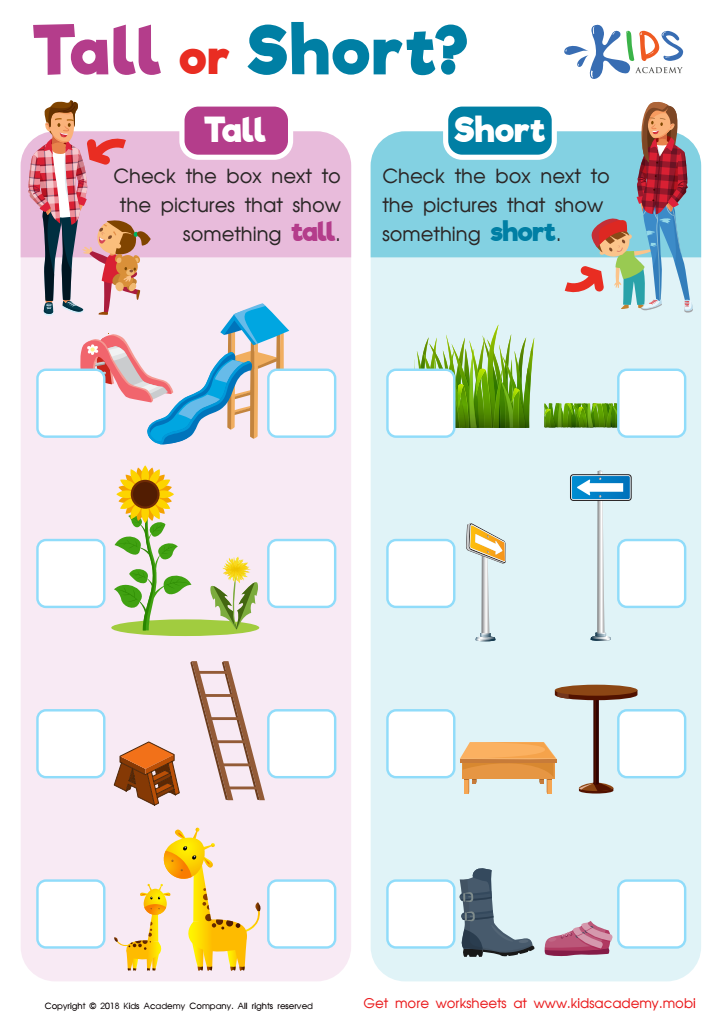
Tall or Short? Worksheet
Comparing tall and short objects is an early math skill. Our free worksheet uses fun colors and pictures to help kids practice. This will give them a head start for higher-level measurement skills, and they'll remember tangible objects for comparison.
Tall or Short? Worksheet
Worksheet
Join Kids Academy for Free
Who is primarily going to use this learning content?






.jpg)
Comparing heights is an essential mathematical concept for children aged 5-8, as it incorporates both fundamental math skills and real-world applications. Engaging with height comparisons fosters the development of critical thinking and analytical skills, since children learn to observe, measure, and interpret data. Understanding concepts such as "taller," "shorter," and "the same height," enhances their vocabulary while allowing them to articulate relationships between different objects, promoting effective communication.
For parents and teachers, encouraging activities around height comparisons can serve as an innovative way to integrate math into everyday life, making learning more meaningful and relatable. For example, measuring the heights of family members or classmates not only beautifies the data but also nurtures a sense of community and teamwork.
Additionally, these activities promote fine motor skills through measuring and graphing, while reinforcing early algebraic concepts as children begin to categorize and analyze information. Overall, comparing heights not only illuminates valuable math skills but also supports children's social and emotional development. Therefore, parents and teachers should care about this critical aspect of math education as it lays the groundwork for more complex math learned in future grades. Engaging children in these activities now sets the stage for a confident and competent approach to math later on.








