
Money identification Math Worksheets for Ages 5-8
4 filtered results
Difficulty Level
Grade
Age
-
From - To
Subject
Activity
Standards
Boost your child's math skills with our engaging Money Identification Math Worksheets designed for ages 5-8! These printable resources make learning about money fun and interactive. Your little ones will practice identifying coins and bills, learning their values, and understanding how to use money in everyday scenarios. Each worksheet features colorful illustrations and relatable examples that capture kids' interest while building essential mathematical foundations. Ideal for both classroom and home use, these worksheets foster confidence and competence in money management. Download now to help your child master money identification and pave the way for a brighter financial future!
Favorites
With answer key
Interactive
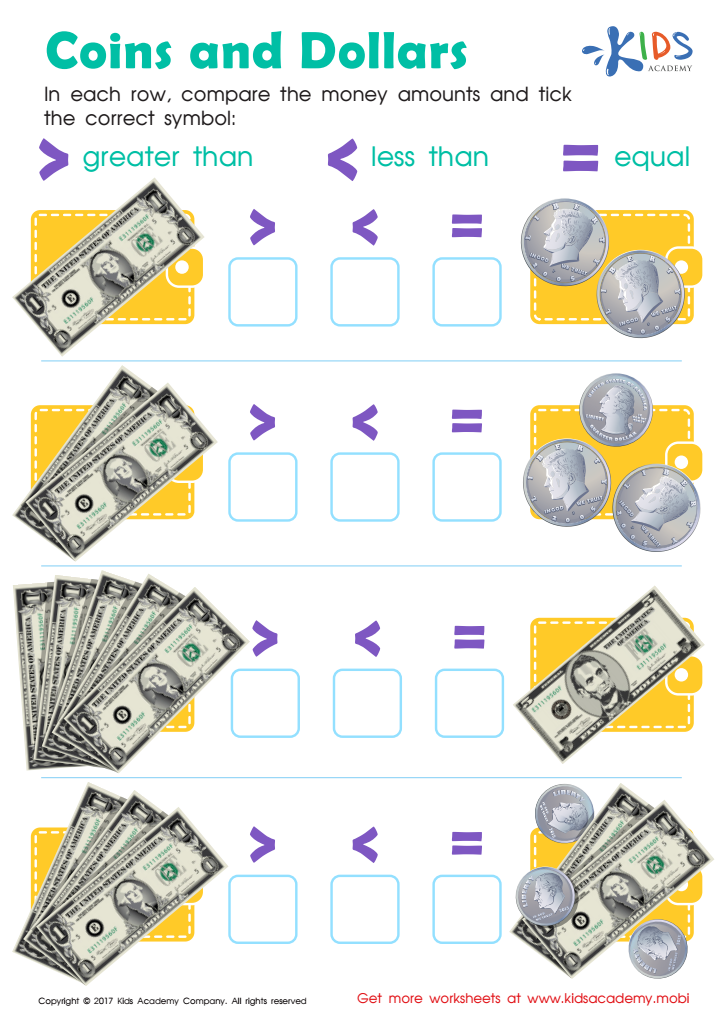
Money: Coins Dollars Printable
Motivate your kid to learn and practise essential math skills, like 'greater than' and 'less than', by introducing the importance of money! The money worksheet "Coins and Dollars" will give them a hands-on experience of counting coins and dollars, making math symbols more memorable.
 Assign to My Students
Money: Coins Dollars Printable
Worksheet
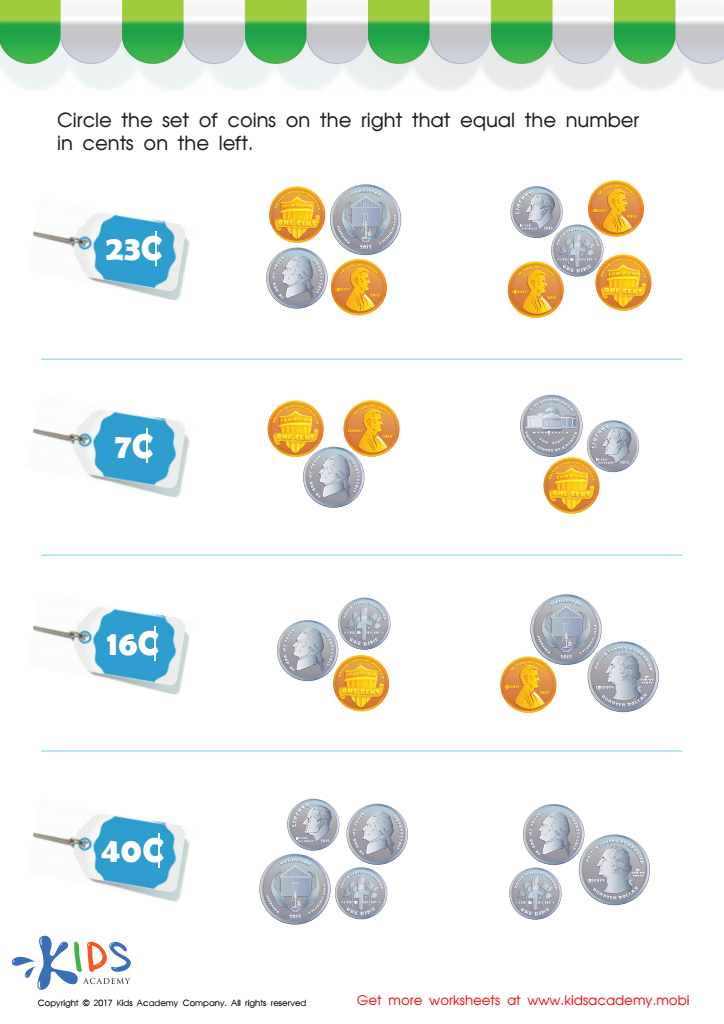
Picking the Coins You Need Money Worksheet
Let's learn to count money with Parents and Kids Academy! Investigate a real shop together: buy a globe, pencils, books, and a school bag using coins. Then, circle the coins you'll need. Visit our website for more free and fun money games for kids!
Picking the Coins You Need Money Worksheet
Worksheet
Join Kids Academy for Free
Who is primarily going to use this learning content?








Money identification is a crucial math skill for children aged 5-8, as it lays the foundation for financial literacy and responsible management of resources in their future. Understanding money helps children recognize and differentiate between various coins and bills, fostering early math skills such as counting, addition, and subtraction. These foundational skills enhance their overall numeracy and problem-solving capabilities.
Moreover, money identification teaches children about the value of money, encouraging them to think critically about spending and saving. This age group is naturally curious and eager to learn about the world around them, making it an ideal time to introduce financial concepts in an engaging and meaningful way. Learning to identify money helps children gain confidence in their ability to navigate everyday transactions, from buying snacks to saving for a desired toy.
Additionally, money-related activities can foster social skills through cooperative games and interactive lessons, promoting teamwork and communication. Involving parents and teachers in these learning experiences reinforces the importance of money management early on, ultimately preparing children for future financial responsibilities and empowering them to make informed choices as they grow. Thus, prioritizing money identification in early education is vital for holistic child development.








