
Reading analog clocks Math Worksheets for Ages 5-8
8 filtered results
Difficulty Level
Grade
Age
-
From - To
Subject
Activity
Standards
Welcome to our engaging collection of Reading Analog Clocks Math Worksheets designed for children aged 5-8! Help your little learners master the art of telling time with fun and interactive worksheets. Our resources cater to various skill levels, introducing key concepts like hour and minute hand identification, digital time comparisons, and real-life scenarios. Each worksheet is crafted to provide practice while keeping learning enjoyable, enhancing kids' confidence in time-telling skills. Perfect for teachers and parents seeking quality educational tools, these worksheets create a solid foundation for understanding clocks and also promote important cognitive skills. Start your time-telling adventure today!
Favorites
With answer key
Interactive
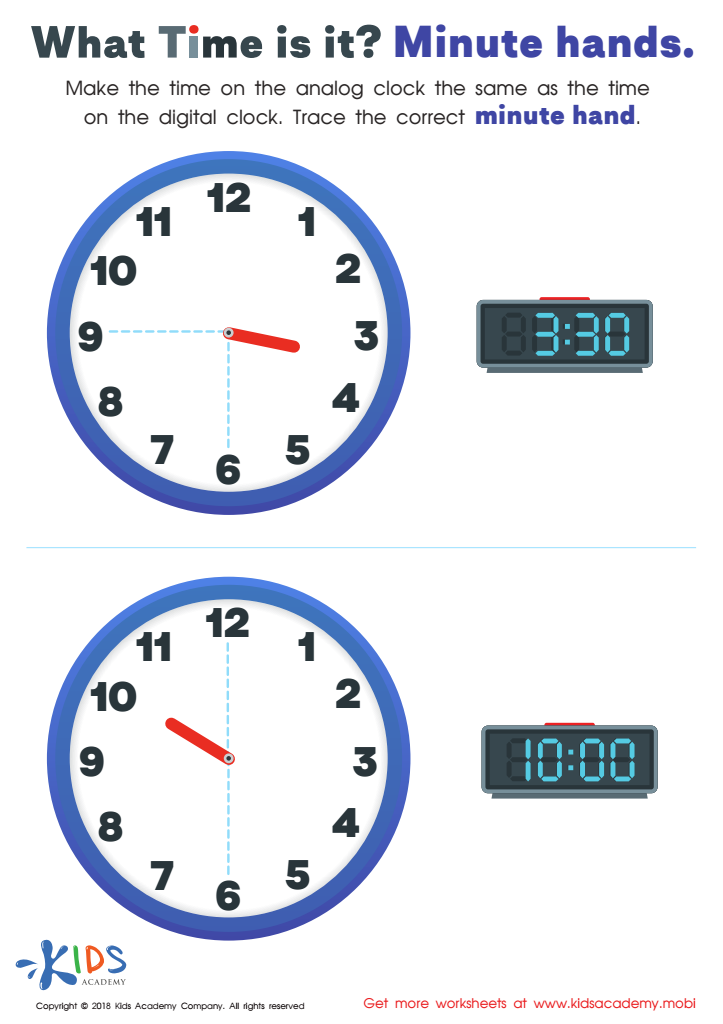
What Time Is it? Minute Hands Worksheet
Help your kids telling time with the minute hand correctly with this tracing sheet. Trace the correct minute hand to make the time on the analog clock the same as the time on the digital clock. Give them a pictured demonstration of how to do it and you'll be all set!
 Assign to My Students
What Time Is it? Minute Hands Worksheet
Worksheet
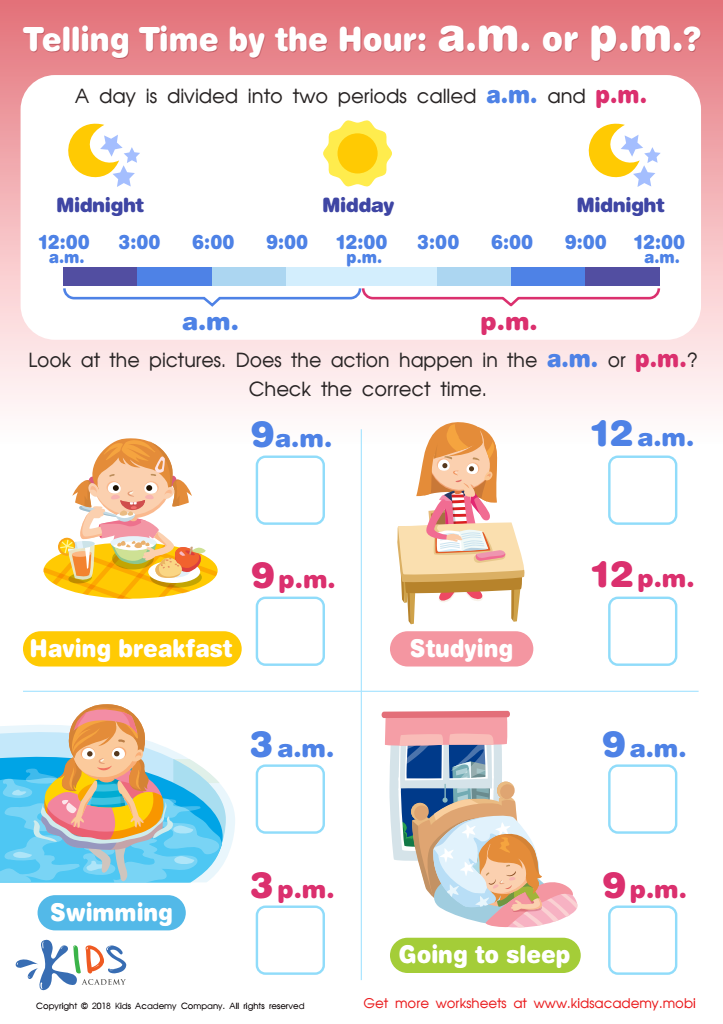
Tilling Time by the Hour: a.m. or p.m.? Worksheet
Can your child tell the time? This worksheet will help them learn. Explain a.m and p.m. and look at the pictures together. Ask your child if the activities happen in the a.m or p.m and help them check the correct time.
Tilling Time by the Hour: a.m. or p.m.? Worksheet
Worksheet
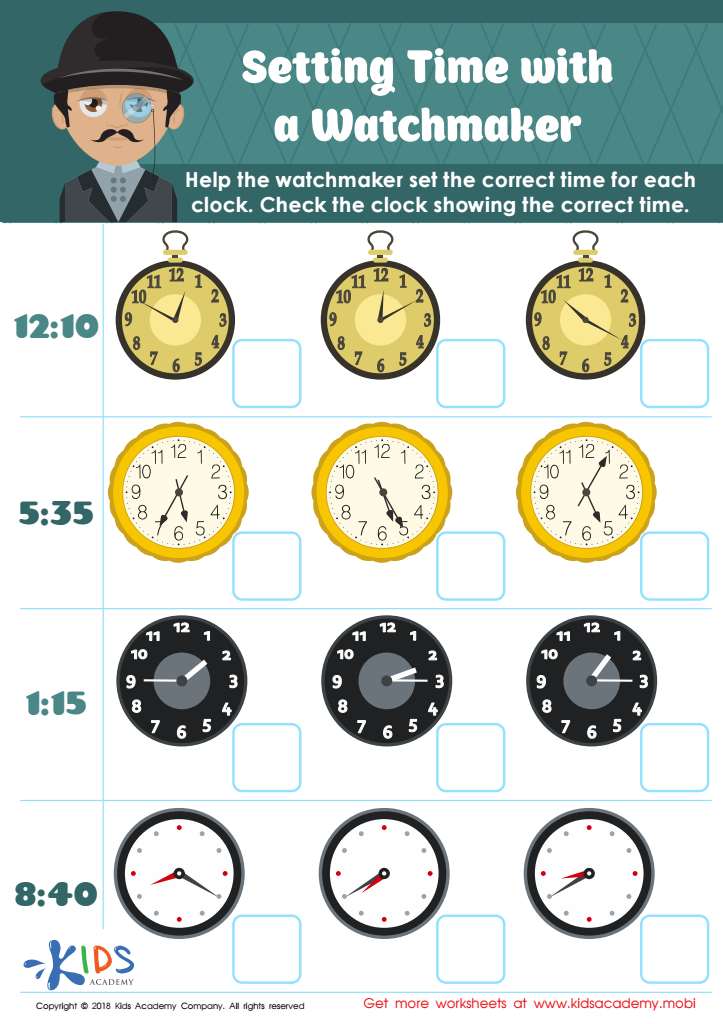
Setting Time with Watchmaker Worksheet
Can your kids tell the time? If so, this worksheet should be easy. Help them set the time for each clock: look at the time written on the left side and find the clock on the right side that matches.
Setting Time with Watchmaker Worksheet
Worksheet
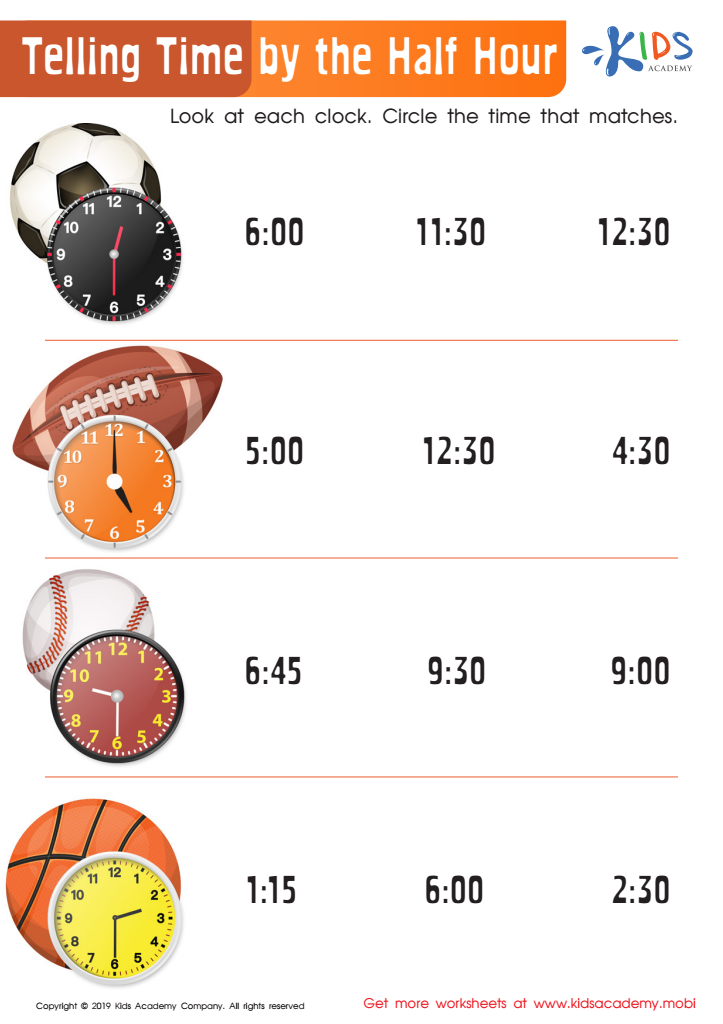
Telling Time by the Half Hour Worksheet
Teach kids to tell time with this worksheet! Four clocks are labeled with different times; help your child circle the right one. It's a great way to teach them to read analog and digital clocks, watches, and written times. Easy and fun learning!
Telling Time by the Half Hour Worksheet
Worksheet
Join Kids Academy for Free
Who is primarily going to use this learning content?







Understanding how to read analog clocks is an essential skill that contributes significantly to children's overall math proficiency and cognitive development. For parents and teachers of children aged 5-8, fostering this skill can provide a solid foundation for numerous academic and life skills.
First, reading analog clocks enhances a child's understanding of time, which is crucial for everyday activities. Knowing how to tell time helps children manage their daily schedules, promotes punctuality, and encourages responsibility. This skill can serve as a foundation for more advanced mathematical concepts such as fractions and measurement, as children learn to divide the clock face into parts and understand the relationships between hours and minutes.
Second, engaging with analog clocks lies at the intersection of math and practical life skills, making it relevant and more meaningful for young learners. Unlike digital clocks, analog clocks require children to interpret and connect visual information, sharpening their analytical thinking and problem-solving skills.
Lastly, the experience of learning to read an analog clock can bond parents and children or create enriching classroom interactions, making it not only an academic pursuit but also a way to strengthen relationships. It's an investment in nurturing capable, confident individuals prepared for the complexity of the world they live in.








