
Understand number relationships Math Worksheets for Ages 5-8
3 filtered results
Difficulty Level
Grade
Age
-
From - To
Subject
Activity
Standards
Explore our engaging "Understand Number Relationships" math worksheets designed specifically for children aged 5-8. These worksheets provide young learners with fun and interactive activities that build a strong foundation in number sense. Kids will grasp essential concepts such as more/less, before/after, and number comparison through colorful illustrations and relatable scenarios. Our educational resources encourage critical thinking and problem-solving skills while making math enjoyable. Suitable for home or classroom use, these worksheets are an excellent way to reinforce learning in a playful and supportive environment. Download now to help your child master number relationships confidently!
Favorites
With answer key
Interactive
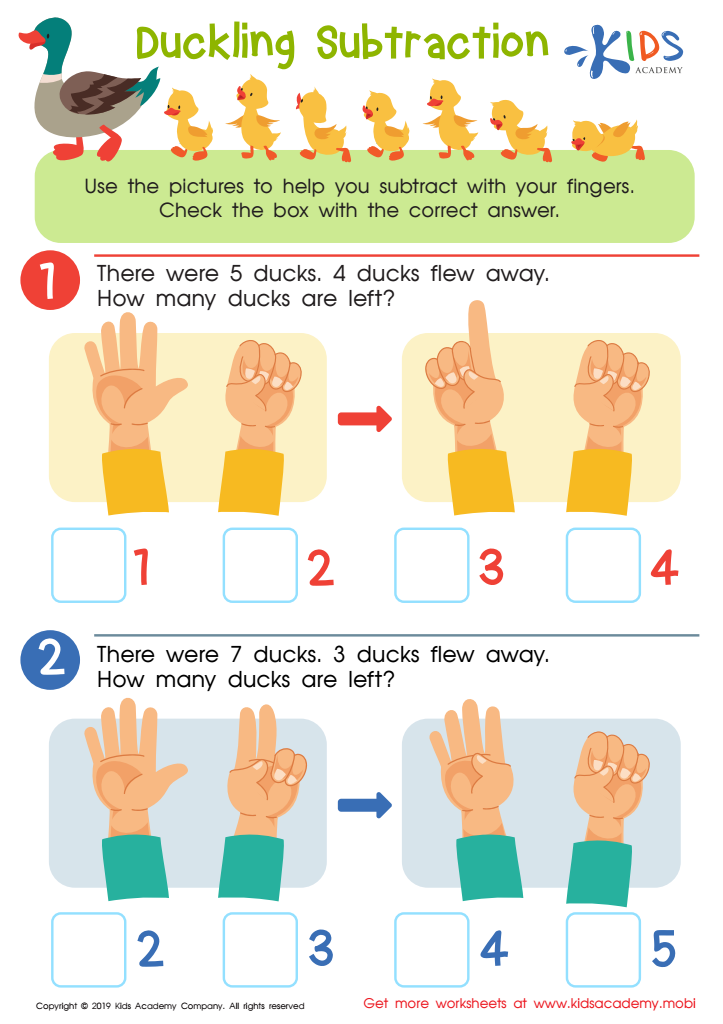
Duckling Subtraction Worksheet
Help your students learn equations and math with this fun worksheet. There are two questions to solve with the help of the pictures. Ask them to subtract with their fingers and check the box with the correct answer. This makes math easier and more enjoyable!
 Assign to My Students
Duckling Subtraction Worksheet
Worksheet
Join Kids Academy for Free
Who is primarily going to use this learning content?







Understanding number relationships is crucial for children aged 5-8, as it lays the foundational skills needed for all future math concepts. For parents and teachers, recognizing the importance of this cognitive milestone can significantly impact a child's academic journey and confidence in math.
By grasping number relationships, children learn to see how numbers interact with each other—how they can be combined, separated, or compared. This understanding goes beyond rote memorization of facts; it promotes critical thinking and problem-solving skills. For instance, when children experiment with addition and subtraction, they begin to understand the concepts of 'more', 'less', and 'equal'.
These early mathematical skills not only relate to academic success but also to everyday life, instilling practical skills that help children navigate real-world situations, such as managing money or measuring ingredients for recipes. When parents and teachers emphasize number relationships, they foster a growth mindset, encouraging kids to view challenges as opportunities to learn.
Furthermore, a strong grasp of number relationships alleviates future math anxiety, creating a positive association with the subject. In nurturing this crucial skill set, caregivers can help ensure that children develop numeracy confidence, outperforming academically, and mastering complex concepts as they progress.








