
Understanding number bonds Math Worksheets for Ages 5-8
3 filtered results
Difficulty Level
Grade
Age
-
From - To
Subject
Activity
Standards
Unlock your child's potential with our "Understanding Number Bonds" math worksheets designed specifically for ages 5-8. These engaging activities help young learners grasp the fundamental concept of number bonds, laying a strong foundation for future mathematics skills. Through a variety of fun and interactive exercises, kids will explore how numbers combine to form a whole, boosting their addition and subtraction skills. Perfect for classroom or home use, our worksheets make math enjoyable and accessible. Give your child the tools they need to succeed and cultivate a love for learning with Kids Academy's expertly crafted resources.
Favorites
With answer key
Interactive
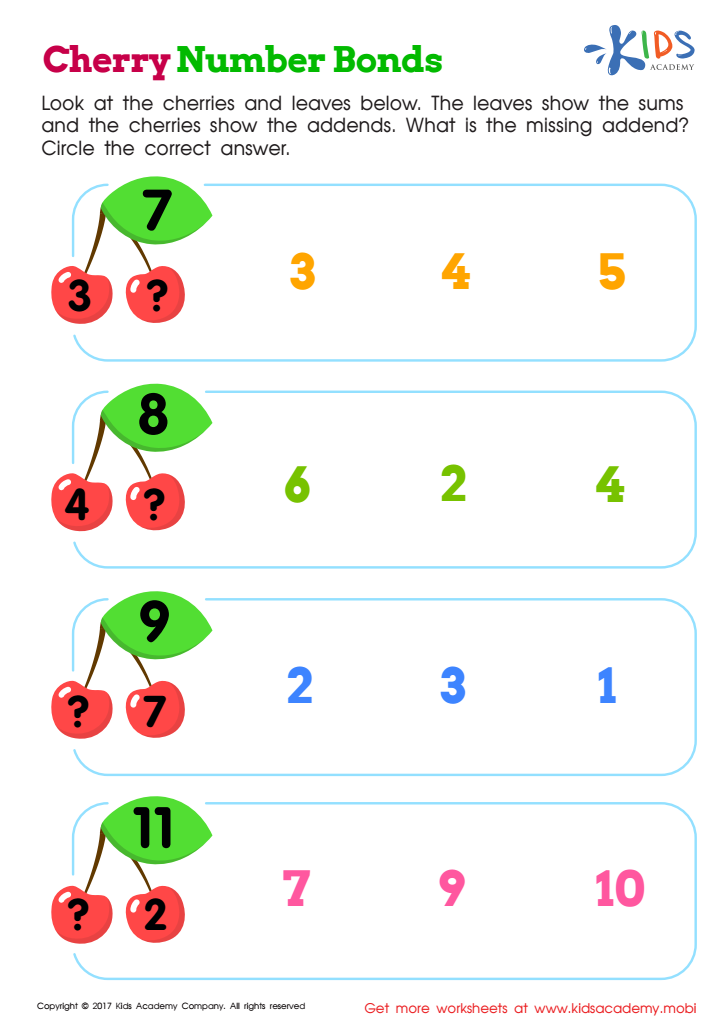
Cherry Number Bonds Worksheet
Help your child figure out which number on the right side is missing from the equation. Look at the worksheet together and you'll see that the numbers on the leaves are the sum of the numbers on the cherries.
 Assign to My Students
Cherry Number Bonds Worksheet
Worksheet
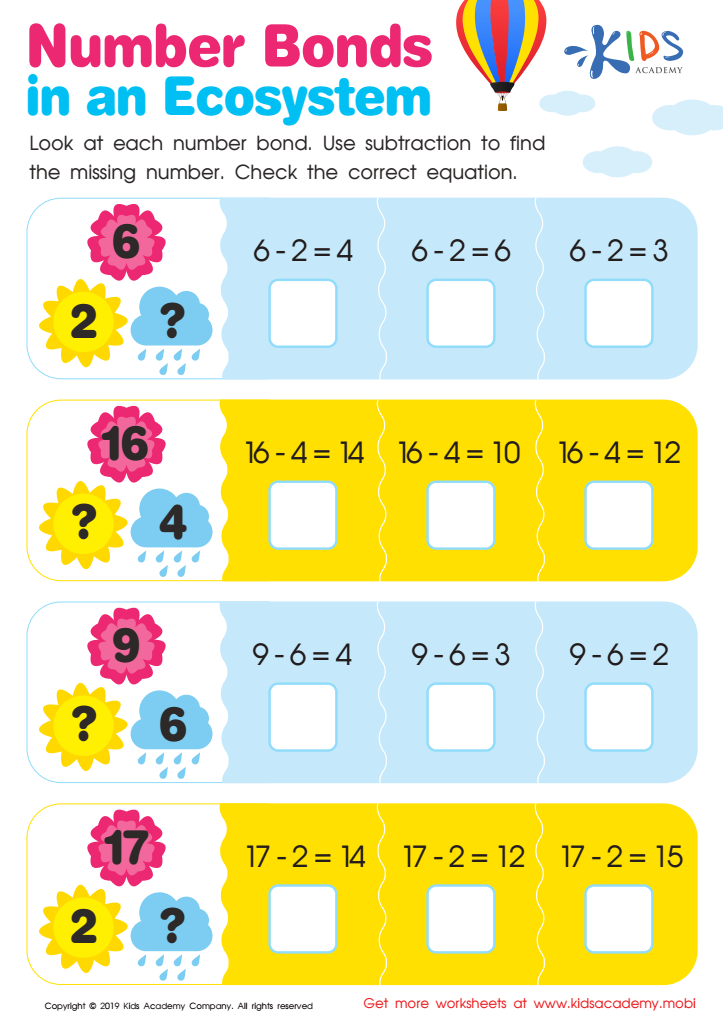
Number Bonds in an Ecosystem Worksheet
This worksheet is a great tool to help your kids sharpen their maths skills. Use the colourful images to teach them how to subtract the missing numbers and check the equation. Show them the four different images and let them try solving each number bond. With your guidance, they'll be able to hone their maths skills in no time!
Number Bonds in an Ecosystem Worksheet
Worksheet
Join Kids Academy for Free
Who is primarily going to use this learning content?



.jpg)




Understanding number bonds is crucial for young learners aged 5-8 because it lays the groundwork for basic arithmetic and fosters mathematical thinking. Number bonds illustrate the relationships between numbers by breaking them down into simpler, more manageable parts. For instance, knowing that 5 can be split into 2 and 3 helps children comprehend addition and subtraction more easily.
For parents and teachers, emphasizing number bonds can lead to improved fluency in mental calculation. When children grasp these concepts early, they develop confidence and a positive attitude toward math. This early confidence is vital for sustained academic success and for building a more complex mathematical understanding later on.
Number bonds also play a critical role in problem-solving skills. By recognizing and working with number relationships, children are better equipped to tackle more complicated mathematical problems. This ability extends beyond math, as analytical and critical thinking skills are valuable in virtually all subjects and everyday situations.
Moreover, teaching number bonds can be fun and interactive, with games, visual aids, and hands-on activities that engage young minds. Early mastery of such fundamental skills can reduce math anxiety, leading to a lifetime of greater ease and appreciation for math. It is an investment in their cognitive and academic development that pays off across multiple dimensions.








