Understanding Quantities Math Worksheets for Ages 5-8 - Page 3
50 filtered results
-
From - To
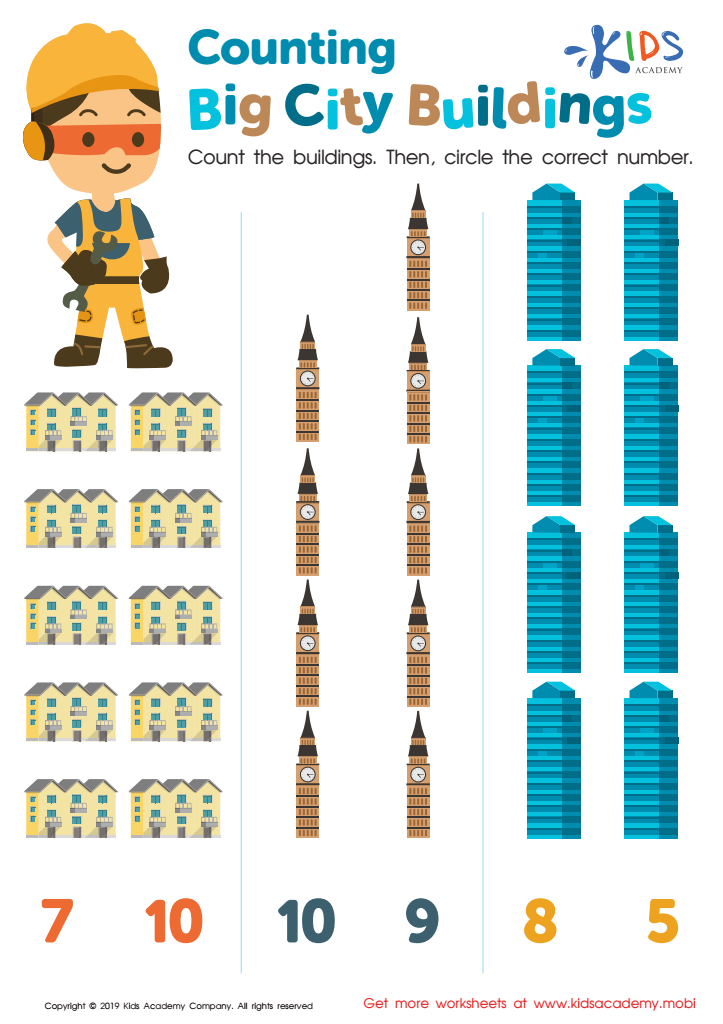
Counting Big City Buildings Worksheet
 Assign to My Students




.jpg)



Understanding quantities is a fundamental concept in early mathematics that serves as the groundwork for children's future mathematical skills. For parents and teachers, fostering a robust understanding of quantities in children aged 5-8 is crucial for several reasons.
Firstly, this understanding enables children to make sense of numbers and their relationships, laying the foundation for more complex operations such as addition, subtraction, multiplication, and division. When children comprehend how to compare, combine, and manipulate quantities, they develop critical thinking and problem-solving skills essential for their academic journey.
Secondly, a solid grasp of quantities promotes confidence in mathematical abilities. Children who understand basic quantity concepts are more likely to engage positively with math activities, reducing math anxiety that can arise later. Creating a positive relationship with math at an early age encourages lifelong learning and an optimistic approach to challenges.
Moreover, understanding quantities supports key life skills, including budgeting, measuring, and planning, fostering independence and practical reasoning in real-world situations. By prioritizing this area of math education, parents and teachers can empower children with essential skills, preparing them for future academic understandings and everyday life success. Investing time in understanding quantities equates to investing in a child's holistic development.








