
Understanding punctuation Writing Worksheets for Ages 5-8
3 filtered results
Difficulty Level
Grade
Age
-
From - To
Subject
Activity
Standards
Introducing our "Understanding Punctuation Writing Worksheets" designed specifically for children ages 5-8. These engaging worksheets aim to build foundational writing skills by helping young learners comprehend essential punctuation marks like periods, commas, and question marks. With fun activities that encourage kids to practice sentence structure and gain confidence in their writing abilities, these worksheets make learning a delightful experience. Each activity is crafted to suit various learning styles, fostering creativity and critical thinking. Perfect for both classroom settings and at-home learning, our worksheets are an invaluable resource for parents and educators alike, setting the stage for effective communication skills.
Favorites
With answer key
Interactive
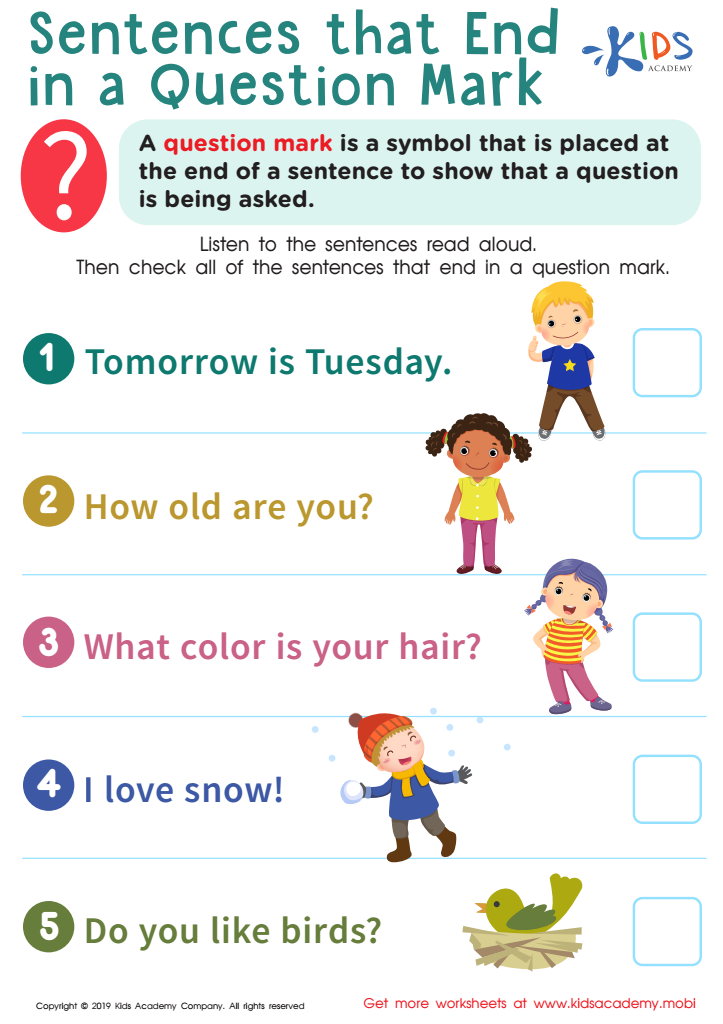
Sentences That End in an Question Mark Worksheet
Teach your students about the four most common punctuation marks - period, comma, question mark, and exclamation mark - with this worksheet. Show them how to use the question mark to indicate a sentence is a question. Then, have them check all sentences that end in a question mark.
 Assign to My Students
Sentences That End in an Question Mark Worksheet
Worksheet
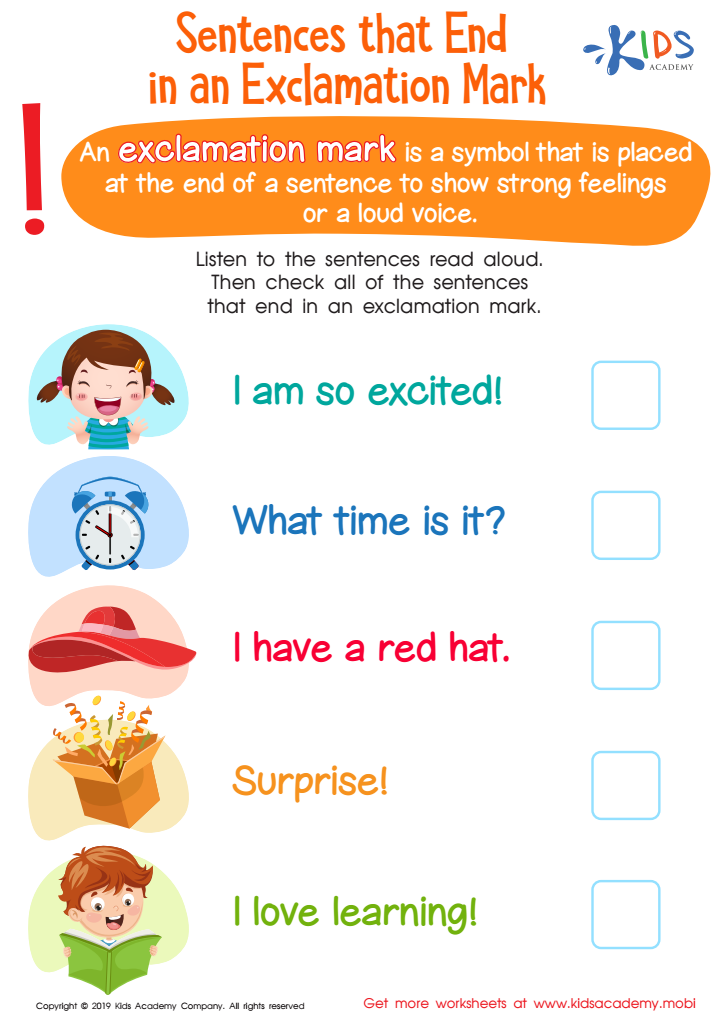
Sentences That End in an Exclamation Mark Worksheet
This worksheet is a great way to brush up kids' punctuation skills. Period, comma, question mark and exclamation mark are the first four punctuation marks they should learn. Exclamation marks show strong emotion or a noise. Use this printout to teach and test kids' understanding of exclamation marks.
Sentences That End in an Exclamation Mark Worksheet
Worksheet
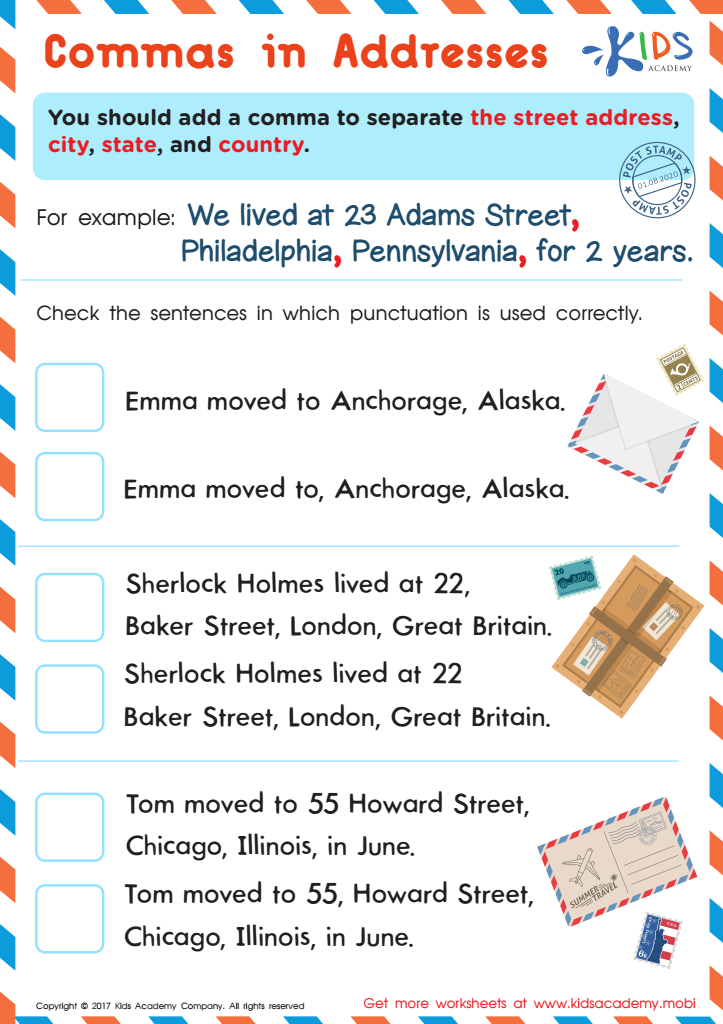
Commas in Addresses Worksheet
Learning comma rules can be tough for kids. Help make it easier with free worksheets, like this fun letter-themed exercise. It'll teach them the rules in isolation and keep them engaged.
Commas in Addresses Worksheet
Worksheet
Join Kids Academy for Free
Who is primarily going to use this learning content?





Understanding punctuation is crucial for children aged 5-8 as it lays the foundation for effective communication and literacy skills. At this age, children are developing their writing abilities, and punctuation helps convey meaning, structure sentences, and provide clarity. When parents and teachers prioritize punctuation, they help young learners understand the flow and rhythm of language, making reading and writing more enjoyable.
Punctuation marks, such as periods, commas, and question marks, serve specific purposes, guiding readers through a text. By mastering these basic symbols, children are better equipped to express their thoughts coherently and engage with others through writing. For example, using a question mark can turn a statement into a more interactive conversation, fostering curiosity and prompting discussions.
Moreover, early exposure to punctuation reinforces critical thinking. Children learn to analyze their writing and understand how different marks affect a sentence's tone and meaning. This skill is vital in the digital age, where clear communication is essential in both personal and academic contexts. Ultimately, empowering children with punctuation knowledge not only enhances their writing skills but also boosts their confidence, leading to lifelong literacy success. Thus, parents and teachers should prioritize punctuation education for this age group.








