
Reading analog clocks Math Worksheets for Ages 5-9
8 filtered results
Difficulty Level
Grade
Age
-
From - To
Subject
Activity
Standards
Discover our engaging "Reading Analog Clocks Math Worksheets" designed for children ages 5-9. With a variety of fun activities and exercises, these worksheets help young learners develop essential time-telling skills on analog clocks. Perfect for reinforcing math concepts, each worksheet progressively builds confidence and understanding, making learning enjoyable. Kids will practice reading different clock times, enhancing their math literacy while preparing them for everyday situations. Easy to print and ideal for classroom or home use, our worksheets provide a fantastic way for educators and parents to introduce this vital skill. Start your child's journey to mastering time today!
Favorites
With answer key
Interactive
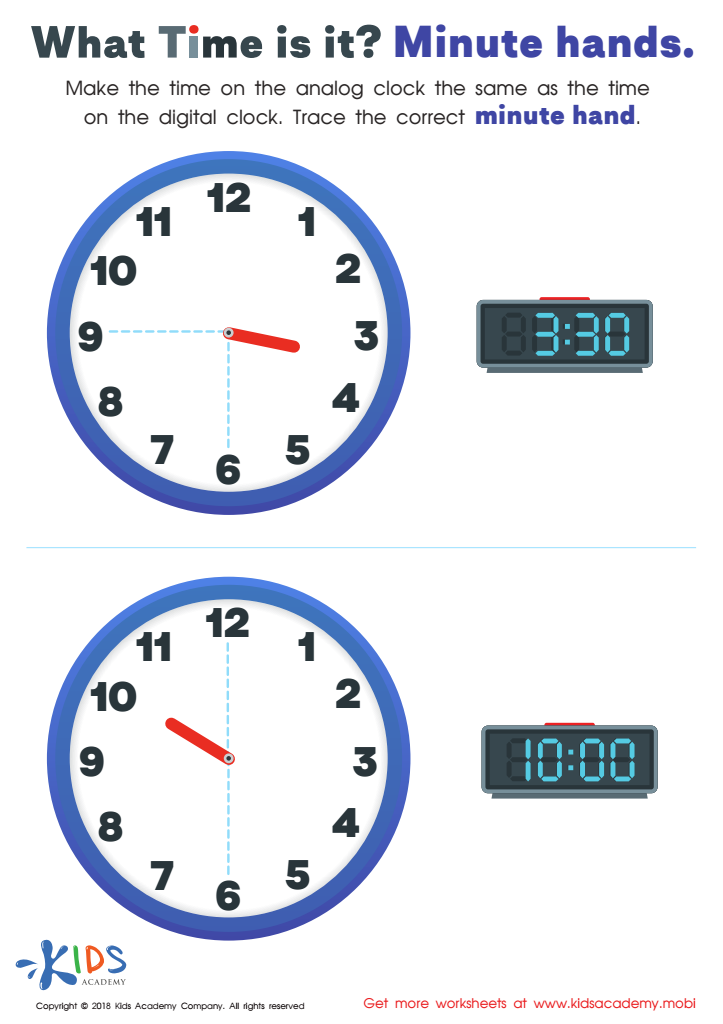
What Time Is it? Minute Hands Worksheet
Help your kids telling time with the minute hand correctly with this tracing sheet. Trace the correct minute hand to make the time on the analog clock the same as the time on the digital clock. Give them a pictured demonstration of how to do it and you'll be all set!
 Assign to My Students
What Time Is it? Minute Hands Worksheet
Worksheet
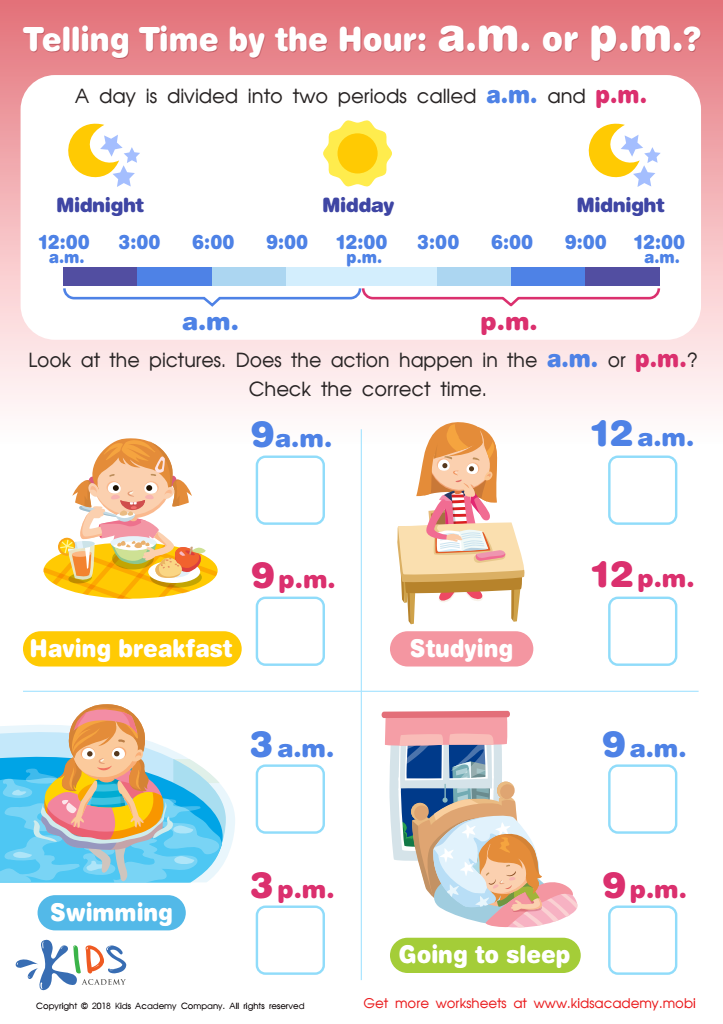
Tilling Time by the Hour: a.m. or p.m.? Worksheet
Can your child tell the time? This worksheet will help them learn. Explain a.m and p.m. and look at the pictures together. Ask your child if the activities happen in the a.m or p.m and help them check the correct time.
Tilling Time by the Hour: a.m. or p.m.? Worksheet
Worksheet
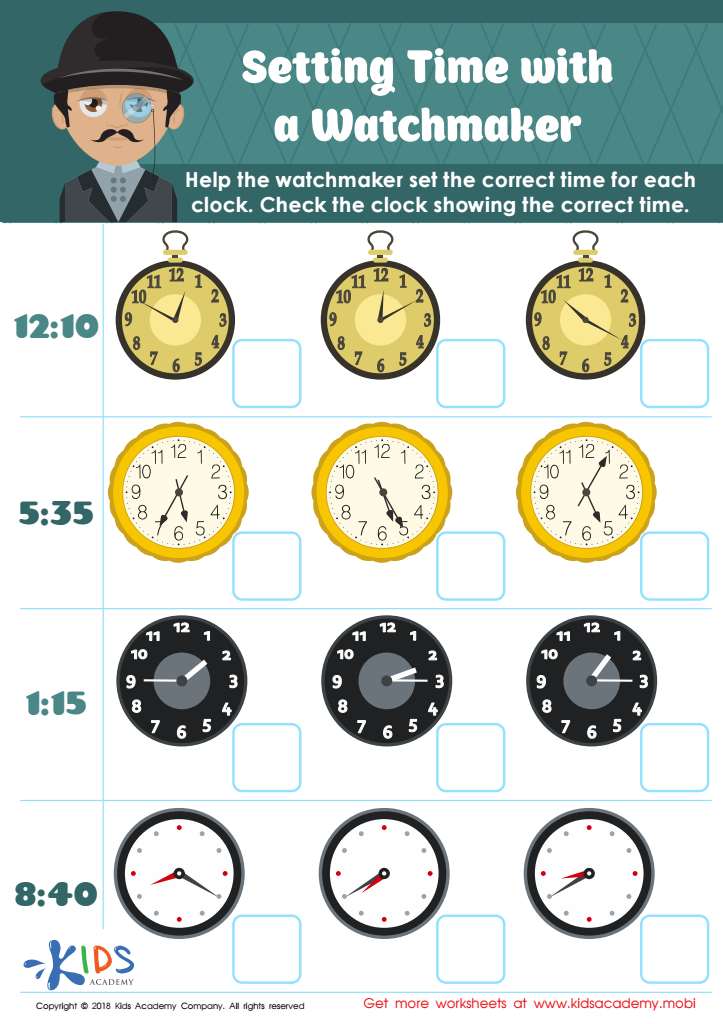
Setting Time with Watchmaker Worksheet
Can your kids tell the time? If so, this worksheet should be easy. Help them set the time for each clock: look at the time written on the left side and find the clock on the right side that matches.
Setting Time with Watchmaker Worksheet
Worksheet
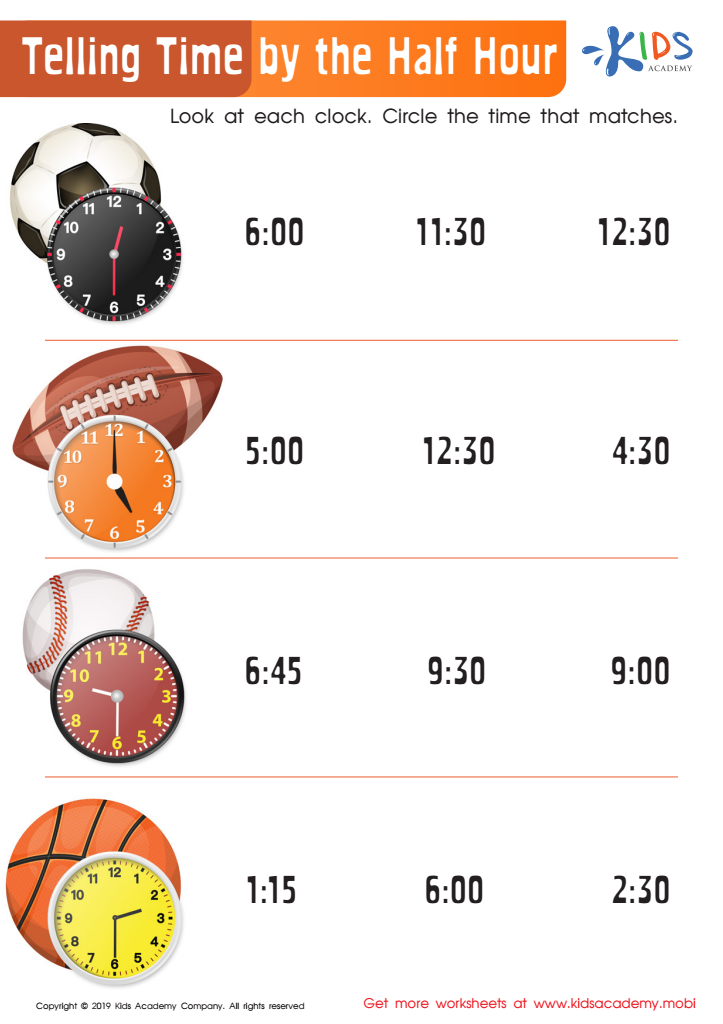
Telling Time by the Half Hour Worksheet
Teach kids to tell time with this worksheet! Four clocks are labeled with different times; help your child circle the right one. It's a great way to teach them to read analog and digital clocks, watches, and written times. Easy and fun learning!
Telling Time by the Half Hour Worksheet
Worksheet
Join Kids Academy for Free
Who is primarily going to use this learning content?








Teaching children to read analog clocks is an essential skill that lays a strong foundation for their mathematical understanding and daily life skills. For parents and teachers, fostering this ability in children aged 5-9 is crucial for several reasons.
First, reading an analog clock reinforces number recognition, counting, and time concepts, which are foundational math skills. Understanding how the hour and minute hands work requires children to interpret numbers and fractions, deepening their overall mathematical reasoning.
Second, the ability to tell time enhances a child’s independence. As they grow, children who can read an analog clock can manage their schedules, understand punctuality, and develop crucial time management skills, making them more responsible individuals.
Furthermore, learning to read analog clocks provides a unique opportunity for interactive learning. Parents and teachers can create engaging activities, such as craft projects to build DIY clocks, encouraging hands-on learning.
Finally, as digital devices dominate, children might miss out on the traditional skill of reading analog clocks. By prioritizing this learning, adults help children become well-rounded individuals who appreciate both modern and classic skills, thus promoting lifelong learning and adaptability.








