
Understanding measurements Measurement Worksheets for Ages 5-9
22 filtered results
Difficulty Level
Grade
Age
-
From - To
Subject
Activity
Standards
Understanding measurements is a fundamental skill for young learners, especially within the critical ages of 5-9. Our Measurement Worksheets are designed to make this crucial concept both fun and engaging. These resources introduce children to basic measurement terms and applications through a variety of activities. From comparing sizes and lengths to identifying weights and capacities, these worksheets provide hands-on practice that reinforces classroom learning. Tailored to suit developmental stages, each worksheet helps build a strong mathematical foundation. Perfect for both home and school settings, our tools aim to boost children’s confidence and proficiency in understanding measurements.
Favorites
With answer key
Interactive
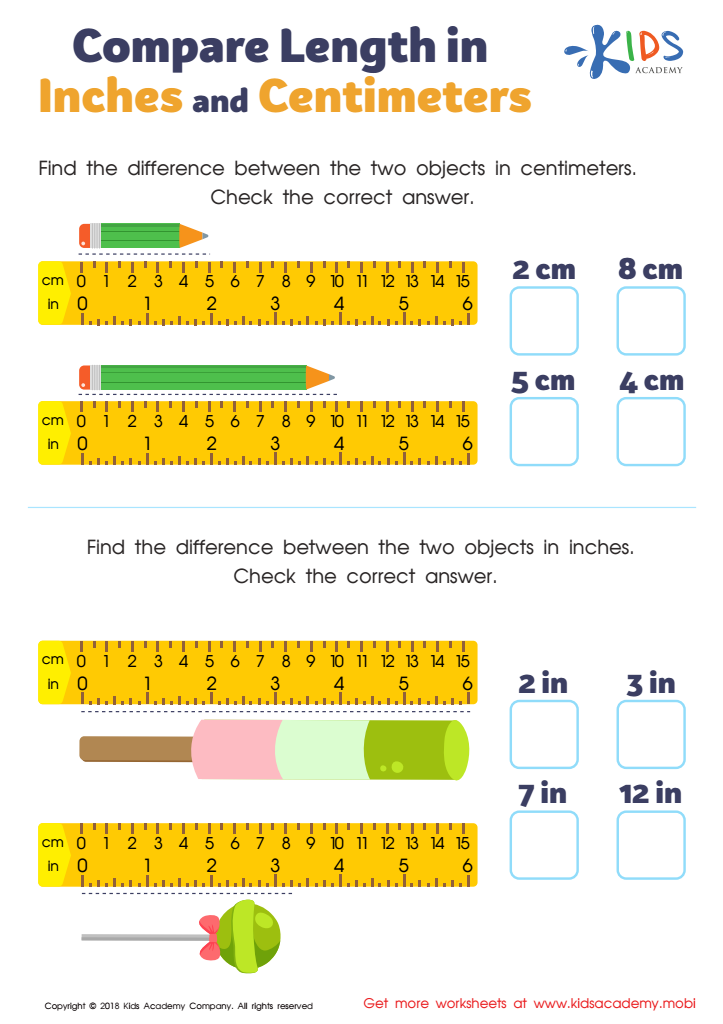
Compare Length in Inches and Centimeters Worksheet
This worksheet has your child measuring objects in both centimeters and inches. The first task requires measuring both objects in centimeters, then finding their difference. The second task is the same but in inches.
 Assign to My Students
Compare Length in Inches and Centimeters Worksheet
Worksheet
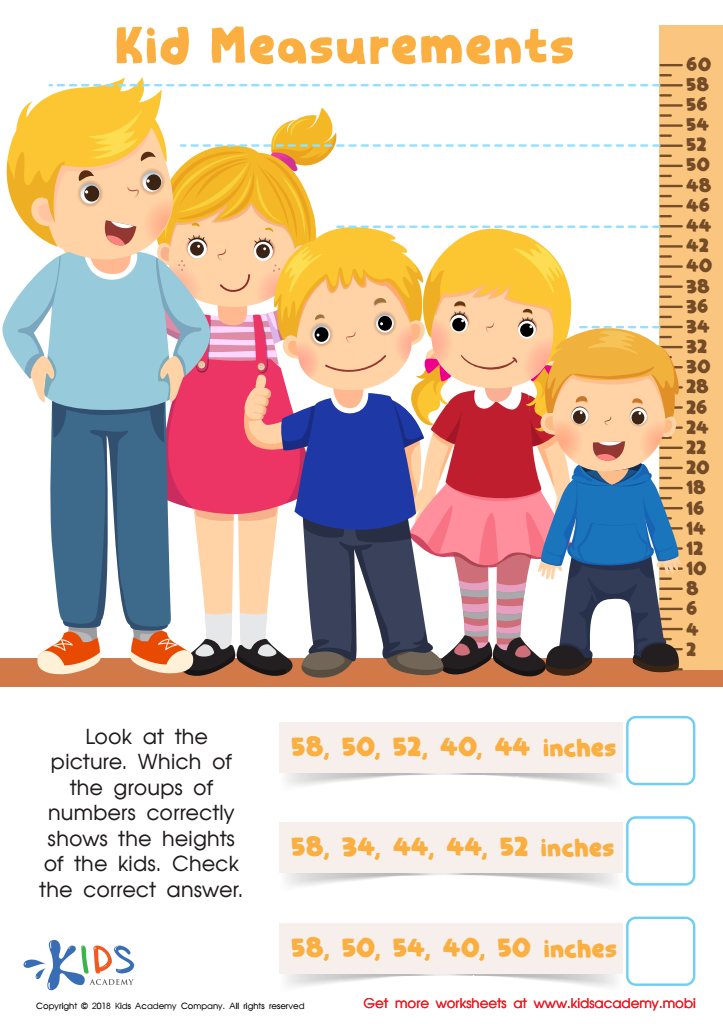
Kids Measurements Worksheet
Help your kids look at the groupings on the bottom right of the worksheet. Compare the heights of the kids shown in the picture to the numbers in each group. Have them check which of the groups of numbers correctly shows the heights.
Kids Measurements Worksheet
Worksheet
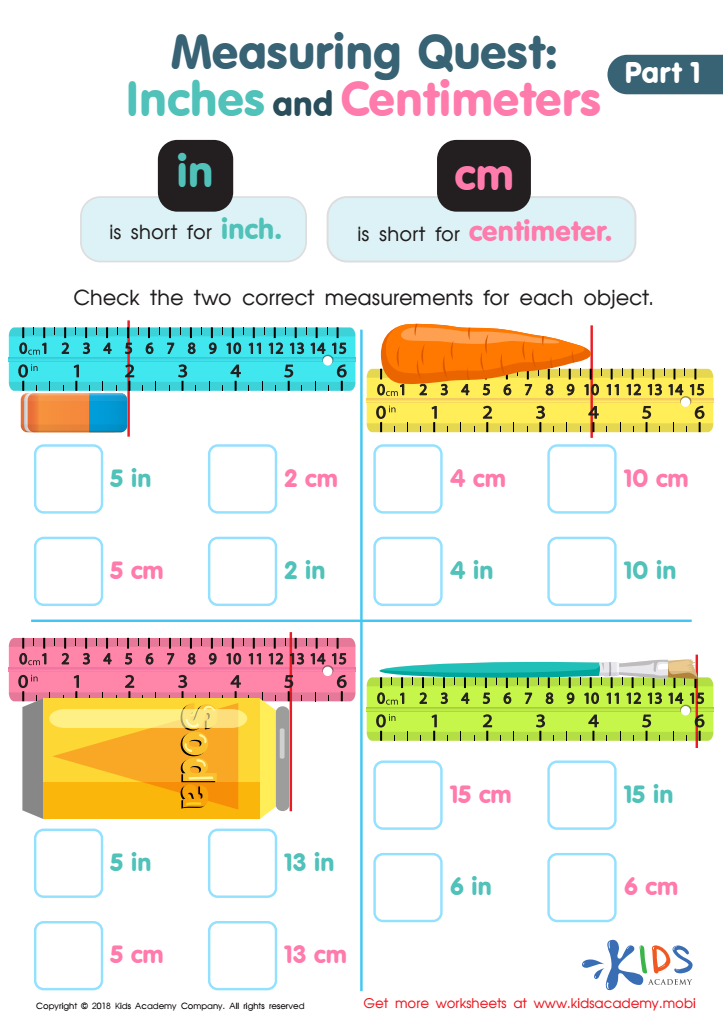
Measuring Quest: Inches and Centimeters Worksheet
Your child will measure items in both inches and centimeters and check the correct measurements from the options given. The metric ruler states 2.5 cm equals 1 inch, and 15 cm equals 6 inches. This worksheet helps ensure accurate measurements, despite the different figures.
Measuring Quest: Inches and Centimeters Worksheet
Worksheet
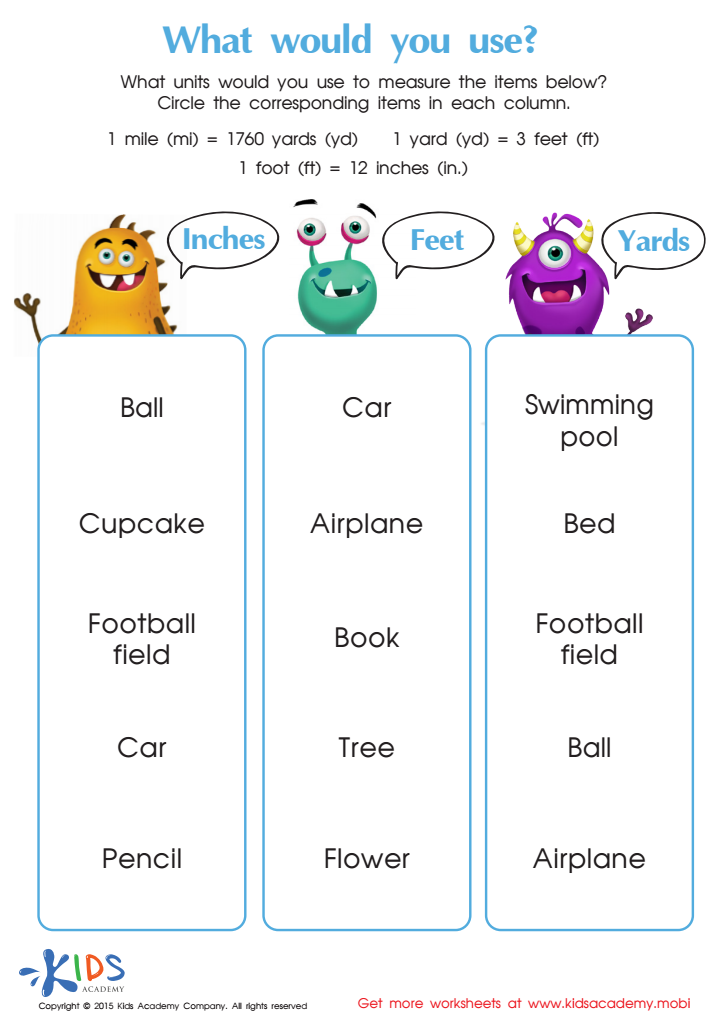
Learning about measuring objects in inches, feet and yards Worksheet
Download, cut and let your preschoolers learn and have fun estimating objects like pencils, airplanes and swimming pools in inches, feet and yards!
Learning about measuring objects in inches, feet and yards Worksheet
Worksheet
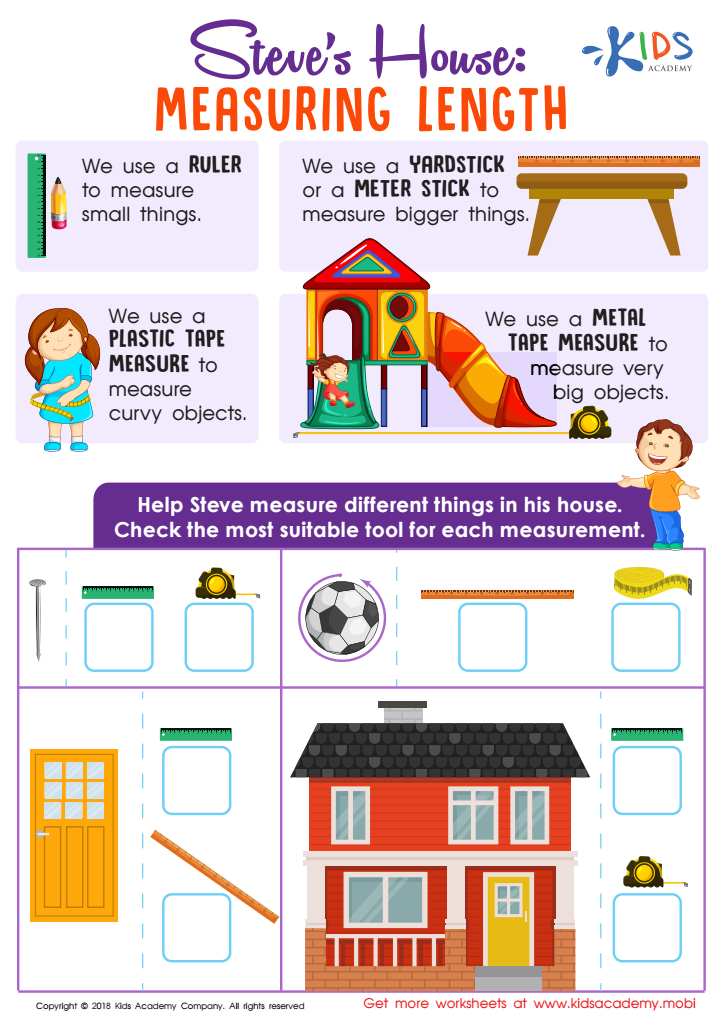
Steve's House: Measuring Length Worksheet
Introduce your kids to the various measuring tools and their uses. Explain how a ruler, plastic tape, yard stick, and metal tape measure are used to measure different objects. Guide them as they help Steve measure things in his home with the correct tool.
Steve's House: Measuring Length Worksheet
Worksheet
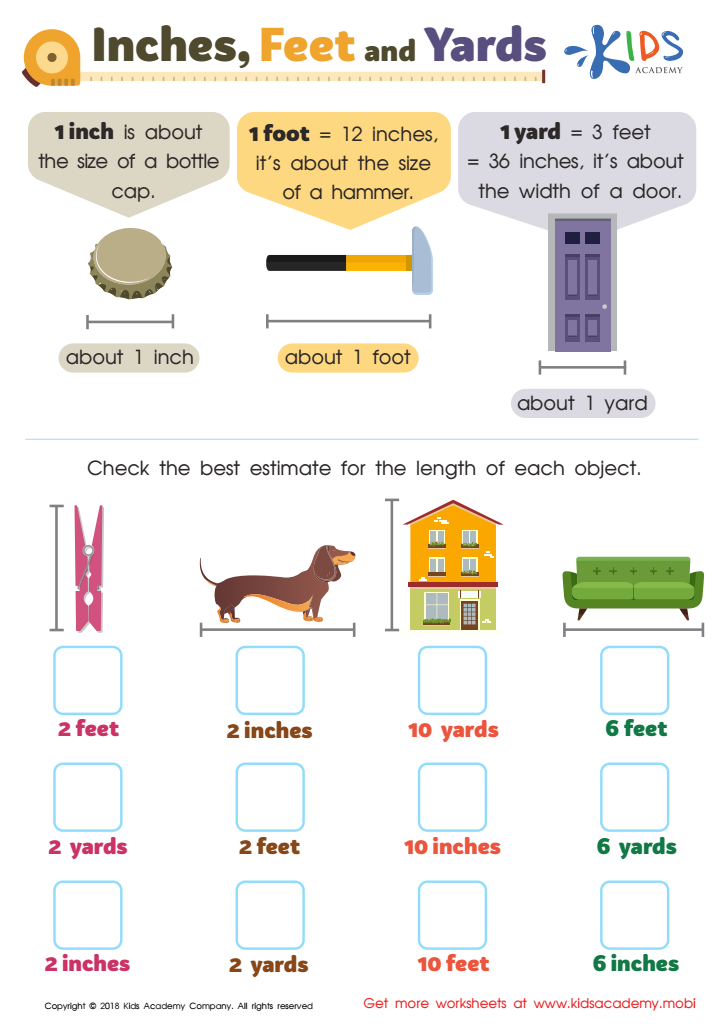
Inches, Feet and Yards Worksheet
Explain the size of measurements to your child by comparing them to objects they can visualize. For example, one inch is a bottle cap and one foot is the size of a hammer. Then, explain that one yard is the width of a door. Then, go through worksheets, circling the best estimates for each object's length.
Inches, Feet and Yards Worksheet
Worksheet
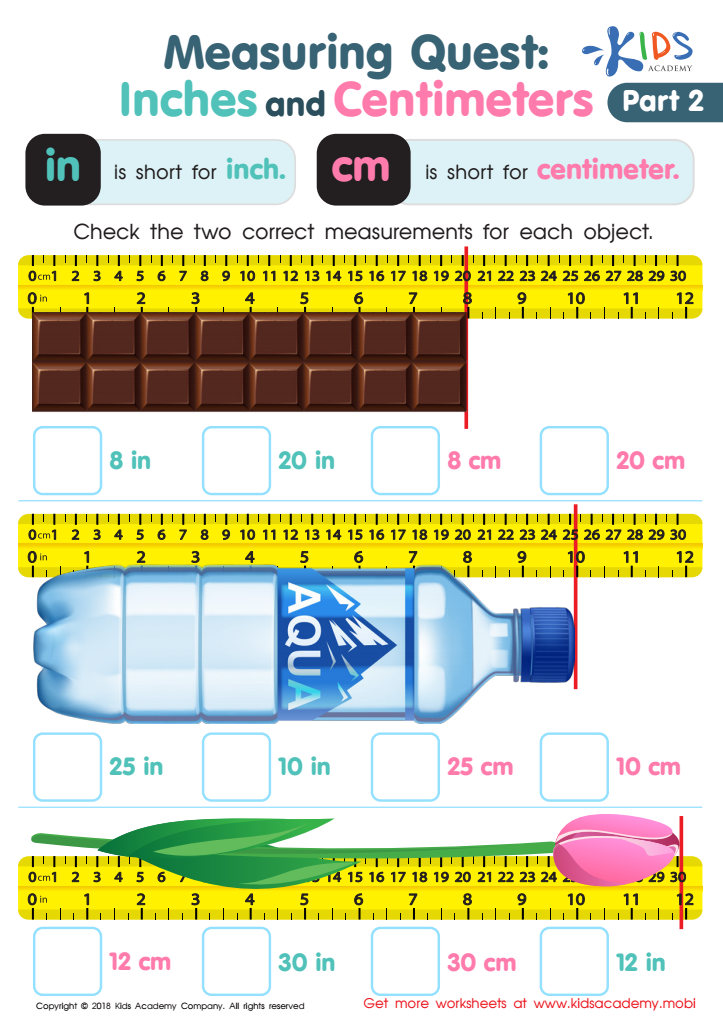
Measuring Quest: Inches and Centimeters - Part 2 Worksheet
This worksheet teaches kids how inches and centimeters measure up. It features rulers with centimeter measurements at the top, and inches at the bottom. Kids must choose the correct measurement for each object among the options provided.
Measuring Quest: Inches and Centimeters - Part 2 Worksheet
Worksheet
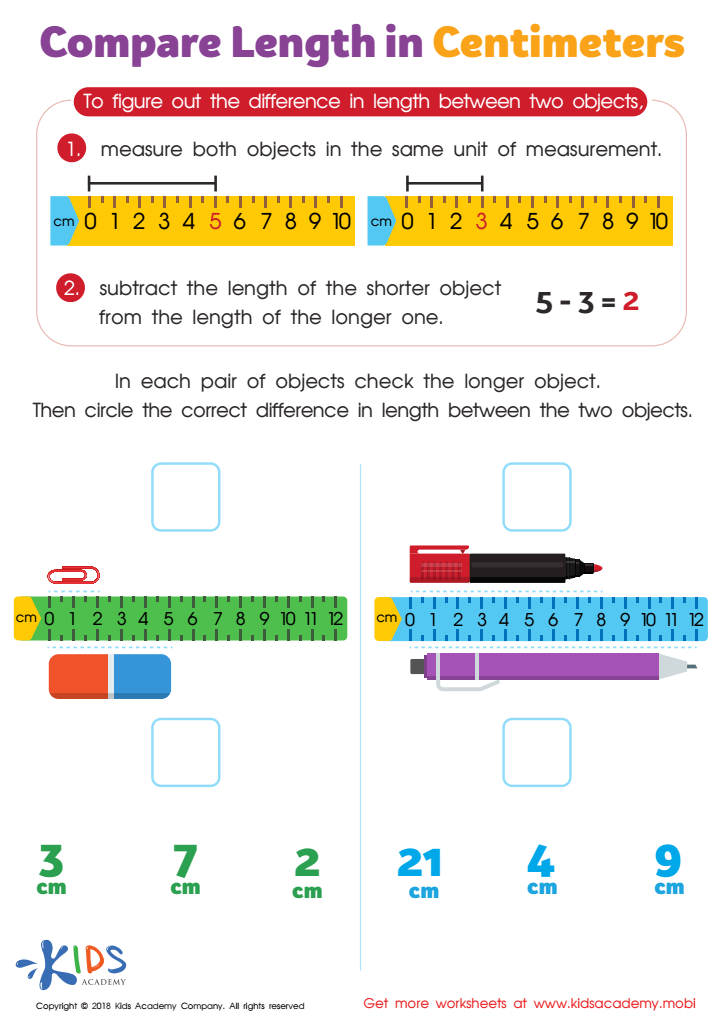
Compare Length in Centimeters Worksheet
To do this worksheet, your child needs to be able to measure accurately, add and subtract. They must measure both items and subtract the shorter from the longer to work out the difference in length.
Compare Length in Centimeters Worksheet
Worksheet
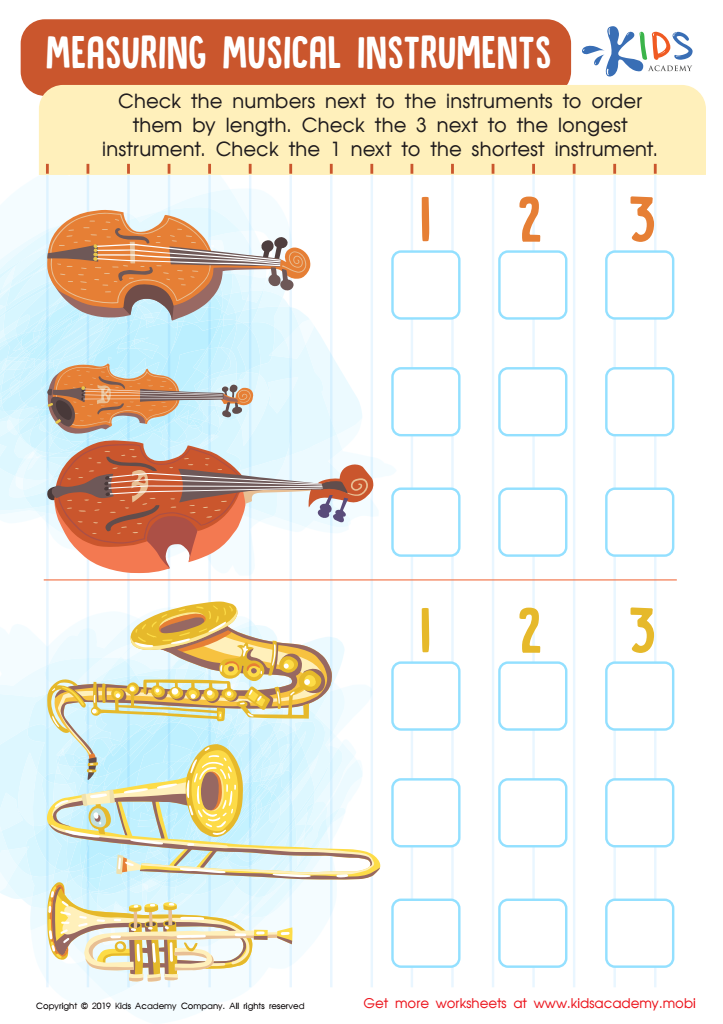
Measuring Musical Instruments Worksheet
Learning measurements can be tricky, but this worksheet makes it easy. Ask your child to identify the instruments in the pictures. Then, order them by length using the numbers. 3 is the longest, 1 is the shortest. Simple exercises like this will help them understand the different metric systems.
Measuring Musical Instruments Worksheet
Worksheet
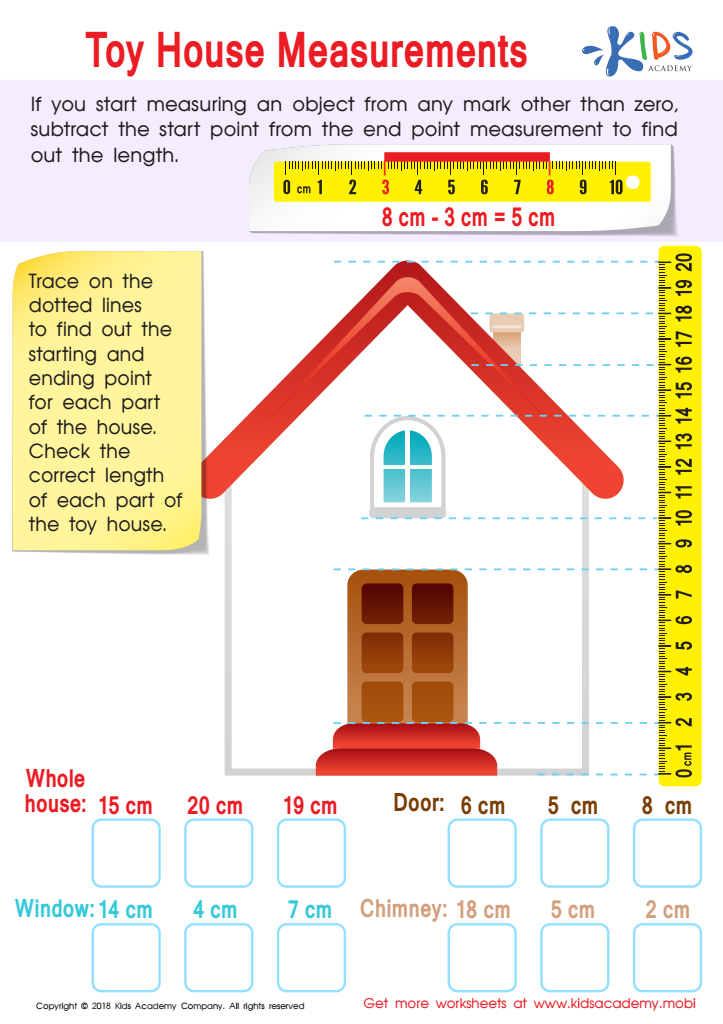
Toy House Measurements Worksheet
This worksheet requires math and measuring skills. When measuring an object from a non-zero starting point, subtract the start point from the end point to get the correct length. Kids must trace the dotted lines to get the right length for each part of the house.
Toy House Measurements Worksheet
Worksheet
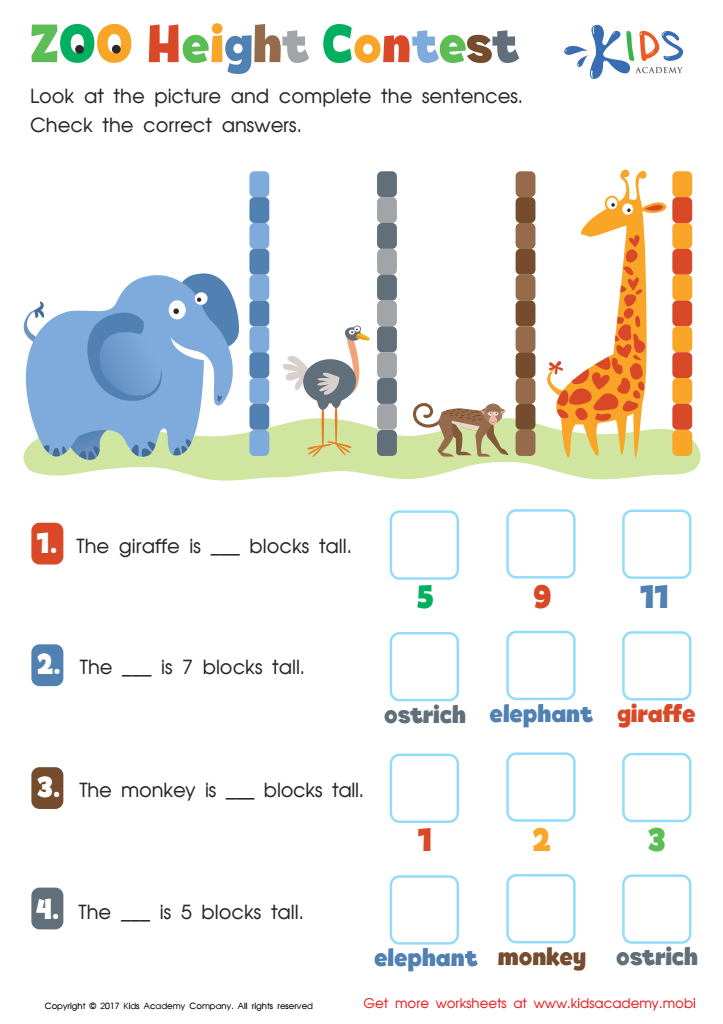
Zoo Height Contest Worksheet
Let's head to the zoo and use colorful blocks to measure your child's favorite animals! With this Kids Academy worksheet, help them practice and prepare for learning measurement. Guide them in looking at the zoo animals and counting blocks to find the height. Then, read the questions and check the box next to the correct answer.
Zoo Height Contest Worksheet
Worksheet
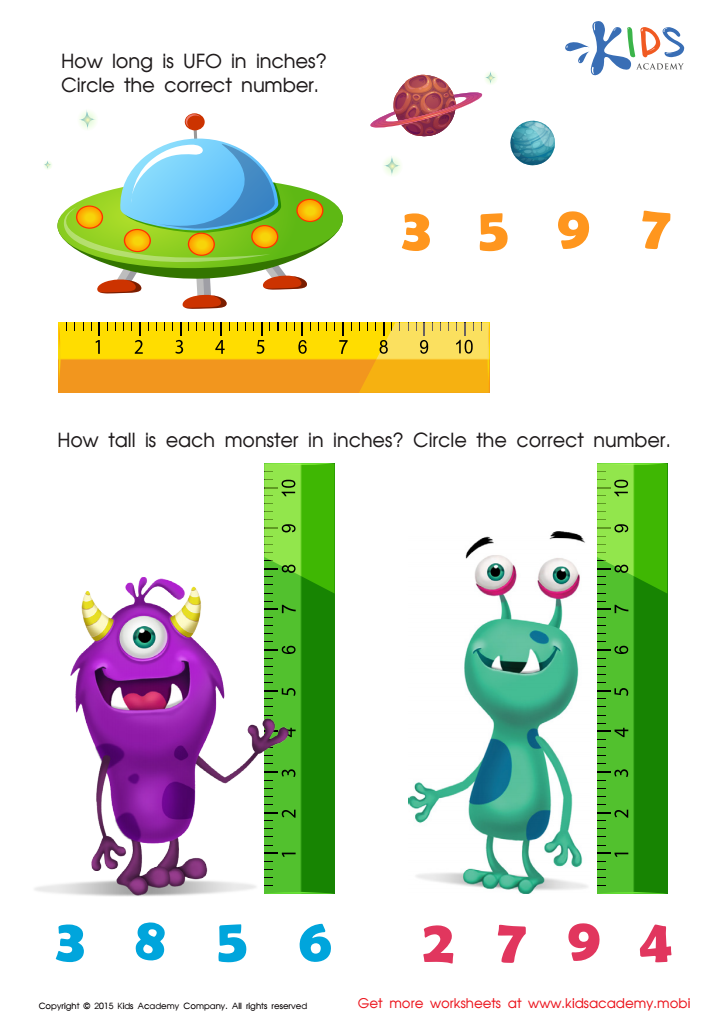
Measuring in Inches Worksheet
Look at the picture, can you measure the UFO & monsters? Write down how long each is. Which is tallest? Circle it. Get more free printable math worksheets for kindergarten at our website.
Measuring in Inches Worksheet
Worksheet
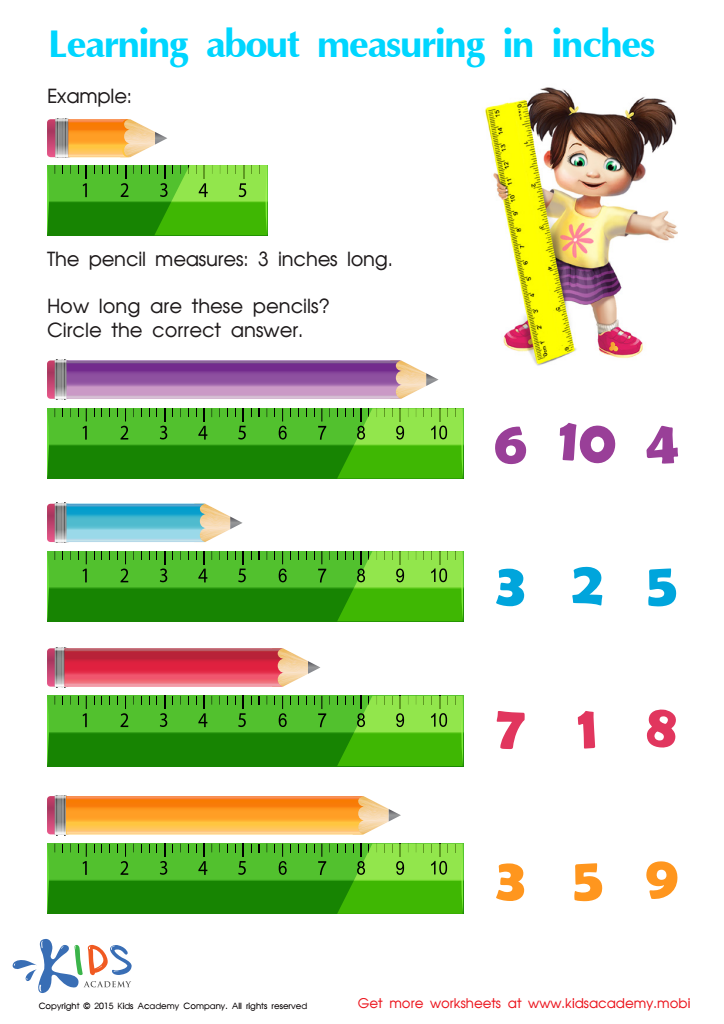
Learning About Measuring In Inches Printable
Print this free worksheet and measure pencils together with kids. See who finds the longest and the shortest! Enjoy learning math with your kids.
Learning About Measuring In Inches Printable
Worksheet
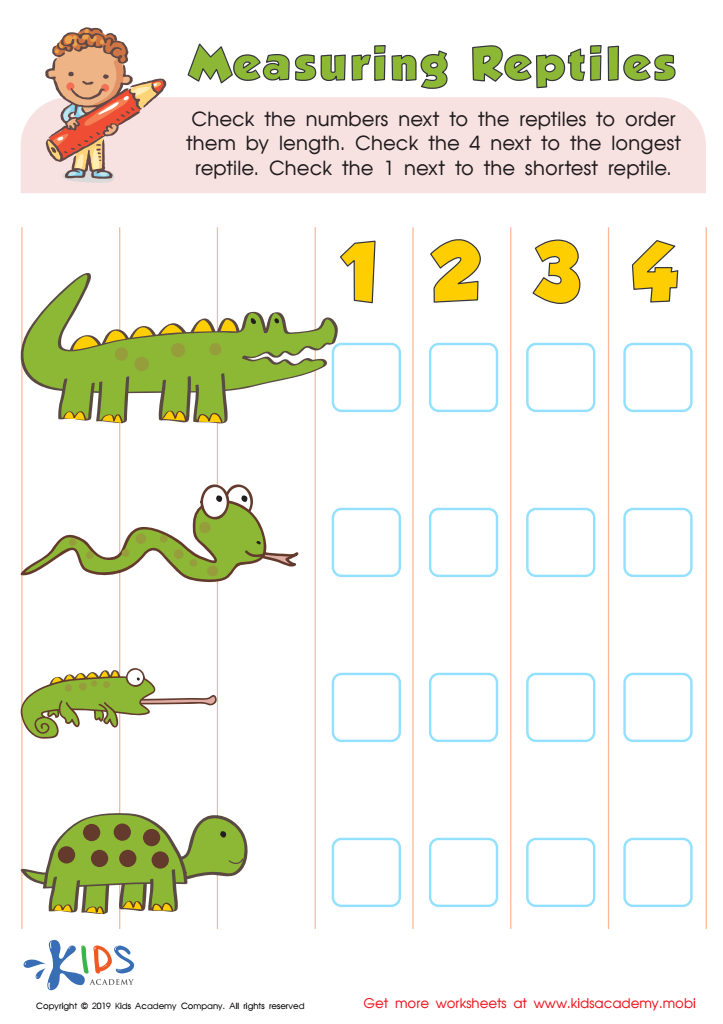
Measuring Reptiles Worksheet
Do your kids know what reptiles are? Ask them to name some and name features. In this activity, your kindergartners will measure with reptiles. Show them the picture and get them to order by length, starting with the one with 4 by the longest reptile, then the one with 1 by the shortest.
Measuring Reptiles Worksheet
Worksheet
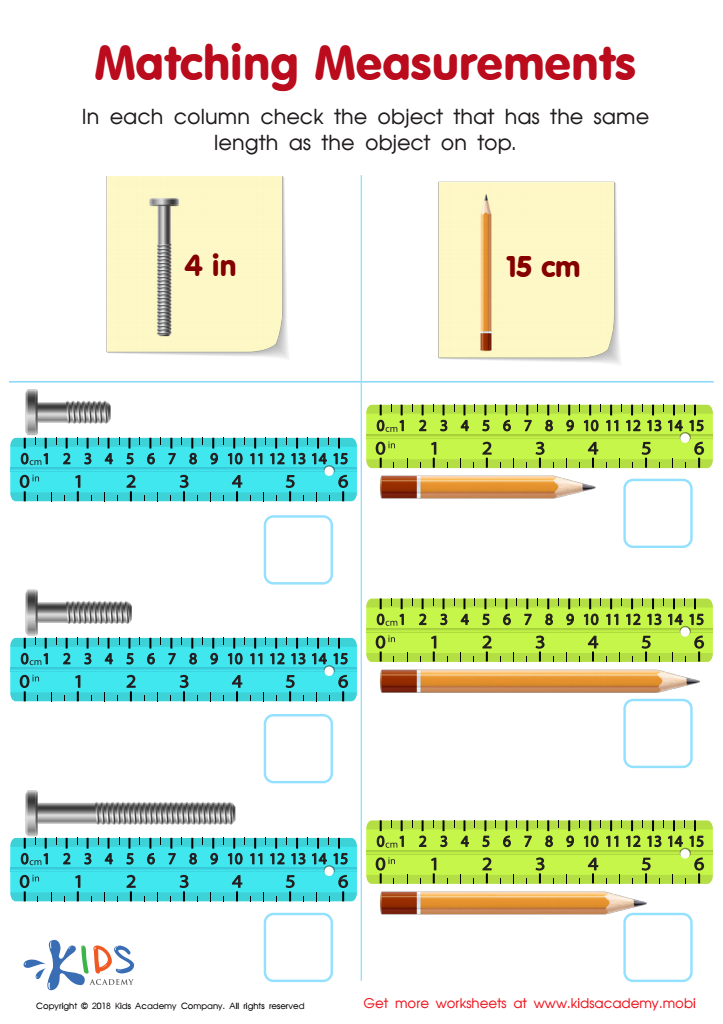
Matching Measurements Worksheet
Get your students to measure different objects with this colorful worksheet. At the top of each column is a prefilled object. Ask them to look at the pictures below each column and identify the objects that are of the same length as the one at the top.
Matching Measurements Worksheet
Worksheet
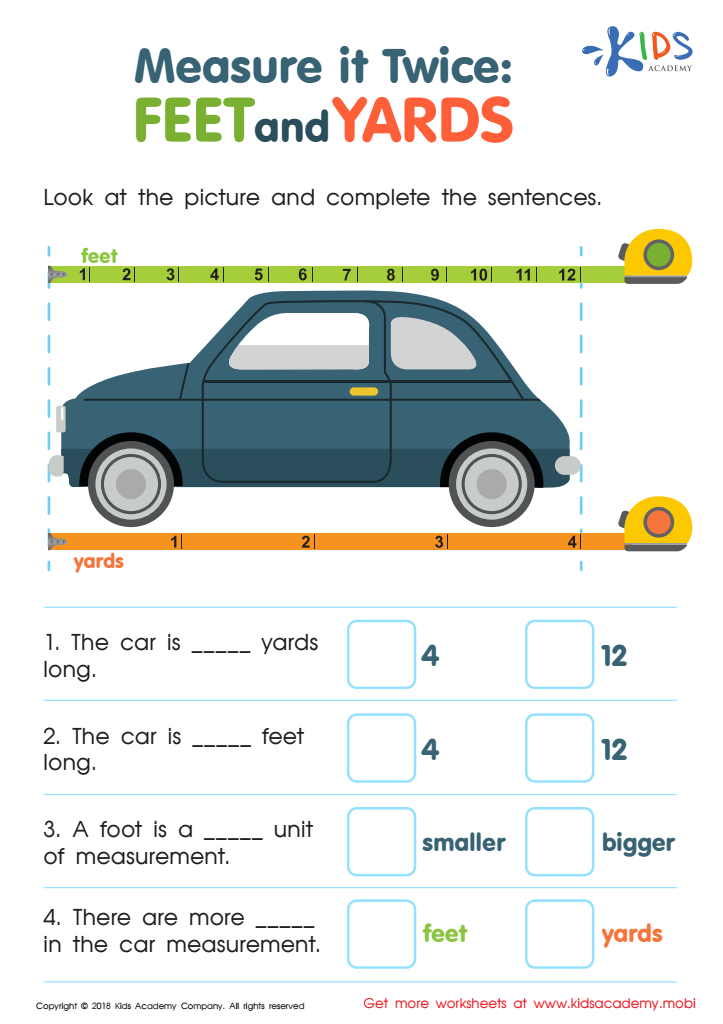
Measure It Twice: Feet and Yards Worksheet
A car is pictured with a metric ruler in feet at the top and a yard ruler at the bottom. Get your child to look at the picture and complete sentences about it; for example, how many yards long is the car? Is a foot a bigger or smaller unit of measurement? It'll teach them that 1 yard is equal to 3 feet.
Measure It Twice: Feet and Yards Worksheet
Worksheet
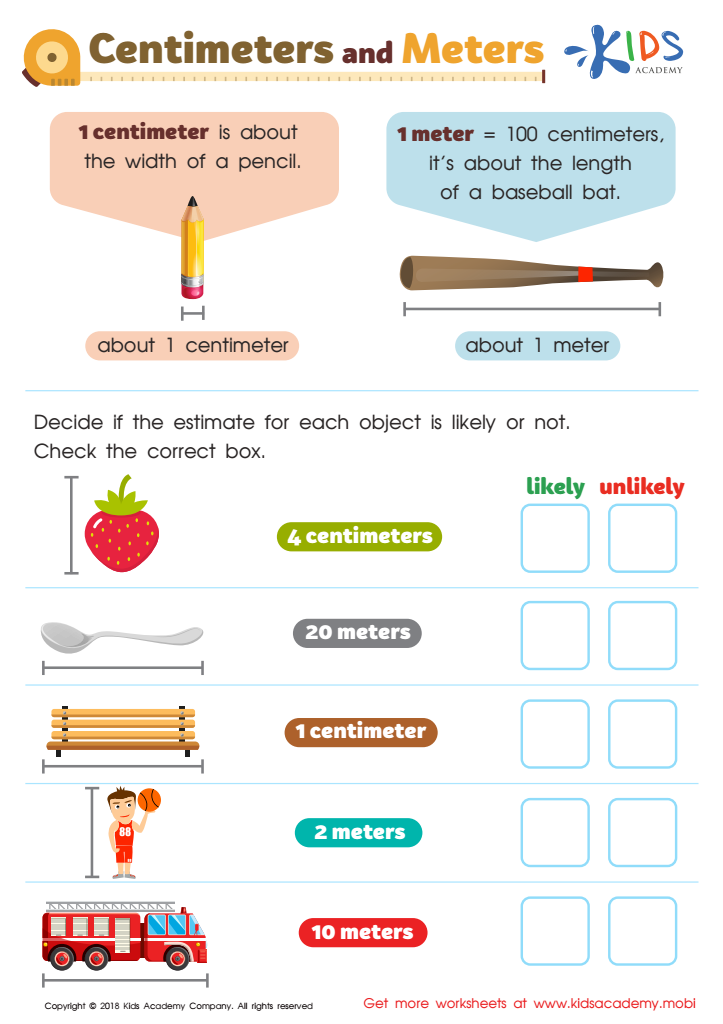
Centimeters and Meters Worksheet
Get a pencil and show your child how wide 1 cm is (about the same width). Then, take a baseball bat and explain that 1 meter is around its entire length. Now your child has an idea of what to picture when hearing cm and m. Look through the worksheet together and show them each object. Ask if the object is likely or unlikely to be the length described.
Centimeters and Meters Worksheet
Worksheet
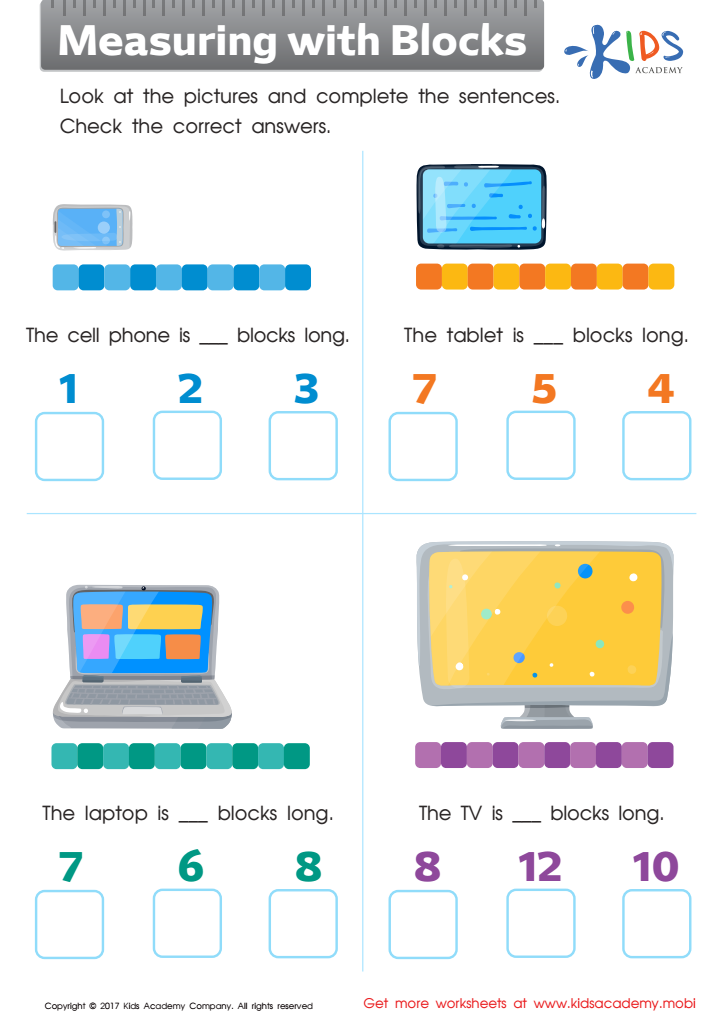
Measuring with Blocks Worksheet
Help your child get ready for math success with this Kids Academy worksheet. It provides colorful blocks to practice measuring objects. Coach them to count the boxes under each picture, then check the box with the right answer. It's a fun way to get acquainted with rulers!
Measuring with Blocks Worksheet
Worksheet
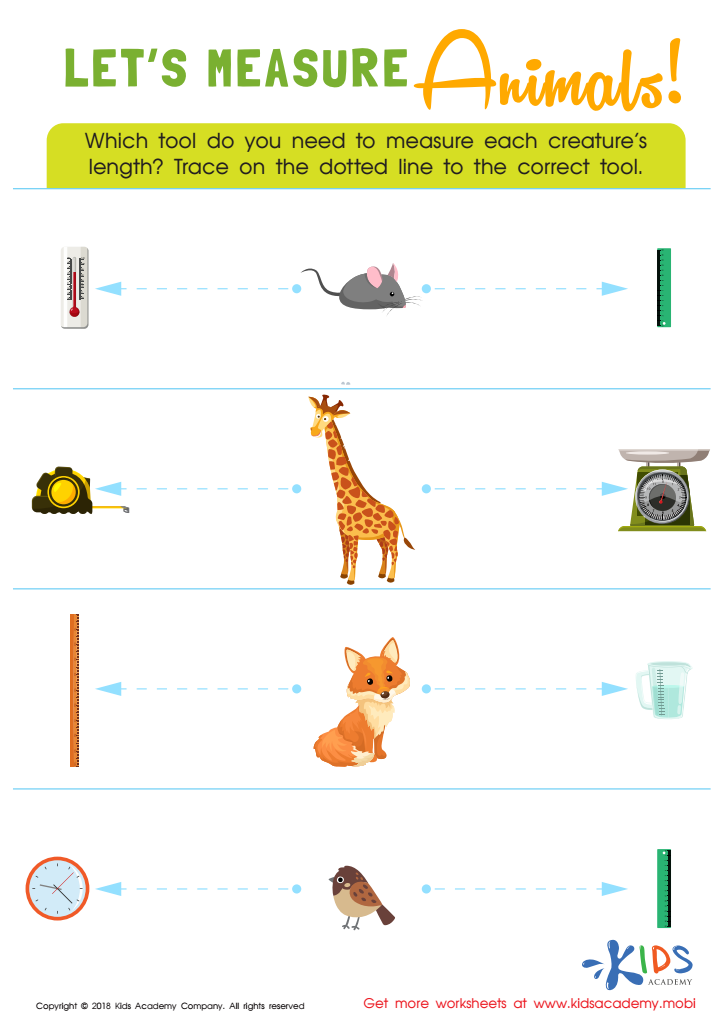
Let's Measure Animals! Worksheet
Have your students measure the length of animals like a mouse, giraffe, fox, and bird using this fun tracing sheet. They must carefully follow the dotted lines to the correct measuring tool, and by the end of the colorful worksheet, they'll know more about measuring and the different tools used.
Let's Measure Animals! Worksheet
Worksheet
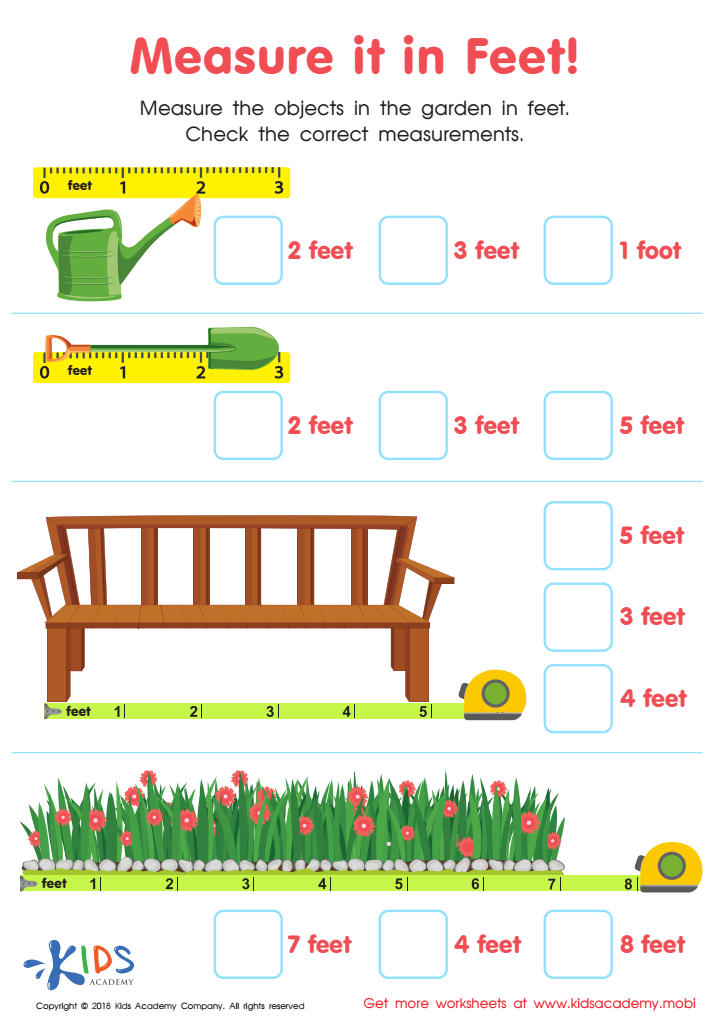
Measure it in Feet Worksheet
Put your kids' measuring skills to the test with this worksheet! Kids will measure garden objects in feet and check the correct measurements from the choices given. Assess how accurately they can measure objects around the house and help them hone those skills.
Measure it in Feet Worksheet
Worksheet
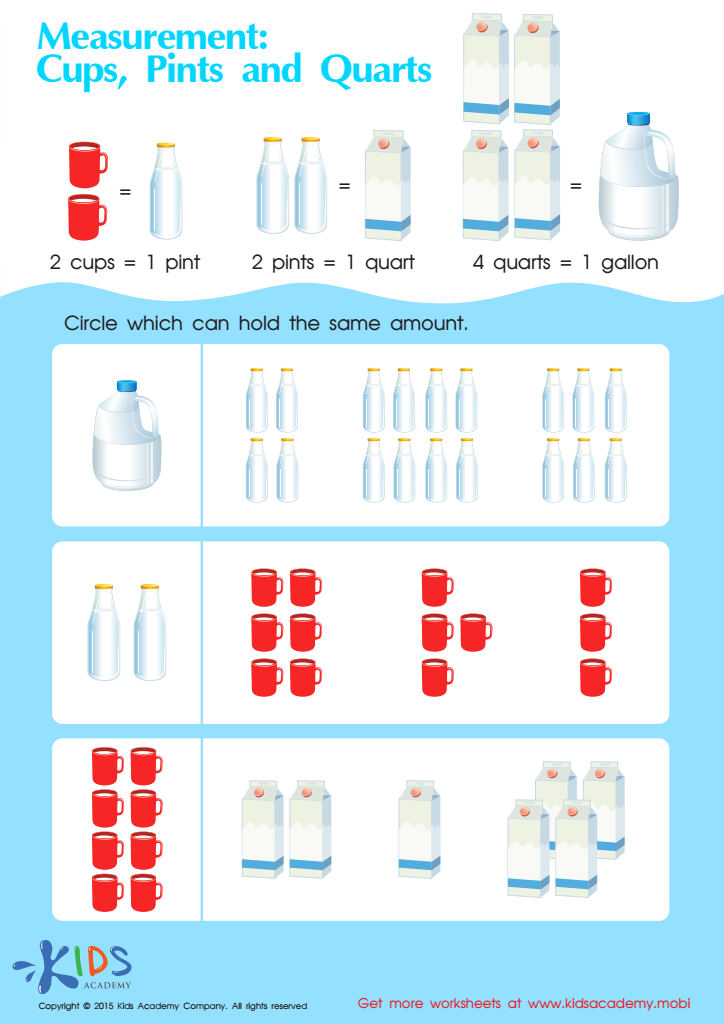
Cups, Pints and Quarts 2 Worksheet
Practice measuring liquids with our free math worksheets. Learn how many cups are in a quart and how many quarts are in a gallon. Accurately calculate the answers and write them in the provided spaces. Visit Kids Academy for a collection of free worksheets and make math fun!
Cups, Pints and Quarts 2 Worksheet
Worksheet
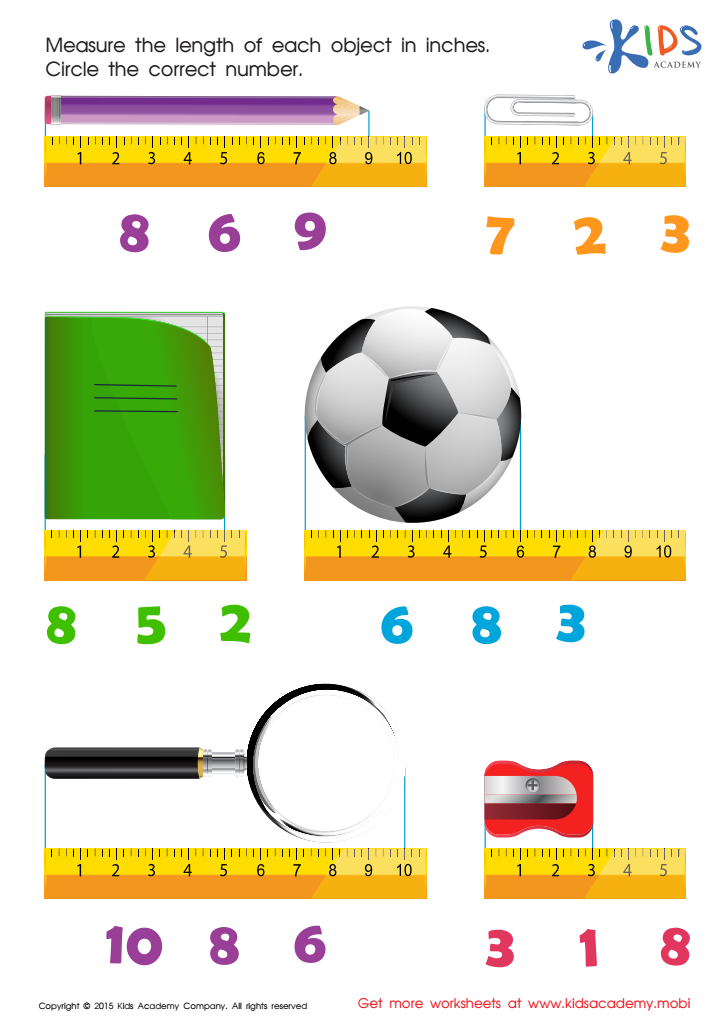
Learning measuring objects in inches Worksheet
Help your little learners gain confidence in using a ruler! Print out our free worksheet, cut out the inch ruler, and let them measure and record objects' width and length. Kids Academy has a variety of math worksheets to make learning math fun! Check out our website for more free printables!
Learning measuring objects in inches Worksheet
Worksheet
Join Kids Academy for Free
Who is primarily going to use this learning content?








Understanding measurements is crucial for children ages 5-9 because it lays the foundation for their future learning and development in various subjects. At this early age, kids are naturally curious, and comprehending basic concepts of measurement can enhance their observational and analytical skills. Measurements encompass a range of activities, from understanding length, weight, and volume to grasping time and temperature.
When children learn to measure, they develop key mathematical and scientific skills, such as estimating, comparing, and problem-solving. Recognizing how to measure objects in their environment also strengthens their ability to make sense of the world around them. For example, understanding time helps them follow daily schedules, while grasping weight and volume aids in making everyday decisions like pouring drinks or dividing snacks voluntarily.
Moreover, learning measurements promotes cognitive growth, fine motor skills, and cooperative learning. Activities like using rulers, scales, or measuring cups engage children physically and mentally, developing their hand-eye coordination and attention to detail. Collaborative measurement tasks also encourage team work and effective communication.
Being able to comprehend and use measurements confidently empowers children, making them more independent and prepared for real-world situations. Therefore, parents and teachers should prioritize teaching measurement to foster a well-rounded educational foundation.








