
Lowercase identification Alphabet Worksheets for Ages 6-7
5 filtered results
Difficulty Level
Grade
Age
-
From - To
Subject
Activity
Standards
Our Lowercase Identification Alphabet Worksheets for ages 6-7 are perfect tools to enhance early reading skills! These engaging and educational worksheets focus on helping children recognize and identify lowercase letters through fun, interactive activities. With colorful designs and exercises that cater to various learning styles, learners develop strong letter recognition, phonics, and early reading foundations. Ideal for classroom settings or at-home learning, these worksheets are a fantastic resource for teachers and parents dedicated to nurturing their child's literacy journey. Download now and let your child enjoy our diverse range of effective, easy-to-follow alphabet learning materials.
Favorites
With answer key
Interactive
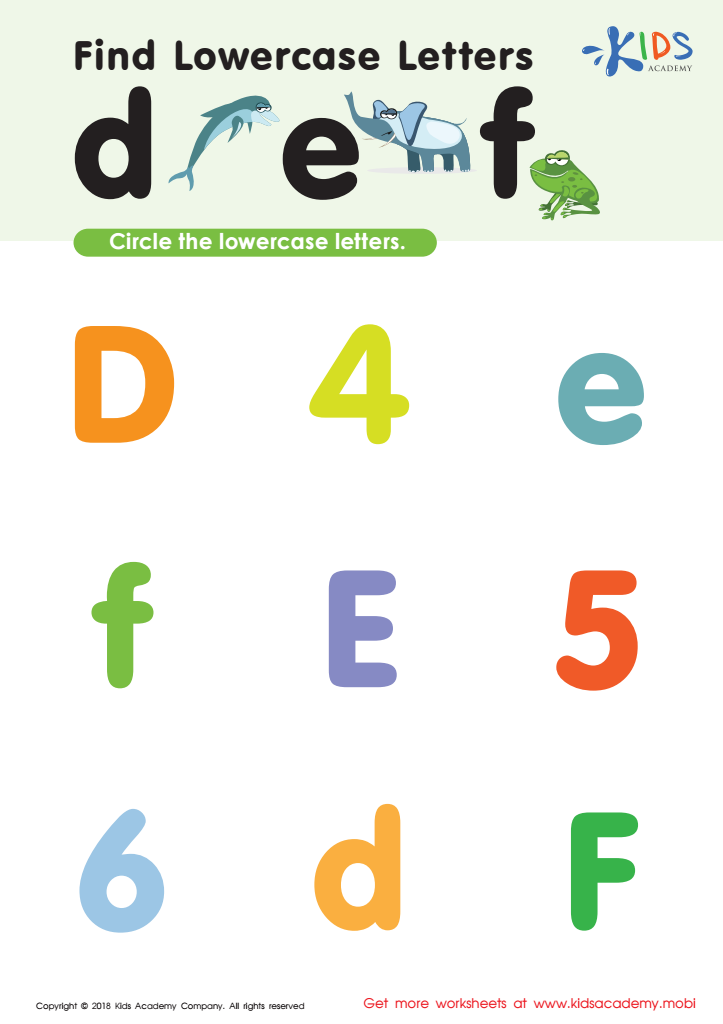
Find Lowercase Letters d e f Worksheet
Engage your child's brain with this fun, colorful worksheet. They'll identify and circle lowercase letters among other numbers and uppercase letters in bright colors. This will keep their attention as they learn, and can be downloaded in PDF form!
 Assign to My Students
Find Lowercase Letters d e f Worksheet
Worksheet
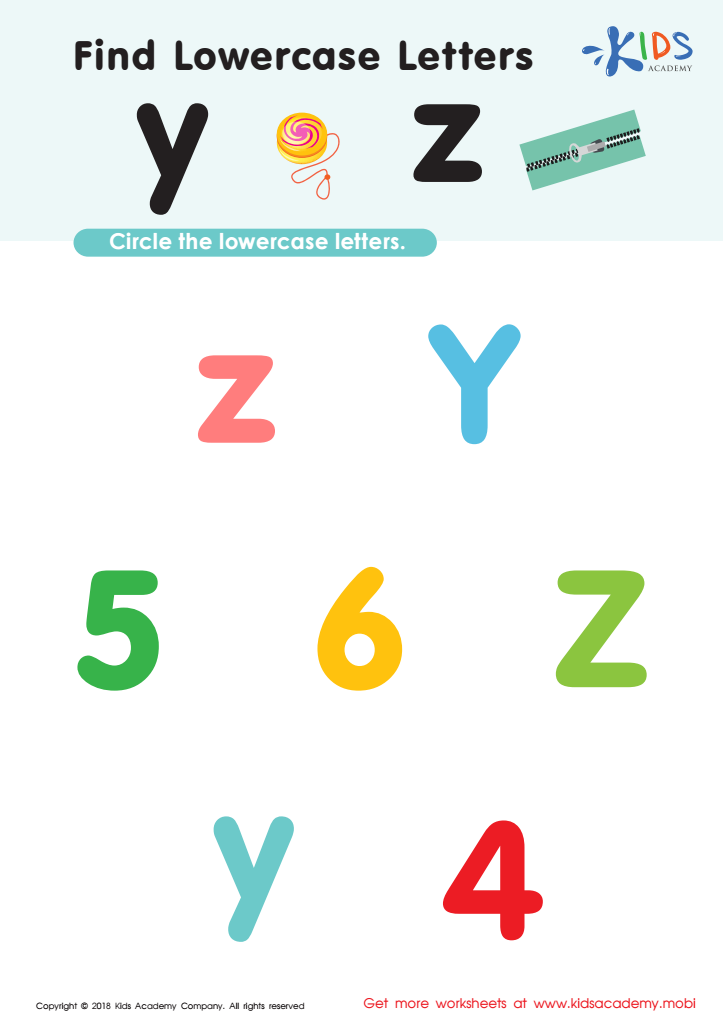
Find Lowercase Letters y z Worksheet
Help your kid learn the alphabet. Before they can move on to words and reading, they must first know the lower and uppercase letters. Show them how to find the letters y and z in this worksheet, which is filled with uppercase letters and numbers. Together, find and circle them.
Find Lowercase Letters y z Worksheet
Worksheet

Find lowercase letters a b c Worksheet
Help your child identify lowercase letters with this worksheet. Carefully look at each letter and have your child circle the lowercase ones. This exercise is vital in helping them understand the alphabet and the difference between lower and uppercase letters.
Find lowercase letters a b c Worksheet
Worksheet
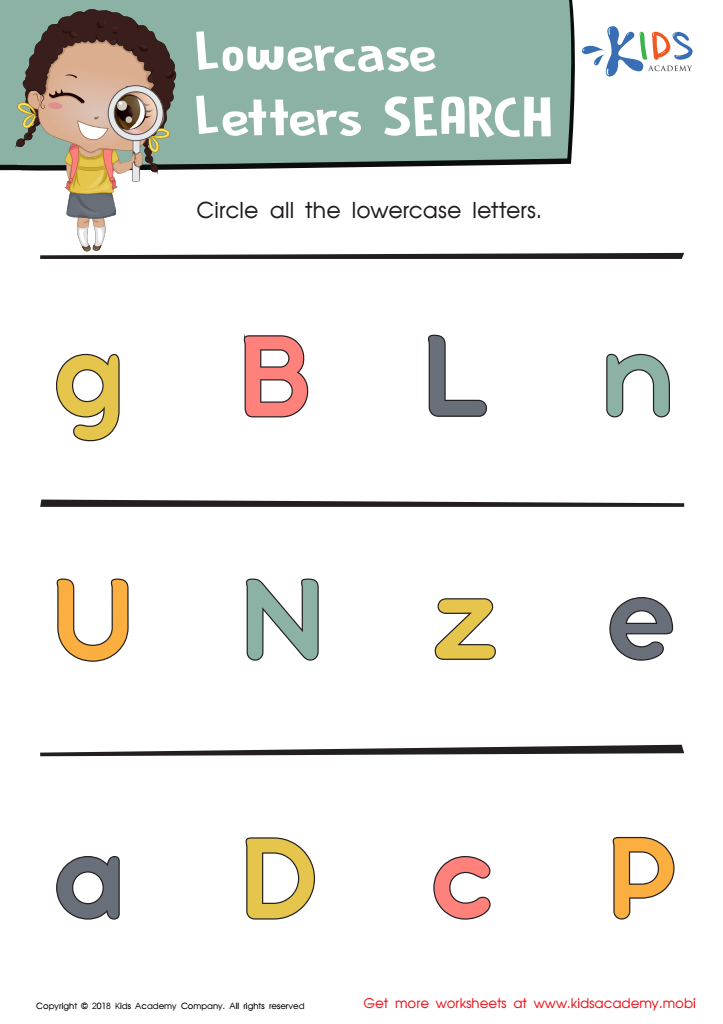
Lowercase Letters Search: Assessment Worksheet
Circle all the lowercase letters in this worksheet. Identify them among a mix of uppercase and lowercase letters. Your child will have fun with this exercise thanks to its bright primary colors. Enjoyment and learning go hand-in-hand!
Lowercase Letters Search: Assessment Worksheet
Worksheet

Find Lowercase Letters v w x Worksheet
If your child doesn't know the alphabet, get them this helpful worksheet. It's an easy exercise to build their understanding of the alphabet and lowercase letters. Find the letters v, w, and x among other uppercase letters and numbers in the downloadable PDF.
Find Lowercase Letters v w x Worksheet
Worksheet
Join Kids Academy for Free
Who is primarily going to use this learning content?







Understanding lowercase letters is crucial for children aged 6-7 as it forms a fundamental part of their literacy development. At this age, children transition from recognizing uppercase letters, often introduced first, to mastering lowercase letters, which are more frequently used in reading and writing. Mastery of lowercase letter identification helps significantly in several key areas.
Firstly, reading fluency is greatly enhanced as the majority of printed text is in lowercase. Being able to quickly and accurately identify these letters enables children to decode words more efficiently, building their reading speed and comprehension.
Secondly, writing skills improve as students need to write in lowercase for almost all daily writing activities. Proper identification of lowercase letters ensures that children can form them correctly, improving their overall handwriting and spelling abilities.
Moreover, early and consistent exposure to lowercase letters bolsters phonemic awareness, a vital component of learning to read. Recognizing the visual differences between 'p' and 'P' or 'b' and 'B' enhances their ability to grasp the sounds each letter represents, which is the cornerstone of phonics.
Lastly, fostering confidence and enthusiasm for reading and writing at this stage builds a positive foundation for future learning. By supporting children in mastering lowercase letters, parents and teachers are helping to set them up for academic success in literacy and beyond.







