
Basic geometry comprehension Worksheets for Ages 6-7
3 filtered results
Difficulty Level
Grade
Age
-
From - To
Subject
Activity
Standards
Unlock the world of shapes and spatial reasoning with our Basic Geometry Comprehension Worksheets designed for ages 6-7. Our engaging activities help young learners understand fundamental geometric concepts, identifying shapes, lines, and angles. Each worksheet is crafted to enhance critical thinking, problem-solving skills, and a love for math. Kids will enjoy colorful, fun exercises, progressing from simple shapes to more complex structures, matching, sorting, and drawing their way to mastery. Whether used at home or in the classroom, these worksheets offer a solid foundation for future math success. Download now to embark on a fascinating geometric adventure!
Favorites
With answer key
Interactive
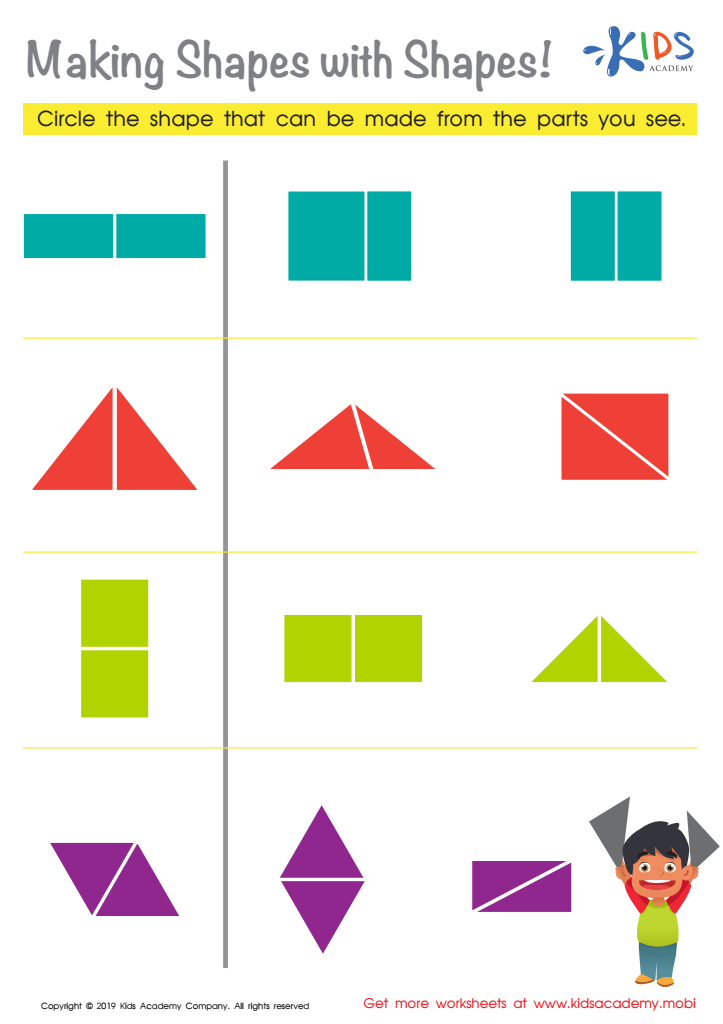
Making Shapes with Shapes Worksheet
Help your kindergartners identify shapes with this simple worksheet. Examine the shapes on the left and have them circle the one they can make from the parts in the picture. Shapes can be tricky, but this exercise will help clear up any confusion.
 Assign to My Students
Making Shapes with Shapes Worksheet
Worksheet
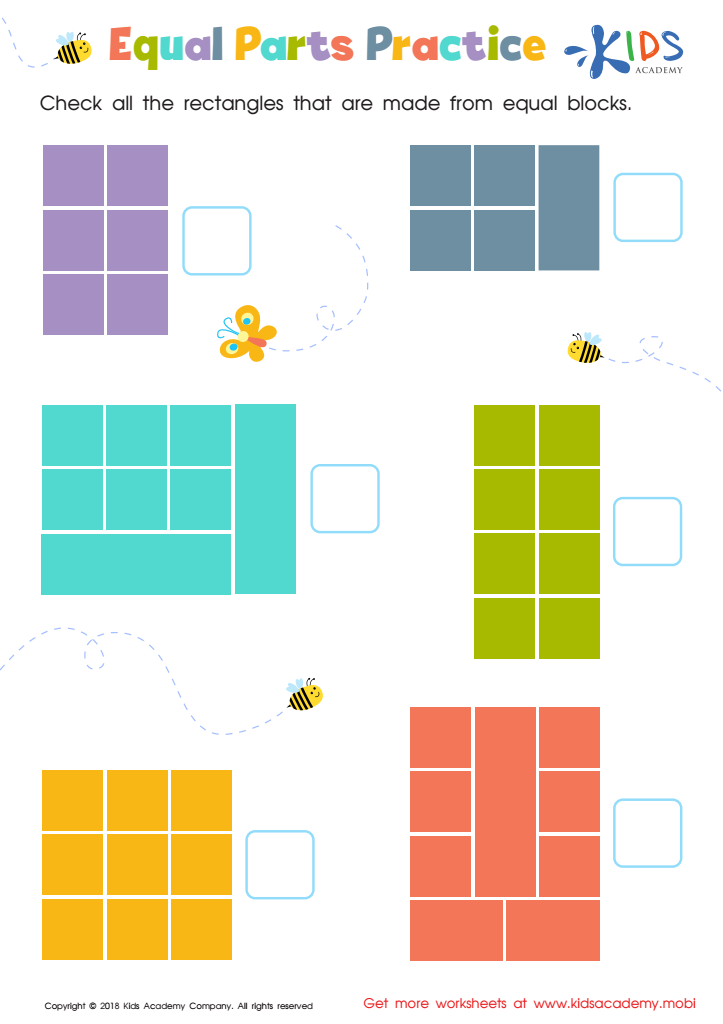
Equal Parts Practice Worksheet
This worksheet checks your child's knowledge of halves and equal pieces. Have them go through the rectangles and check those made up of equal blocks. Your kids should be able to tell which parts are equal and which are not after the exercise.
Equal Parts Practice Worksheet
Worksheet
Join Kids Academy for Free
Who is primarily going to use this learning content?





.jpg)

Basic geometry comprehension is crucial for children aged 6-7 as it lays the foundation for key cognitive and academic skills. At this developmental stage, kids are naturally curious and are developing their spatial awareness and visual perception. Understanding basic geometric concepts like shapes, sizes, patterns, and spatial relations helps them make sense of the world around them.
By learning shapes and their properties, children enhance their ability to recognize and categorize objects, which is essential for logical thinking and problem-solving. These skills translate into better performance in math as geometry is interconnected with number concepts and operations. Additionally, geometric reasoning supports learning in other subject areas, such as science (understanding the shape and structure of objects) and art (recognizing patterns and symmetry).
Engaging with geometry also nurtures fine motor skills; activities like drawing shapes and hands-on manipulation of objects improve hand-eye coordination. It supports language development, as children learn to describe the attributes of different shapes using appropriate vocabulary.
Caring about a child's geometry comprehension from an early age also prepares them for more complex mathematical and scientific concepts they will encounter in later grades. Ultimately, it fosters a well-rounded educational experience, promoting both analytical and creative thinking. Parents and teachers who prioritize geometry help set young learners on a path to academic success and practical problem-solving in real-life situations.








