Observational skills Space Worksheets for Ages 6-7
3 filtered results
-
From - To
Unlock the wonders of the universe with our Observational Skills Space Worksheets for Ages 6-7! Designed to engage young learners, these worksheets provide a fun and interactive way to develop essential observational skills through exciting space-themed activities. Each worksheet encourages children to observe details, identify patterns, and think critically about planets, stars, and celestial phenomena. Ideal for homeschooling or supplemental practice, our worksheets support early science education while fostering curiosity about the cosmos. Perfect for classroom use or at-home learning, these resources are an excellent way to inspire a lifelong love for space exploration. Discover the universe today!
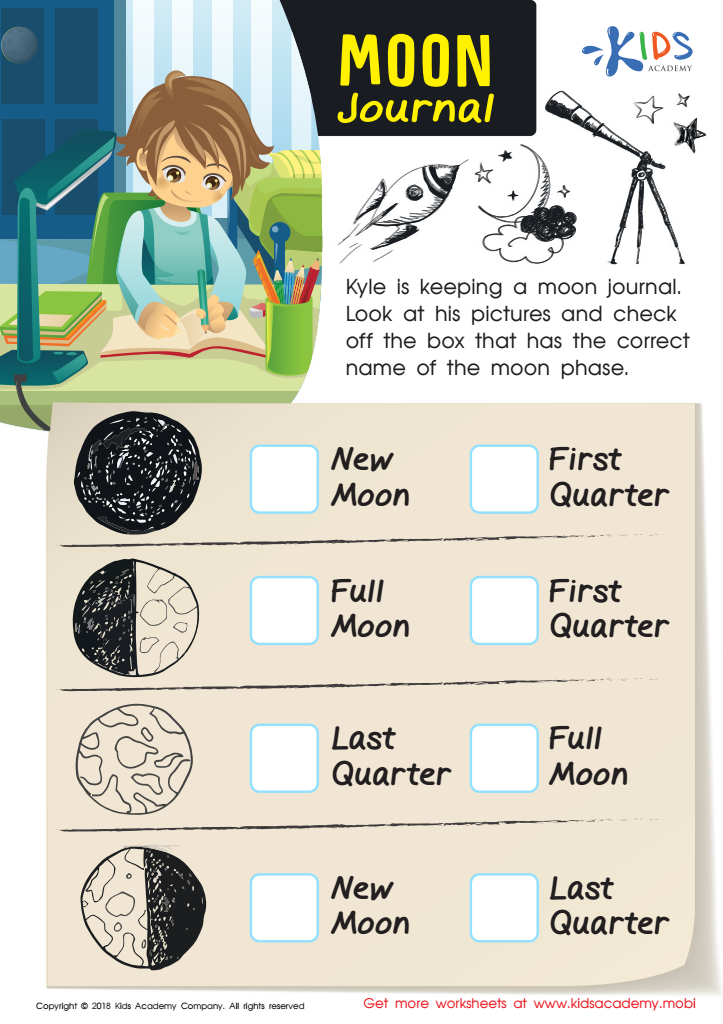
Moon Journal Worksheet
 Assign to My Students
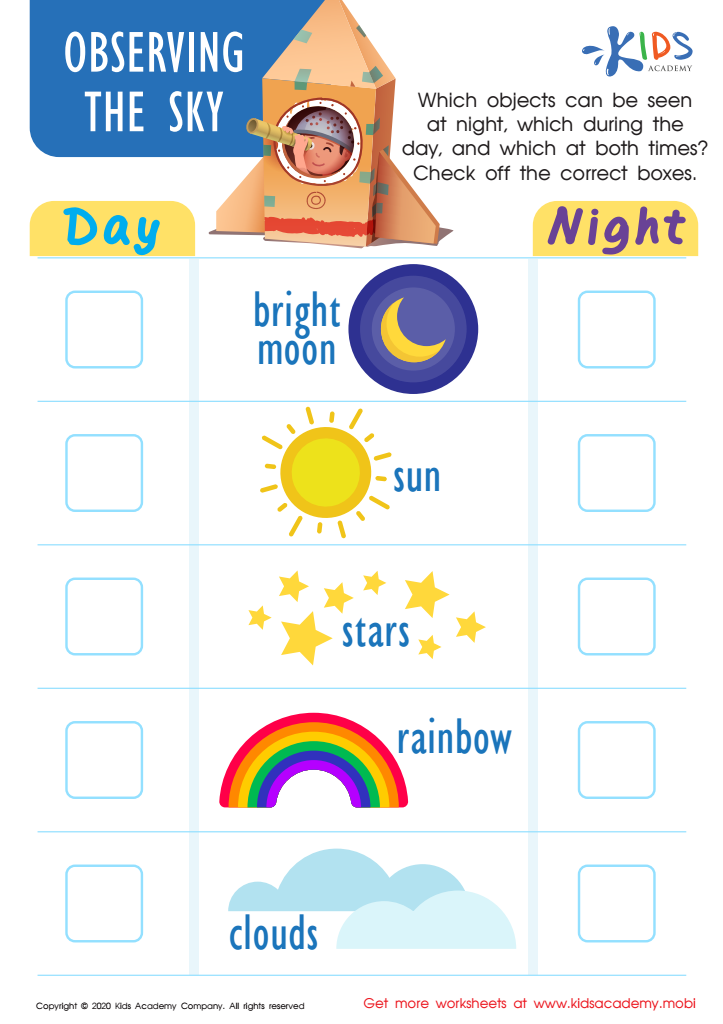
Observing the Sky Worksheet
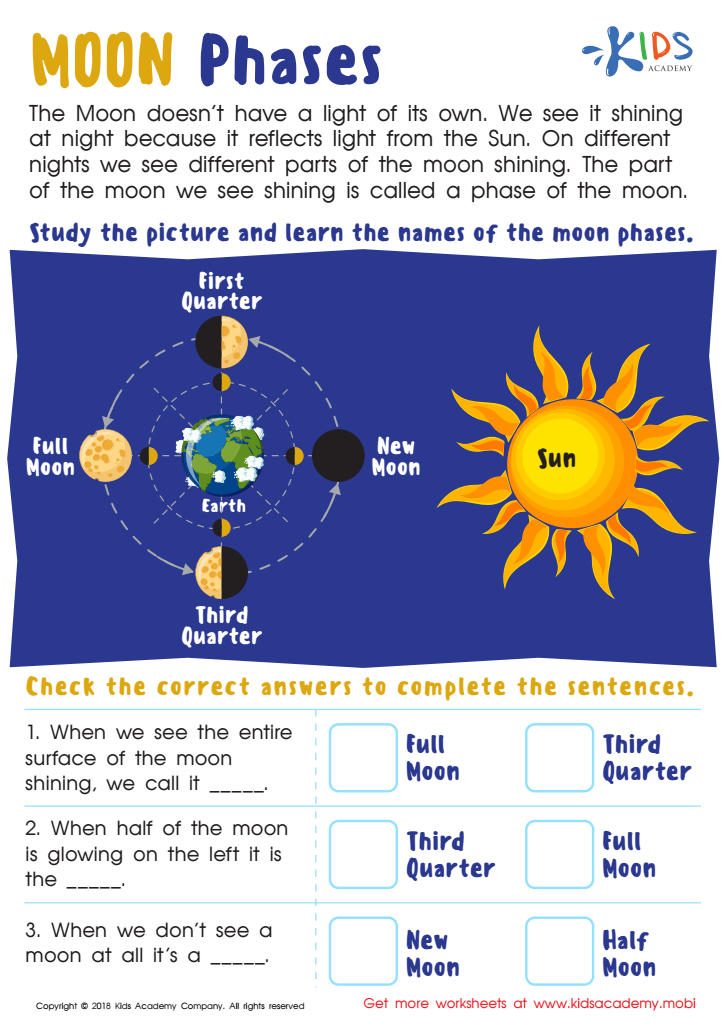
Moon Phases Worksheet




%20(1).jpg)


Observational skills are crucial for children aged 6-7, as they significantly influence learning and development. At this stage, children are naturally curious about the world around them, and honing their observational abilities enhances their capacity to engage with their environment, understand concepts, and develop critical thinking.
For parents and teachers, fostering these skills can lead to improved literacy and numeracy. By encouraging children to observe details in their surroundings, such as shapes, patterns, and colors, they can better grasp mathematical concepts and enhance their vocabulary through descriptive language. Observation allows children to make connections, ask questions, and draw conclusions—a foundational aspect of scientific inquiry.
Furthermore, strong observational skills contribute to emotional and social development. Children learn to read non-verbal cues, fostering empathy and improving their ability to communicate with peers. This evolution helps create interactive learners who are not only capable of taking in information but also of applying it in various contexts.
Incorporating observational activities—whether through nature walks, art projects, or classroom experiments—creates rich learning experiences. Therefore, parents and teachers should actively support observational skill development to equip children for future success in a rapidly changing world.







