
Vowel differentiation Worksheets for Ages 6-8
3 filtered results
Difficulty Level
Grade
Age
-
From - To
Subject
Activity
Standards
Explore our engaging Vowel Differentiation Worksheets designed for ages 6-8 at Kids Academy! These exciting, printable worksheets help young learners distinguish between short and long vowel sounds through fun exercises and activities. Ideal for early readers, our carefully crafted worksheets enhance phonemic awareness and promote confident reading skills. Whether it’s sorting vowels, matching sounds, or playing educational games, children will improve their language proficiency while having fun. Dive into our collection to support your child's literacy journey today. Perfect for use in classrooms or at home, these worksheets make mastering vowels enjoyable and effective!
Favorites
With answer key
Interactive
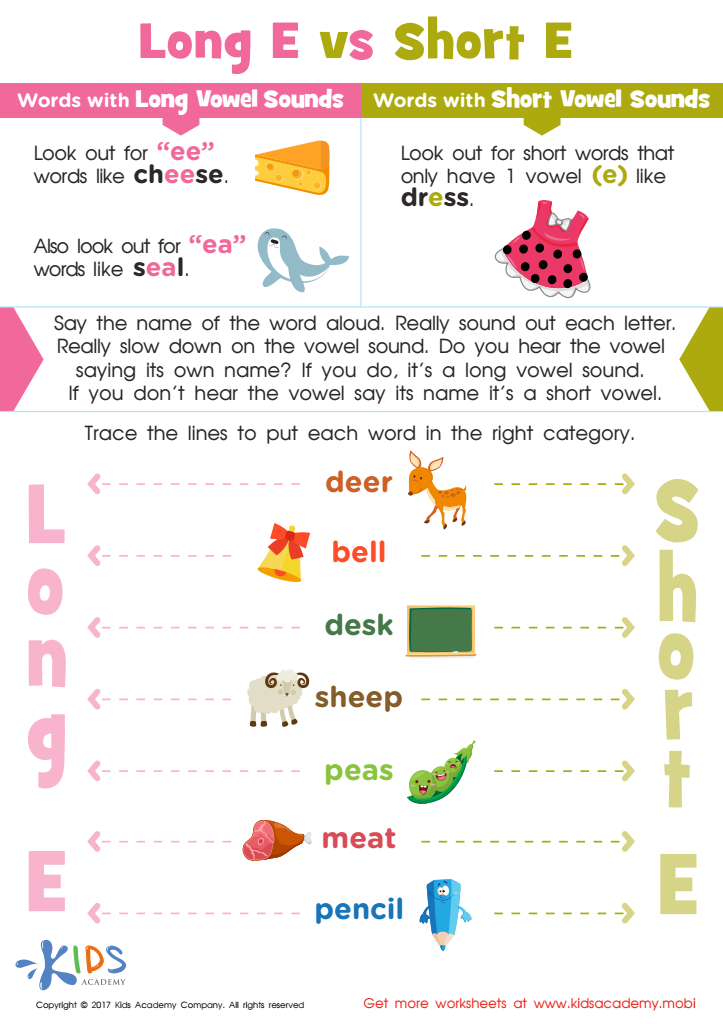
Long and Short Vowel E Spelling Worksheet
This worksheet helps kids master spelling with the letter "E". They read about long and short vowel sounds, view examples and sound out words to complete it. Two vowels distinguish long "E" sounds from its short vowel counterparts with just one.
Long and Short Vowel E Spelling Worksheet
Worksheet
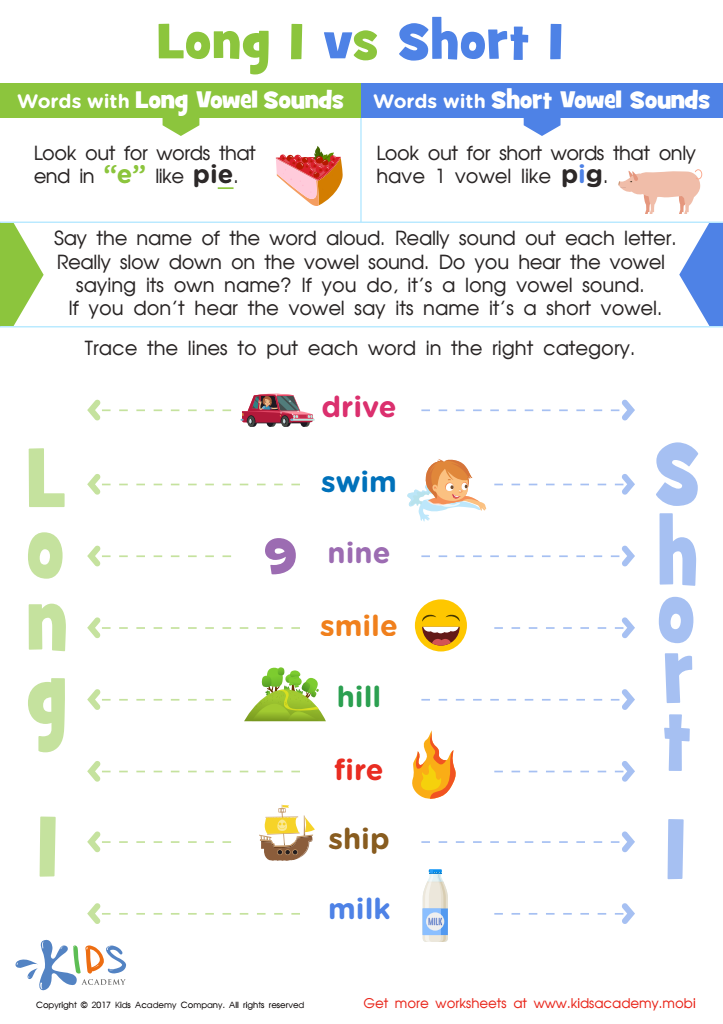
Long and Short Vowel I Spelling Worksheet
When it comes to long "I" sounds, kids should look out for the letter "E" at the end. With examples and sounding out words, kids will improve spelling skills with this long/short "I" worksheet!
Long and Short Vowel I Spelling Worksheet
Worksheet
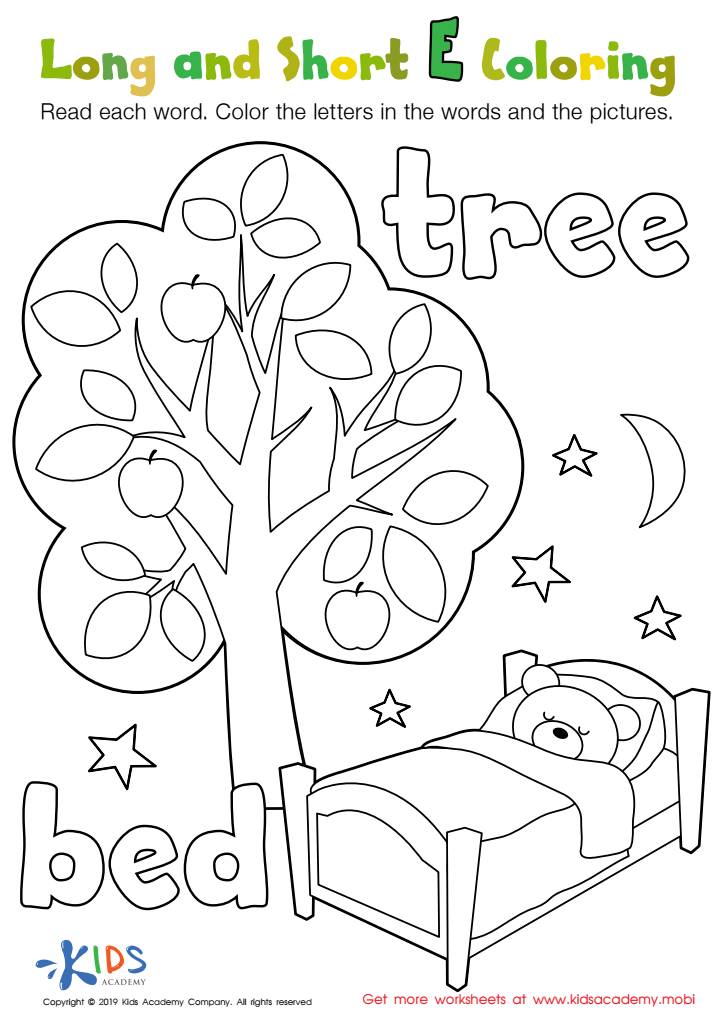
Long and Short E Worksheet
This fun printout makes learning phonics enjoyable for Grade 3 students. Get them to read the words “tree” and “bed” to recognize the different sounds of the letter “E”. After hearing the words they can color the words and the pictures to understand differences between long and short vowels.
Download (PDF)
 Assign to My Students
Assign to My Students
Long and Short E Worksheet
Worksheet
Join Kids Academy for Free
Who is primarily going to use this learning content?








Vowel differentiation is critical for children aged 6-8 as it forms the foundation of reading and writing skills. At this developmental stage, students are typically solidifying their understanding of the alphabet and beginning to decode words. Vowels, which can have multiple sounds (such as short and long forms), play a pivotal role in word formation. An accurate grasp of vowel sounds enables children to pronounce words correctly, which is essential for both reading fluency and comprehension.
For parents and teachers, emphasizing vowel differentiation means setting up young learners for academic success. Early difficulties with vowels can lead to challenges in reading speed, word recognition, and ultimately, confidence in reading. Mastery of vowel sounds can also enhance spelling and writing skills, as children will be able to construct words accurately, reflecting their phonetic awareness. Activities like reading aloud, phonics games, and vowel-focused exercises can make learning engaging and effective.
Moreover, early literacy skills are predictive of future academic achievement. Strong reading skills gained through proper vowel differentiation can have long-term educational benefits, helping children excel not just in language arts, but across all subjects requiring reading. Therefore, focusing on vowel differentiation during the early grades is a small investment with significant returns for a child's educational journey.








