Understanding fact families Addition Worksheets for Ages 6-8
4 filtered results
-
From - To
Discover the pivotal concept of fact families with our "Understanding Fact Families Addition Worksheets" for ages 6-8. These engaging worksheets help young learners master the relationship between addition and subtraction, with clear, interactive exercises that demystify math. By recognizing how numbers within a family relate, children enhance their problem-solving skills and build a solid arithmetic foundation. Worksheets feature visually appealing designs tailored to captivate and educate, ensuring that learning math is fun. Ideal for parents and teachers, our resources promote confidence in kids, preparing them for advanced mathematical concepts. Support your child's journey to becoming a math whiz today!
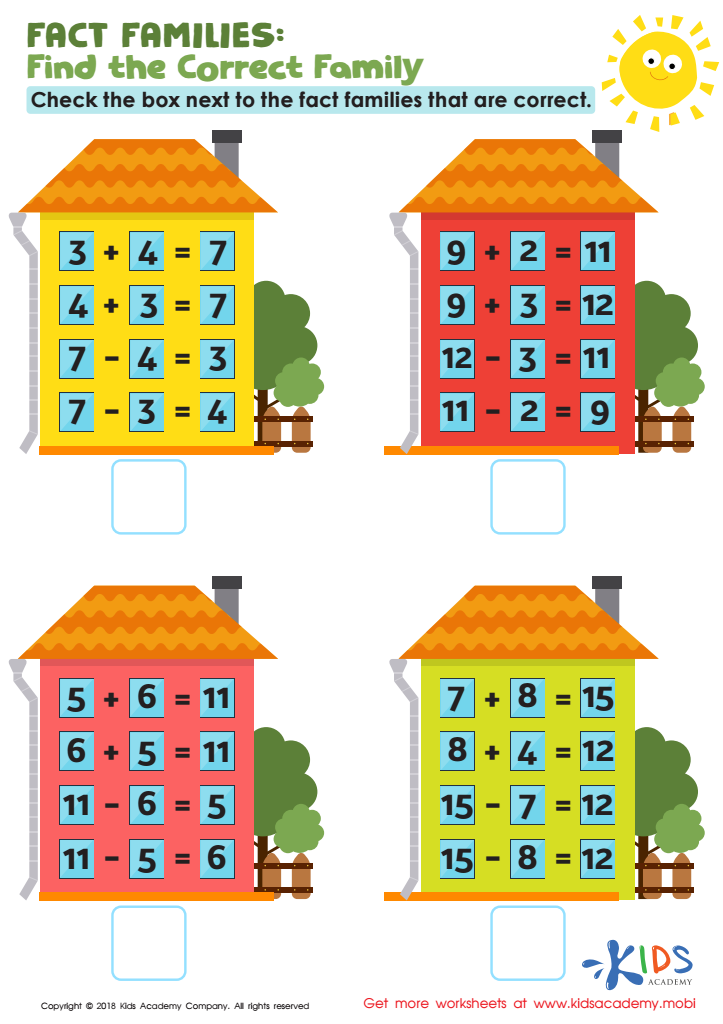
Fact Families: Find Correct Family Worksheet
 Assign to My Students
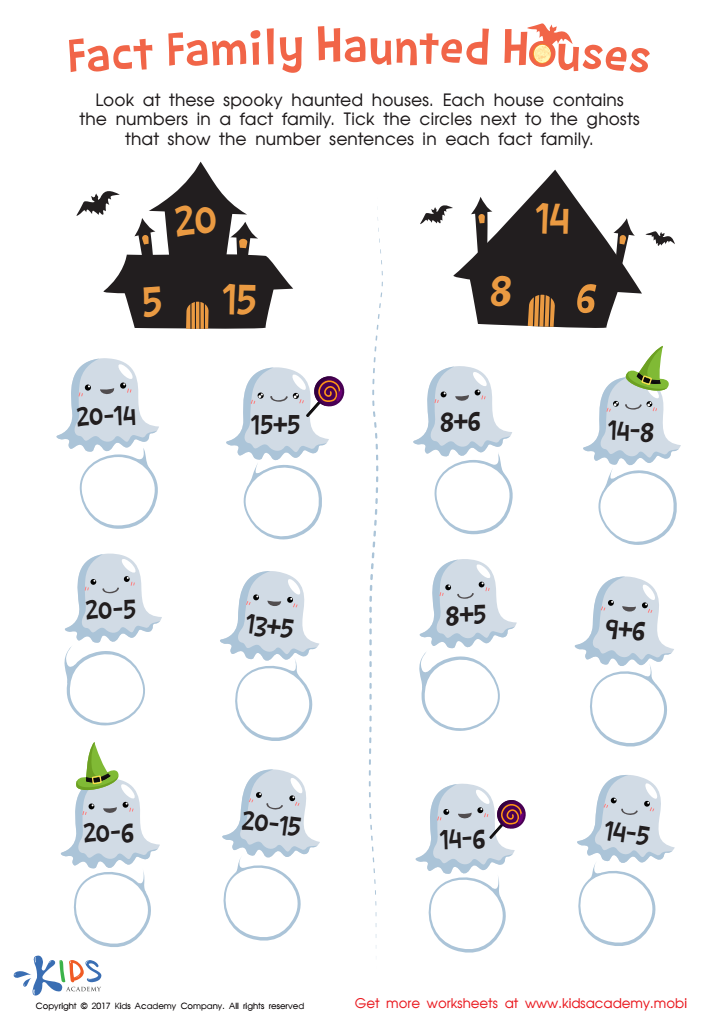
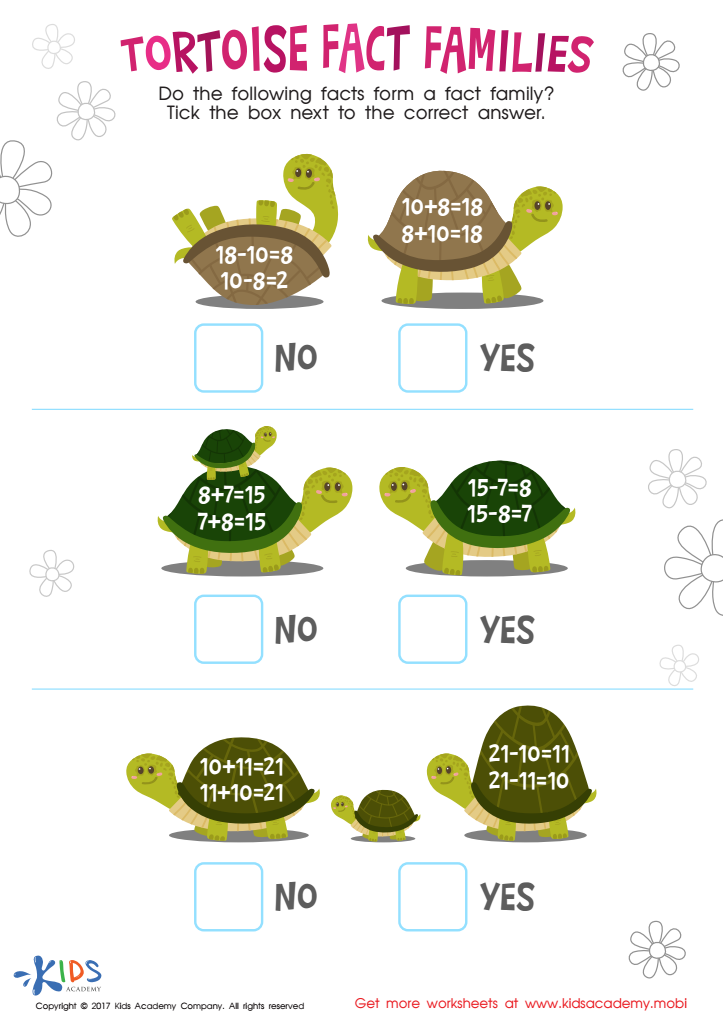
Tortoise Fact Families Printable
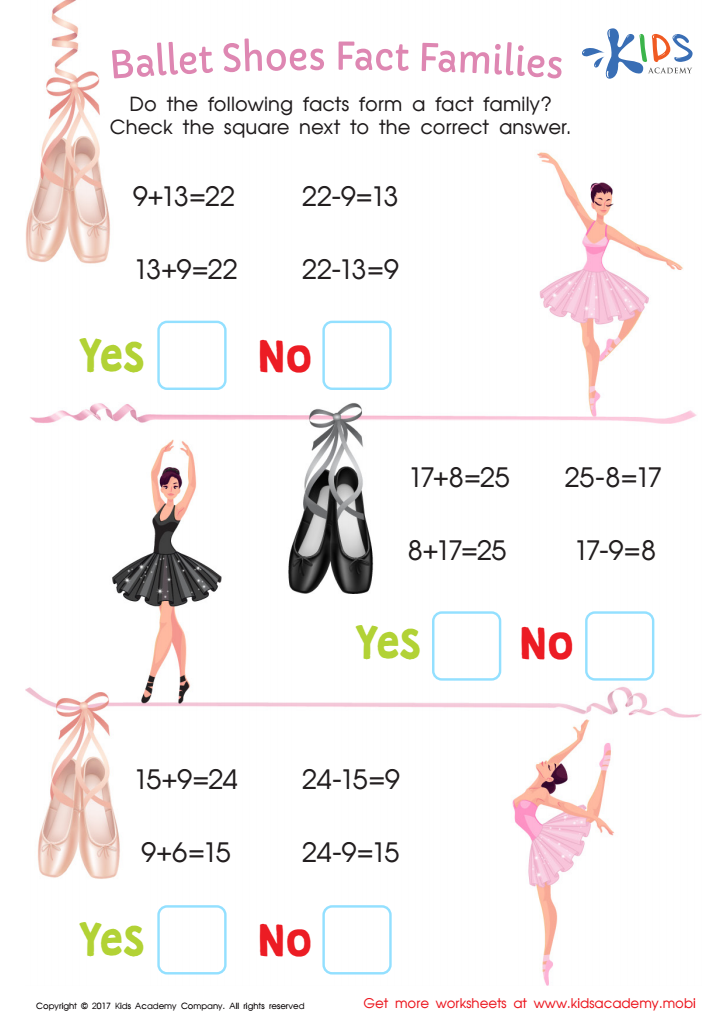
Ballet Shoes Fact Family Printable








Understanding fact families in addition is crucial for children aged 6-8 because it builds a strong foundation for their mathematical learning. Fact families are sets of related addition and subtraction facts, showing the relationship between numbers. For instance, if a child knows that 3 + 4 = 7, they can also understand that 4 + 3 = 7, 7 - 3 = 4, and 7 - 4 = 3. This interconnectedness deepens their conceptual understanding of how numbers work together.
When parents and teachers emphasize fact families, they help children see patterns and relationships in math, which promotes number sense and mental arithmetic skills. This foundational knowledge makes it easier for children to tackle more complex math problems later, such as multiplication and division facts. Additionally, understanding fact families enhances a child's confidence, as they realize they can solve multiple related problems from a single set of facts.
Moreover, grasping these relationships helps children with problem-solving skills. They learn that numbers are flexible and that there are different ways to approach a problem, fostering critical thinking. Given that math is a cumulative subject where each new concept builds on the previous ones, ensuring that children have a robust understanding of fact families in addition at an early age is vital for their ongoing success in mathematics.








