
Visual perception improvement Geometry Worksheets for Ages 6-8
3 filtered results
Difficulty Level
Grade
Age
-
From - To
Subject
Activity
Standards
Enhance your child's visual perception skills with our engaging Geometry Worksheets, specifically designed for ages 6-8. These worksheets encourage children to recognize shapes, patterns, and spatial relationships, fostering critical thinking and problem-solving abilities. Through interactive activities, kids will develop their cognitive skills while having fun exploring the world of geometry. Our resources combine colorful visuals with hands-on exercises, making learning enjoyable and effective. Perfect for classroom use or at-home practice, these worksheets promote essential skills that form the foundation for future math success. Help your child thrive in mathematics with our tailored approach to visual perception improvement!
Favorites
With answer key
Interactive
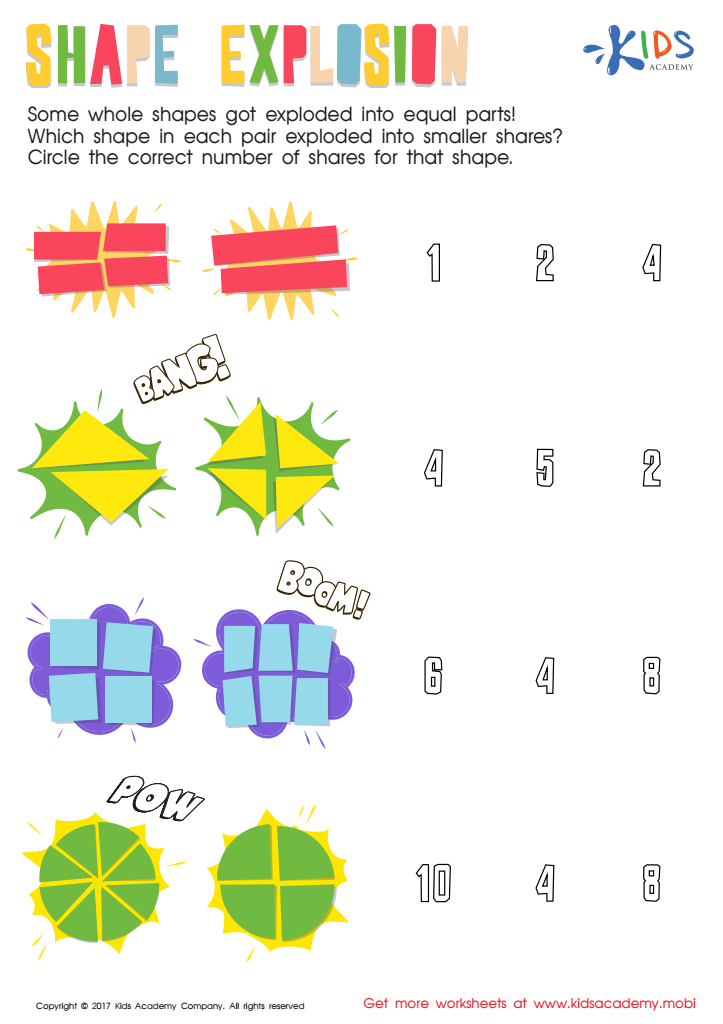
Shape Explosion Worksheet
This worksheet shows students how some shapes explode into two or more equal parts. On the left side are four shapes, each splitting into two or more parts. Ask your child to point out which shape has the smaller share, and help them circle the correct number of shares.
 Assign to My Students
Shape Explosion Worksheet
Worksheet











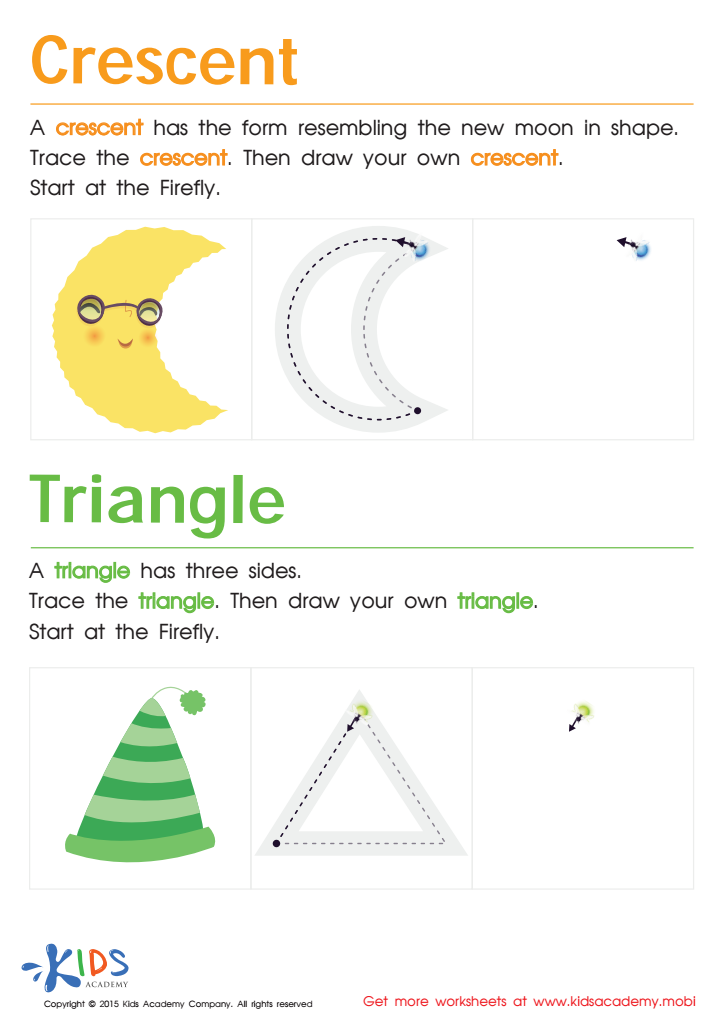
Learning to Draw Crescents And Triangles Worksheet
Help your kids draw a crescent and triangle with this free printable worksheet! Start by tracing a crescent in the form of the new moon, and then teach them that a triangle has three sides and looks like a hat. Find more geometry practice worksheets at Kids Academy!
Learning to Draw Crescents And Triangles Worksheet
Worksheet
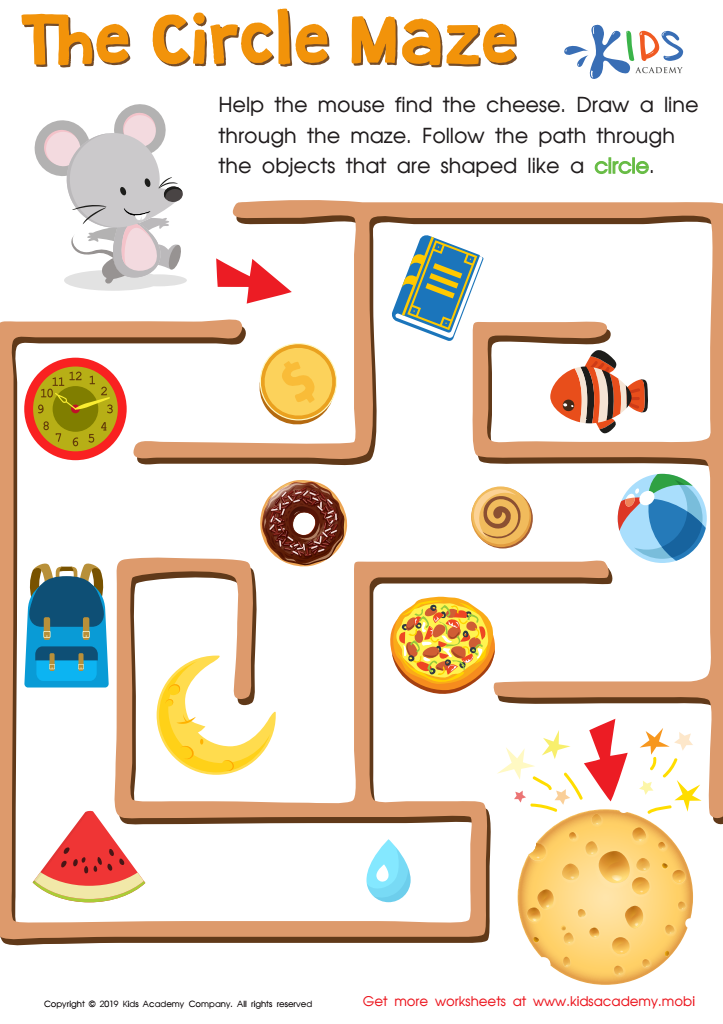
The Circle Maze Worksheet
Kids can have fun learning shapes with this maze worksheet. They can help the mouse find its cheese by tracing the path of a circle through the maze. This printable is great for classroom learning or as an activity at home.
The Circle Maze Worksheet
Worksheet
Join Kids Academy for Free
Who is primarily going to use this learning content?








Visual perception is crucial for children's overall development, particularly in geometry. For ages 6-8, this skill helps kids make sense of the world around them, aiding in tasks such as recognizing shapes, understanding spatial relationships, and developing problem-solving abilities. Enhanced visual perception strengthens cognitive skills, which are foundational for mathematical reasoning and academic success.
Teachers and parents should prioritize visual perception improvement in geometry for several reasons. First, this age group is in a critical developmental stage where they build essential skills that influence future learning. By focusing on geometric concepts, children learn to classify shapes, identify patterns, and make connections between visual and abstract representations.
Moreover, strong visual perception skills contribute to improved attention, memory, and coordination, significantly benefiting a child's performance across subjects. Incorporating engaging activities, such as puzzles and hands-on spatial tasks, effectively establishes a strong geometric foundation.
Ultimately, emphasizing visual perception in geometry equips children with the tools they need for higher-order thinking, boosting their confidence and enthusiasm in mathematics and beyond. As parents and teachers support these endeavors, they help shape well-rounded learners prepared to tackle more complex challenges in their academic journeys.








