
Comparing lengths Numbers Worksheets for Ages 6-8
4 filtered results
Difficulty Level
Grade
Age
-
From - To
Subject
Activity
Standards
Discover engaging "Comparing Lengths" worksheets designed for children ages 6-8! Our fun and interactive printables help young learners develop essential measuring skills by comparing the lengths of various objects. Through colorful visuals and relatable scenarios, kids enhance their understanding of concepts such as longer, shorter, and equal lengths. These worksheets are ideal for both classroom and home learning, fostering critical thinking and problem-solving abilities. Encourage your child to explore measurements while building confidence in math! Download our free "Comparing Lengths" worksheets today, and support your child's growth in this essential foundational skill in an enjoyable way!
Favorites
With answer key
Interactive
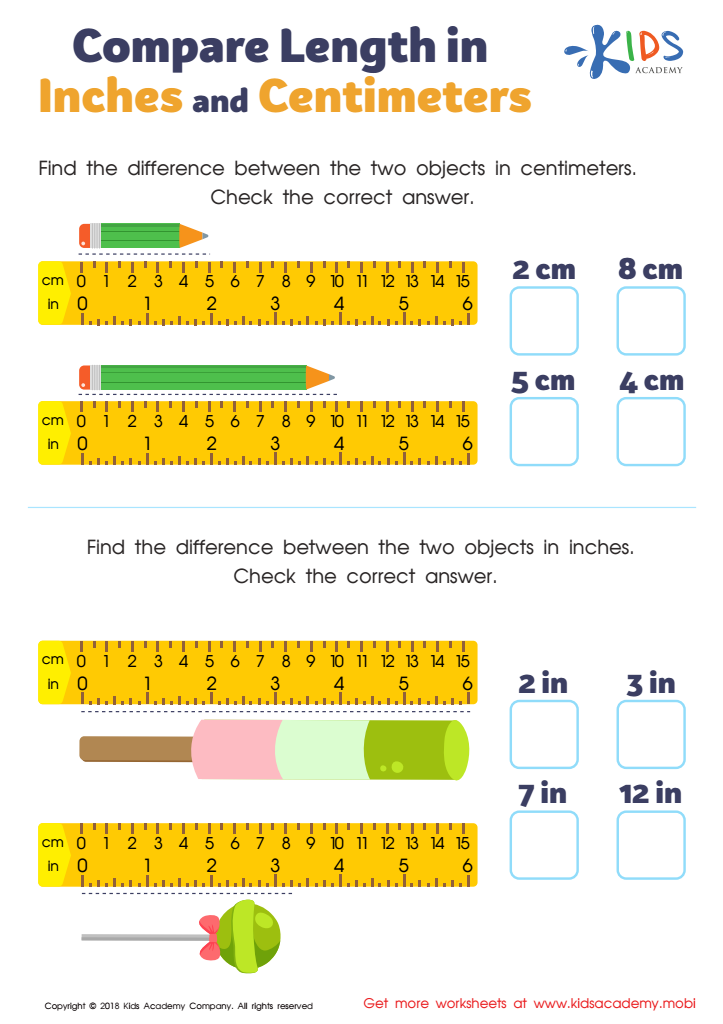
Compare Length in Inches and Centimeters Worksheet
This worksheet has your child measuring objects in both centimeters and inches. The first task requires measuring both objects in centimeters, then finding their difference. The second task is the same but in inches.
 Assign to My Students
Compare Length in Inches and Centimeters Worksheet
Worksheet
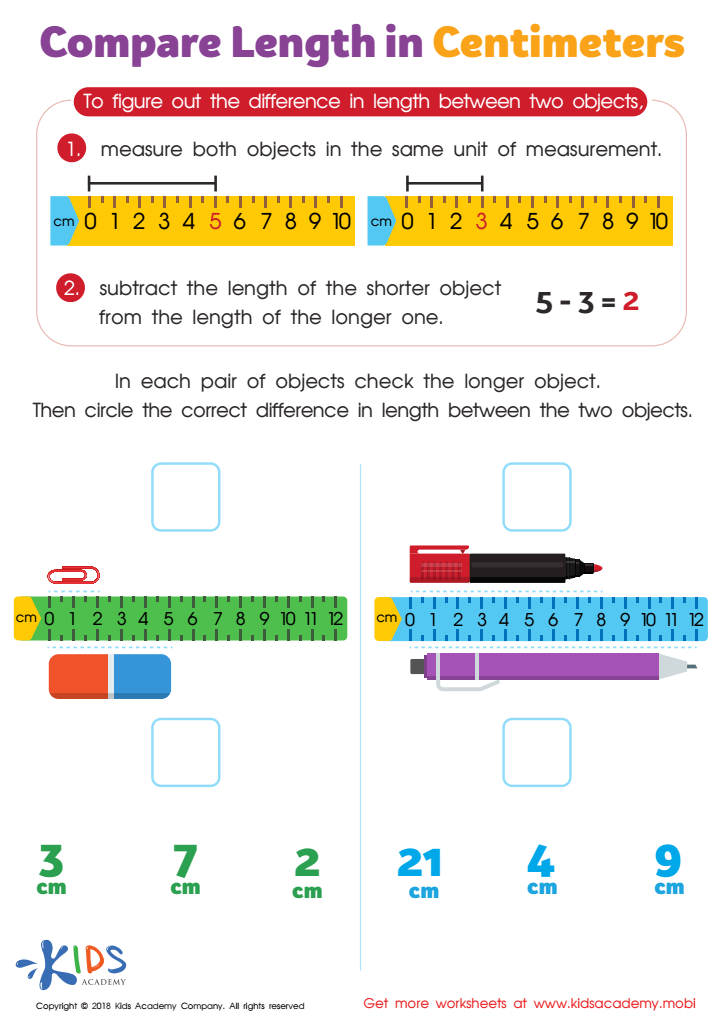
Compare Length in Centimeters Worksheet
To do this worksheet, your child needs to be able to measure accurately, add and subtract. They must measure both items and subtract the shorter from the longer to work out the difference in length.
Compare Length in Centimeters Worksheet
Worksheet
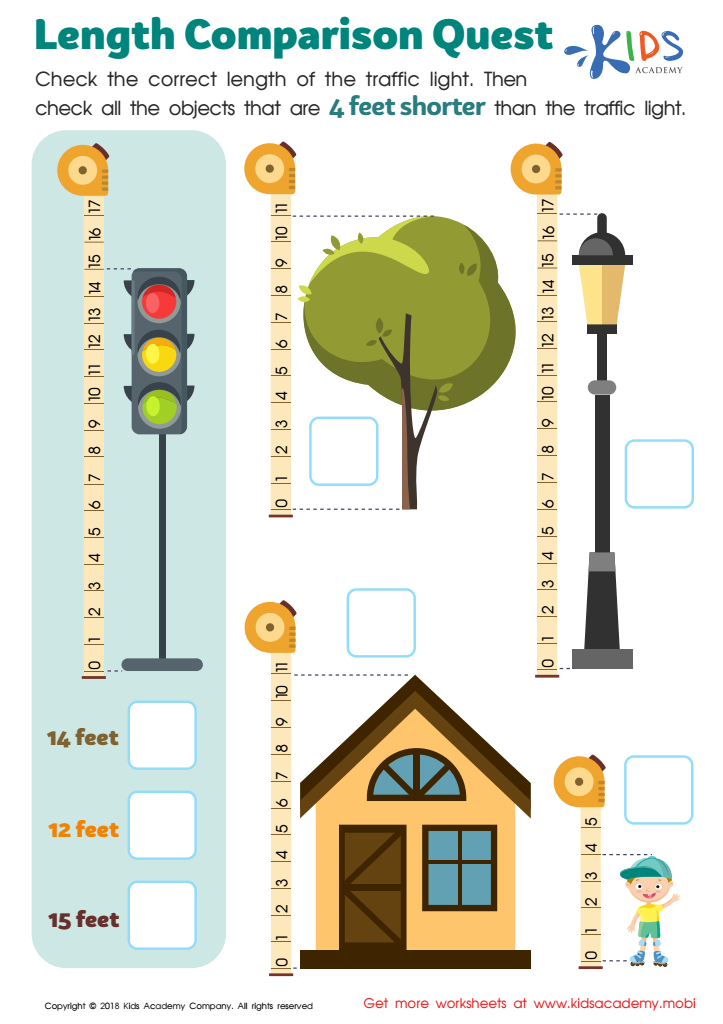
Length Comparison Quest Worksheet
Knowing measurement tools and how to use them is just the start. To be proficient, your kid must be able to accurately compare objects and their lengths. With the 'Length Comparison Quest' worksheet, they will check the correct length of the traffic light in the picture and then compare other objects to it, marking those that measure 4 feet shorter.
Length Comparison Quest Worksheet
Worksheet
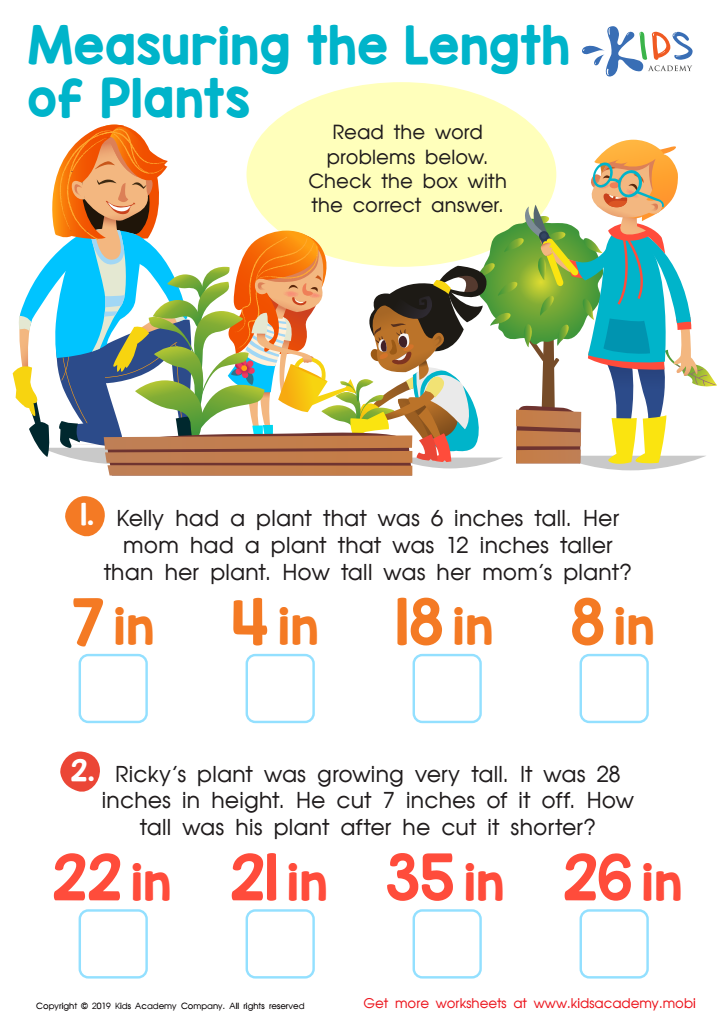
Measuring the Length of Plants Worksheet
Help your kids practice their math skills with this worksheet. Read the word problems in the picture and help them check the correct box. Word problems are equations written in sentence form, so they must be interpreted and understood to be solved correctly.
Measuring the Length of Plants Worksheet
Worksheet
Join Kids Academy for Free
Who is primarily going to use this learning content?








Comparing lengths using numbers is a fundamental skill for children ages 6-8, and it’s essential for both parents and teachers to foster this understanding. Firstly, this skill cultivates critical thinking and problem-solving abilities. When children measure and compare lengths, they learn to analyze data, make estimations, and justify their reasoning—skills that are transferable to various subjects and daily life.
Moreover, comparing lengths supports the development of spatial awareness, which is crucial for mathematical proficiency. Children begin to understand concepts such as “longer” and “shorter,” which lays the groundwork for future geometric understanding and helps in other math skills, including addition and subtraction.
From a practical perspective, measuring and comparing lengths is valuable in everyday situations, such as cooking or crafting, where precise measurements are essential. It equips children with practical skills they can use in real-world contexts.
Additionally, this practice encourages an interest in measurement and mathematics, helping to foster a positive attitude towards these subjects. Parents and teachers who actively engage in these learning experiences can connect with children's curiosities, making math not only educational but also fun and relevant to their lives. Thus, supporting their growth in this area is beneficial for their overall cognitive development.








