Building vocabulary Math Worksheets for Ages 6-8
3 filtered results
-
From - To
Discover our engaging "Building Vocabulary Math Worksheets" designed specifically for children ages 6-8! These worksheets seamlessly blend math and language skills, helping young learners expand their vocabulary while mastering essential math concepts. From basic addition and subtraction to understanding mathematical terms and problem-solving language, our resources encourage critical thinking and fluency. Each worksheet is crafted to be visually appealing, interactive, and age-appropriate, ensuring that learning is fun and effective. Perfect for classroom use or at-home practice, these worksheets provide a strong foundation in both mathematics and vocabulary, setting children on the path to academic success. Start building essential skills today!
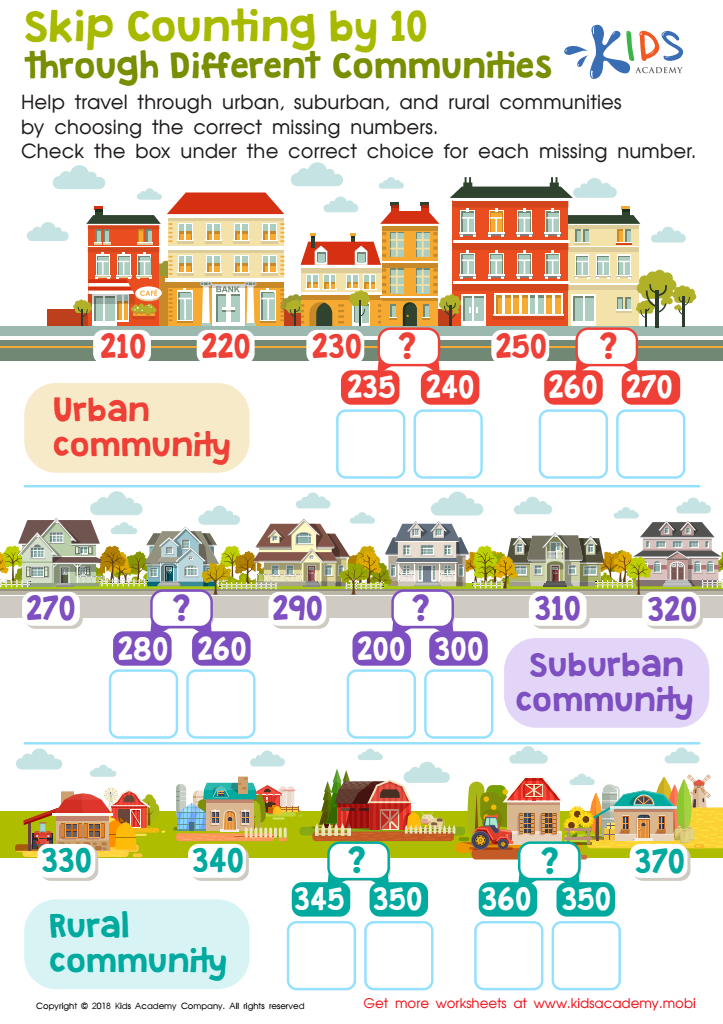
Skip Counting by 10 through Different Communities Worksheet
 Assign to My Students






.jpg)

Building vocabulary in math for ages 6-8 is crucial for several reasons. First, young children's understanding of mathematical concepts often hinges on their vocabulary. Words like "sum," "difference," "greater than," and "fraction" are integral to grasping basic arithmetic and broader mathematical concepts. Without a strong foundational vocabulary, children may struggle to express their understanding, inhibiting their problem-solving abilities and overall confidence.
Additionally, a rich math vocabulary fosters critical thinking. By learning specific terms, children can better articulate their thought processes, ask questions, and explain their reasoning to others. This foundation not only aids in understanding current material but also prepares them for more advanced concepts they will encounter later in their education.
Furthermore, engaging parents and teachers in this initiative strengthens collaborative learning. When both parties emphasize vocabulary in math, it creates a consistent environment that promotes mastery. This team approach allows children to reinforce what they've learned at school at home, making learning more effective.
Ultimately, building a strong math vocabulary in early education lays the groundwork for future academic success, enhances cognitive skills, and cultivates a lifelong interest in mathematics. By prioritizing vocabulary development, parents and teachers empower children to become confident, proficient learners.








