Identify shapes Math Worksheets for Ages 6-8
11 filtered results
-
From - To
Explore our engaging Identify Shapes Math Worksheets tailored for children aged 6-8! These carefully crafted activities help young learners recognize and differentiate various geometric shapes. Bursting with colorful and interactive exercises, our worksheets enhance critical thinking and visual-spatial skills. Kids will enjoy tracing, matching, and drawing shapes while progressing through increasingly challenging tasks. Perfect for both classroom and home use, these worksheets align with educational standards to ensure your child builds a solid foundation in geometry. Foster your child's mathematical confidence and make learning fun with our delightful Identify Shapes Math Worksheets!
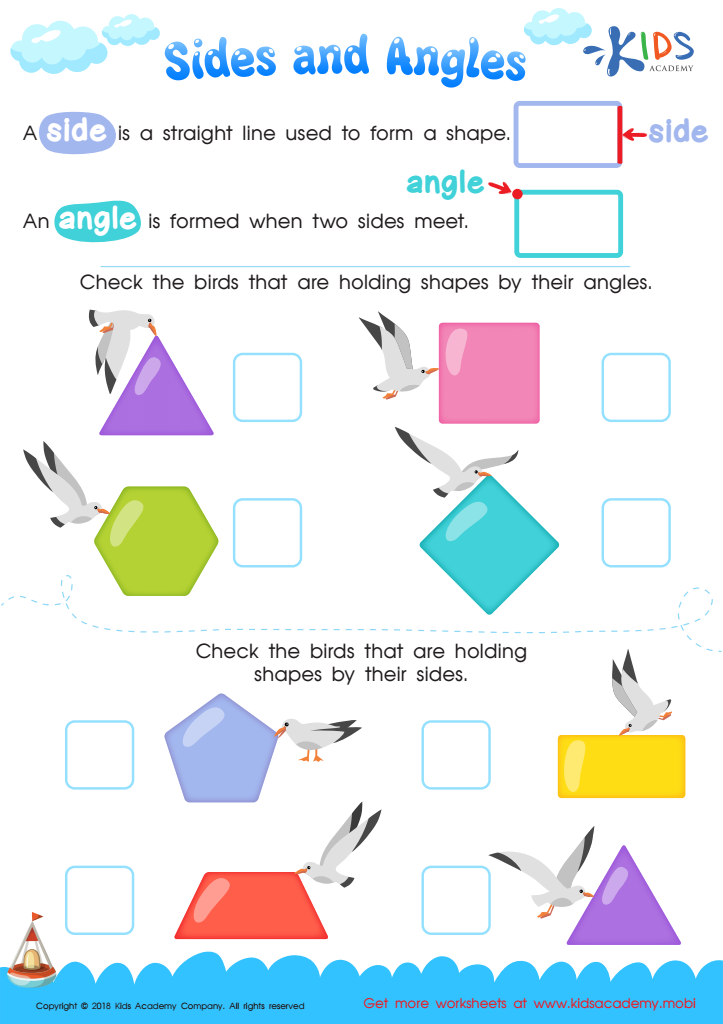
Sides and Angles Worksheet
 Assign to My Students






Understanding shapes is a fundamental part of early education for children aged 6-8. This skill is essential as it lays the groundwork for more complex mathematical concepts and improves cognitive development. Recognizing and identifying shapes helps children develop spatial awareness, which is crucial for understanding the relationships between different objects and navigating the world around them.
Studying shapes also enhances critical thinking and problem-solving skills. When children learn to differentiate and categorize shapes, they begin to understand patterns and make sense of how different elements fit together. This analytical skill is invaluable not just in mathematics but across various disciplines and daily tasks.
Additionally, an early understanding of shapes is directly linked to reading and writing. For example, distinguishing between a circle and a square can translate into recognizing the different forms of letters and numbers, which is essential for literacy.
Moreover, engaging with shapes can be fun and creative, tapping into children's natural curiosity. Activities involving shapes can be integrated into games, art, and physical activities, making learning enjoyable and diverse. By caring about and nurturing a child’s ability to identify shapes, parents and teachers are setting a strong foundation for future learning, making education a positive and rewarding experience.








