
Spatial awareness Reading Worksheets for Ages 6-8
4 filtered results
Difficulty Level
Grade
Age
-
From - To
Subject
Activity
Standards
Enhance your child's reading skills and spatial awareness with our expertly crafted Spatial Awareness Reading Worksheets for Ages 6-8. These engaging worksheets, designed by educational professionals, help young learners develop crucial spatial reasoning skills while cultivating their love for reading. Each activity integrates reading comprehension with fun, hands-on exercises that stimulate cognitive growth and visual perception. Perfect for both classroom and at-home practice, these worksheets feature colorful, appealing layouts and age-appropriate content that captures kids’ interest. Boost your child’s academic confidence and skills with our comprehensive worksheets, designed to make learning both enjoyable and effective.
Favorites
With answer key
Interactive
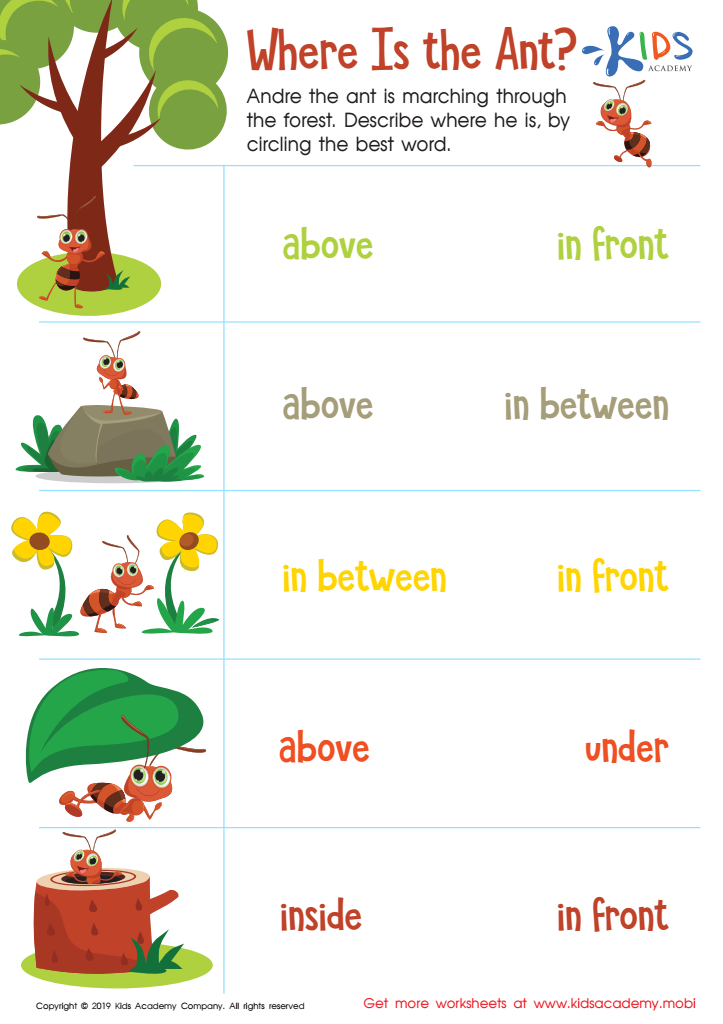
Where Is the Ant? Worksheet
Kids are captivated by ants. Andre is a busy ant, marching through the forest. Help your child circle the best word that best describes what he's doing in each picture. This colorful printout will show them the way.
 Assign to My Students
Where Is the Ant? Worksheet
Worksheet
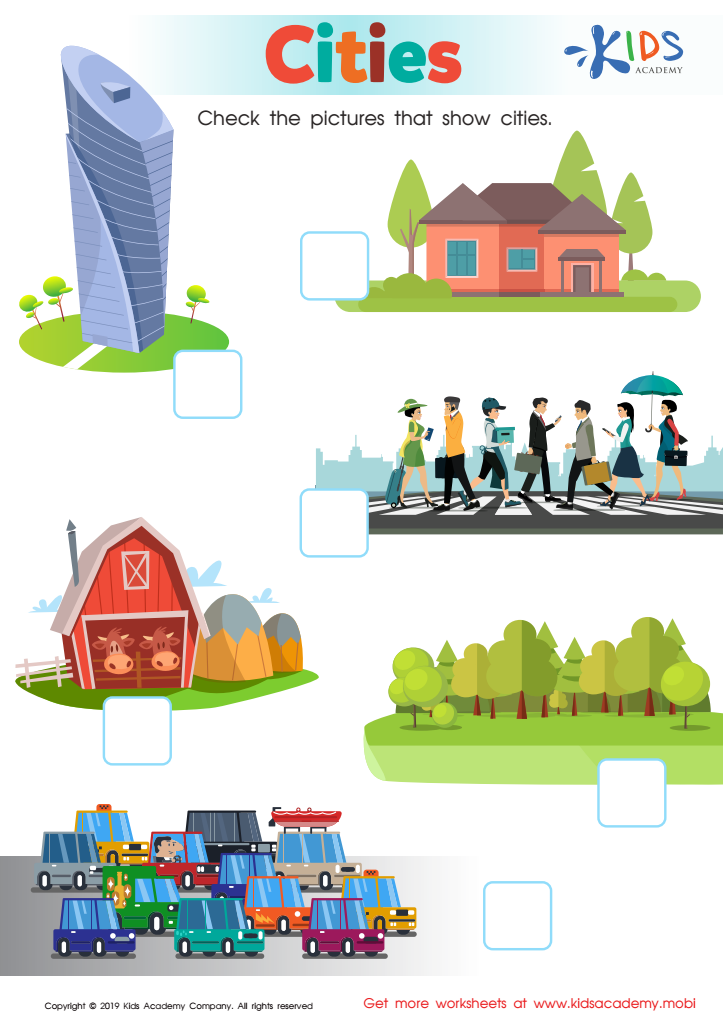
Cities Worksheet
This social studies PDF introduces kids to the differences between cities and towns. Colorful imagery helps them to distinguish between the two; for example, cities have traffic, business people and skyscrapers, while suburbs and rural areas do not. This allows children to have a reference point for what makes cities unique.
Cities Worksheet
Worksheet
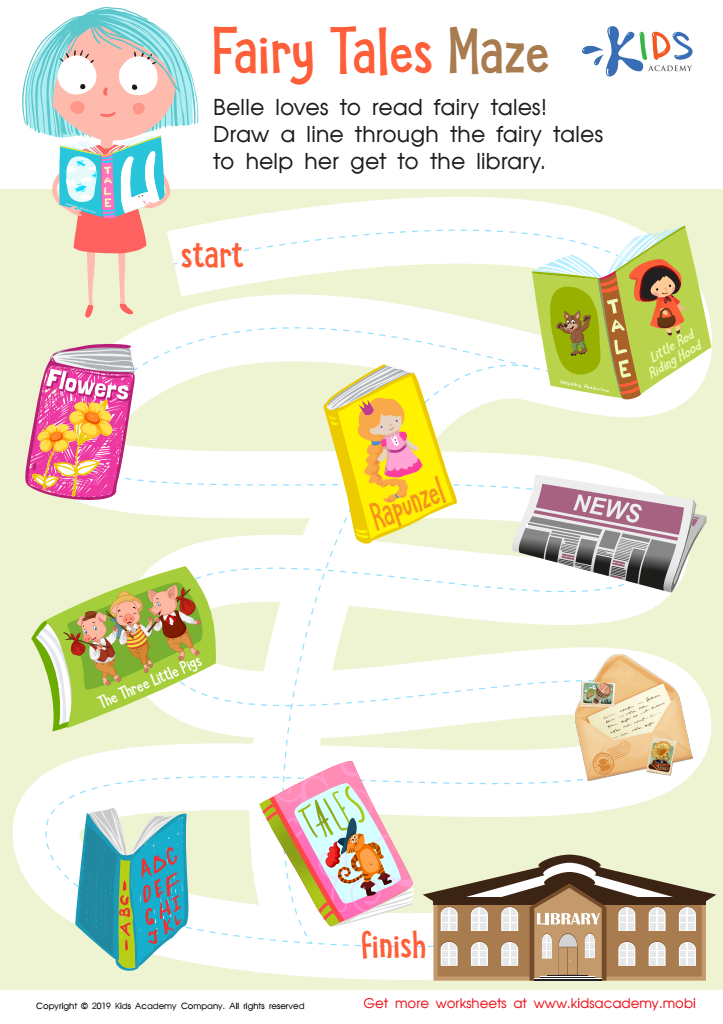
Fairy Tales Maze Worksheet
Kids love mazes and fairy tales, so this free worksheet is a great way to help teach young readers about familiar topics. They'll join Bella and use the traceable lines to travel through different reading genres, and find their way to the library for a nice reward!
Fairy Tales Maze Worksheet
Worksheet
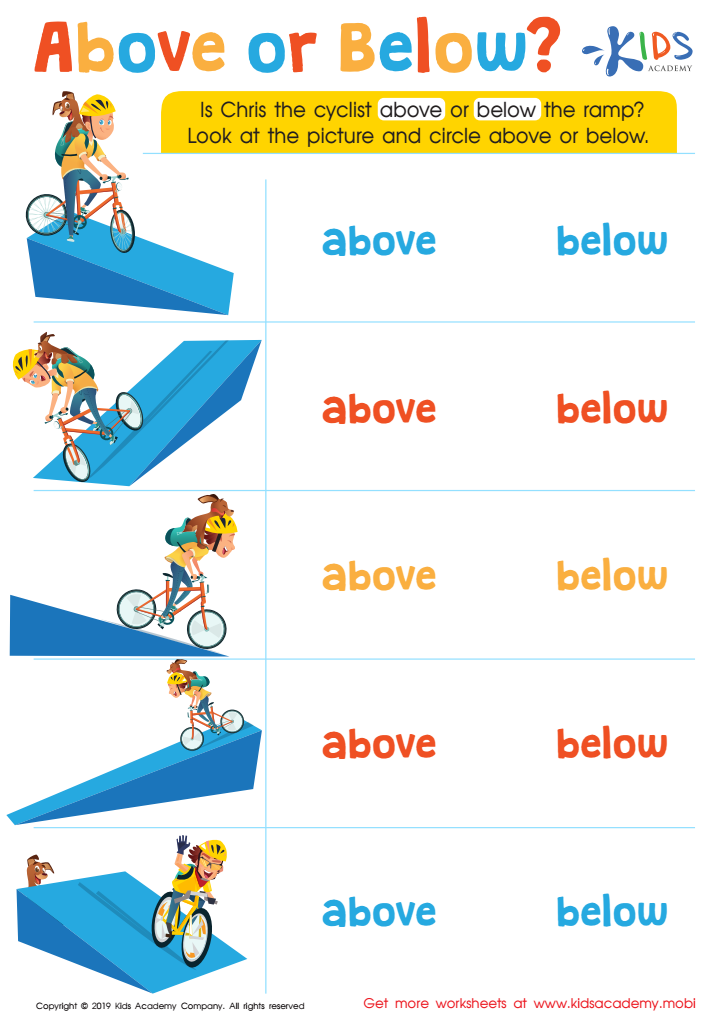
Above or Below? Worksheet
Do your kids cycle? Chris is a cyclist practicing on a ramp. Look at the pictures with them and decide if Chris is above or below the ramp. It's an important skill to help your kids become fluent speakers and writers - using the right words to describe something. Cycling is a fun sporting event.
Above or Below? Worksheet
Worksheet
Join Kids Academy for Free
Who is primarily going to use this learning content?








Spatial awareness skills, including understanding one’s position in space, recognition of shapes, and the ability to mentally manipulate objects, are crucial for children ages 6-8 as they form the foundation for many critical and complex cognitive functions. Firstly, spatial awareness underpins essential academic skills, particularly in mathematics. For example, recognizing shapes, understanding geometry, and solving puzzles all require well-developed spatial reasoning. This has been shown to correlate with higher achievement in math not only during early learning but throughout the educational journey.
Additionally, spatial awareness positively impacts reading and writing proficiencies. It enables children to maintain appropriate spacing between words, understand the orientation of letters and numbers, and smoothly navigate texts. Thus, spatial skills contribute to better hand-eye coordination and fine motor skills which are pertinent for writing.
Moreover, spatial awareness fosters problem-solving and critical thinking abilities, as it encourages children to visualize and plan ahead, be it in assembling blocks or grasping the layout of their environment. This capacity also extends to everyday activities, enhancing children’s ability to follow directions, understand maps, and build social interactions through improved body language cues.
Given these broad-ranging impacts on academic performance, coordination, and day-to-day functionalities, prioritizing spatial awareness reading and activities is key for parents and teachers striving to support holistic child development.








