
Visual perception improvement Geometry Worksheets for Ages 6-9
3 filtered results
Difficulty Level
Grade
Age
-
From - To
Subject
Activity
Standards
Enhance your child’s visual perception skills with our engaging Geometry Worksheets designed for ages 6-9! These printable resources focus on developing essential skills through fun and interactive activities that make learning enjoyable. Your young learners will explore shapes, spatial awareness, pattern recognition, and more, building a strong foundation in geometry while boosting their visual perception. Perfect for homeschooling, classrooms, or extra practice at home, these worksheets help kids develop critical thinking and problem-solving skills essential for future learning. Encourage creativity and confidence as your child discovers the fascinating world of geometry! Start the journey to improved visual perception today!
Favorites
With answer key
Interactive
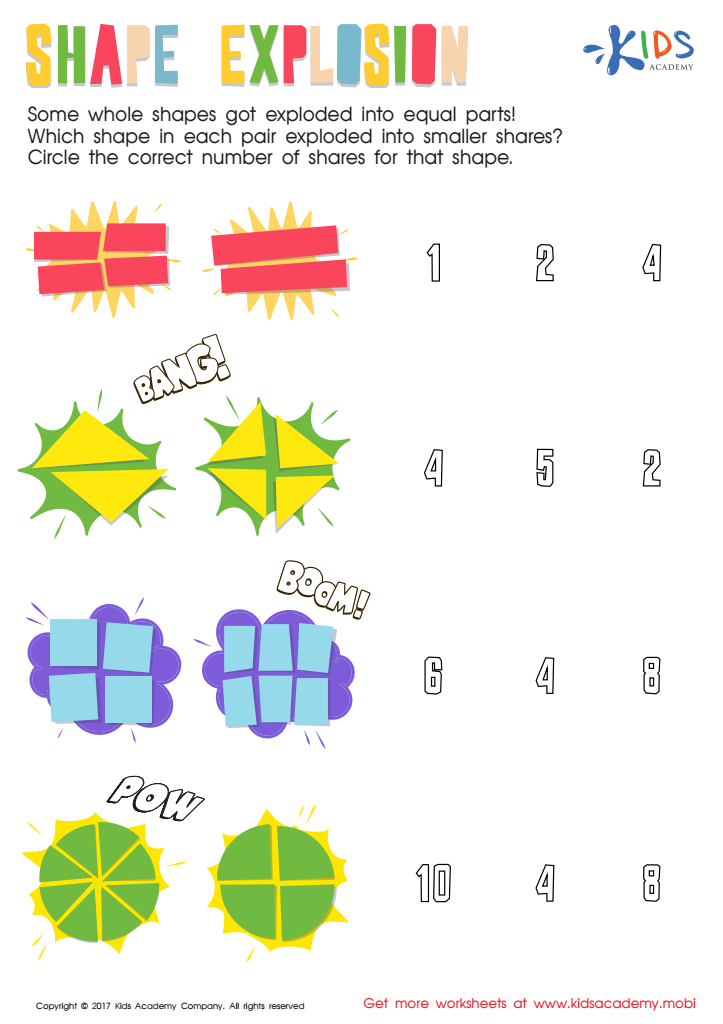
Shape Explosion Worksheet
This worksheet shows students how some shapes explode into two or more equal parts. On the left side are four shapes, each splitting into two or more parts. Ask your child to point out which shape has the smaller share, and help them circle the correct number of shares.
 Assign to My Students
Shape Explosion Worksheet
Worksheet











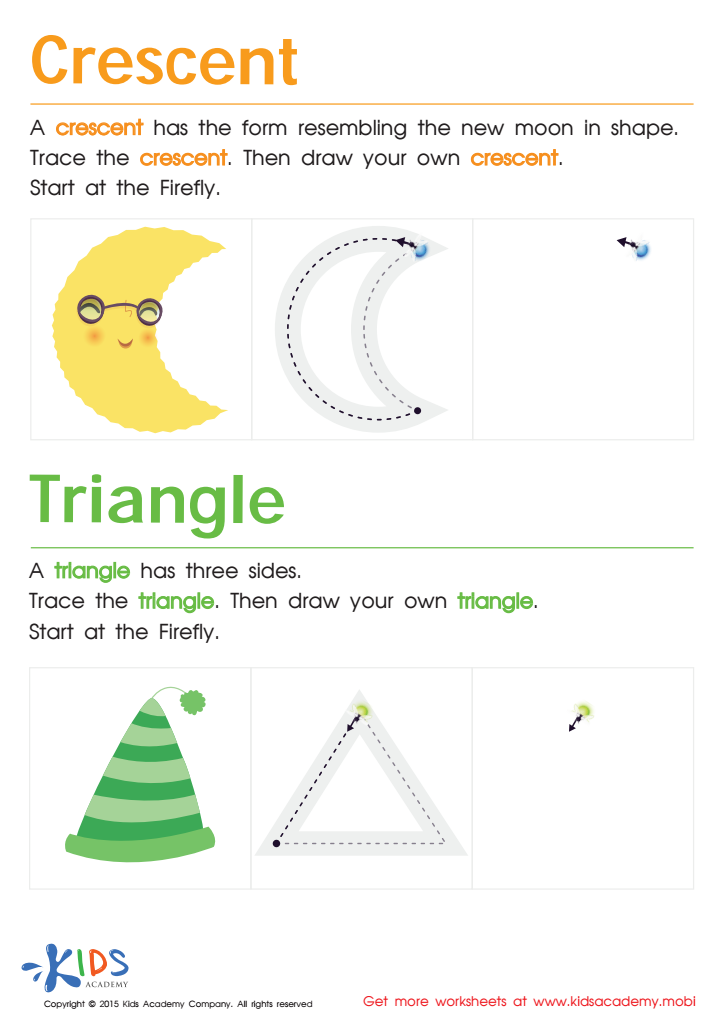
Learning to Draw Crescents And Triangles Worksheet
Help your kids draw a crescent and triangle with this free printable worksheet! Start by tracing a crescent in the form of the new moon, and then teach them that a triangle has three sides and looks like a hat. Find more geometry practice worksheets at Kids Academy!
Learning to Draw Crescents And Triangles Worksheet
Worksheet
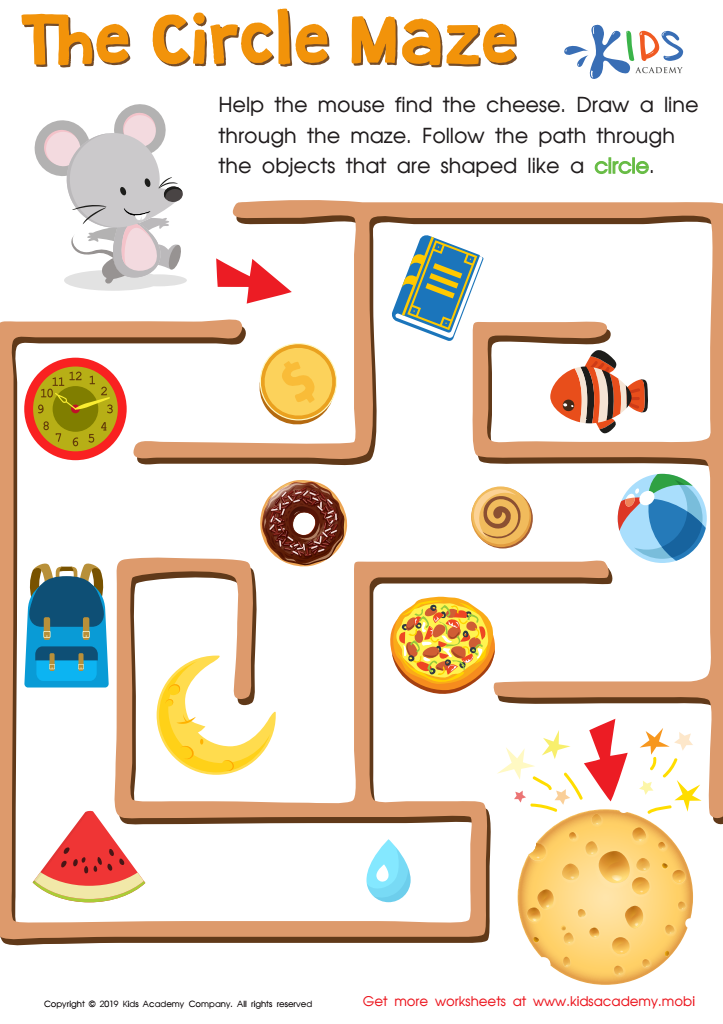
The Circle Maze Worksheet
Kids can have fun learning shapes with this maze worksheet. They can help the mouse find its cheese by tracing the path of a circle through the maze. This printable is great for classroom learning or as an activity at home.
The Circle Maze Worksheet
Worksheet
Join Kids Academy for Free
Who is primarily going to use this learning content?








Parents and teachers should prioritize visual perception improvement in geometry for children aged 6-9 because it's foundational for a variety of cognitive and academic skills. At this developmental stage, children's ability to understand shapes, spatial relationships, and patterns influences their success not only in mathematics but also in subjects like science, reading, and art.
Improving visual perception enhances children's problem-solving capabilities and boosts their critical thinking. By recognizing and manipulating shapes, children develop an innate sense of logic that aids in pattern recognition and spatial reasoning. These skills bridge the gap between abstract ideas and tangible understanding.
Additionally, a strong basis in geometry nurtures essential life skills—like navigation, understanding maps, and even interpreting graphs—which become increasingly important as they grow. Furthermore, fostering positive experiences with geometry instills a love for STEM (Science, Technology, Engineering, Mathematics) subjects early on, promoting confidence in tackling more complex concepts later.
Finally, enhancing visual perception can be especially beneficial for children with learning difficulties, providing them with strategies to engage more effectively in their learning environments. In essence, investing in visual perception improvement during these formative years can set the stage for academic success and a lifetime of problem-solving skills.








