
Comparing shapes Math Worksheets for Ages 6-9
6 filtered results
Difficulty Level
Grade
Age
-
From - To
Subject
Activity
Standards
Discover our engaging "Comparing Shapes Math Worksheets" tailored for children aged 6-9! These printable resources provide a fun and interactive way for young learners to delve into the world of geometry. Each worksheet emphasizes crucial skills like identifying, comparing, and contrasting various shapes, fostering critical thinking and enhancing problem-solving abilities. With colorful illustrations and age-appropriate challenges, children will enjoy developing their understanding of shapes while improving their math confidence. Perfect for classroom use or homeschool learning, our worksheets are designed to make math lively and enjoyable. Explore the exciting journey of shapes today and watch your child's skills flourish!
Favorites
With answer key
Interactive
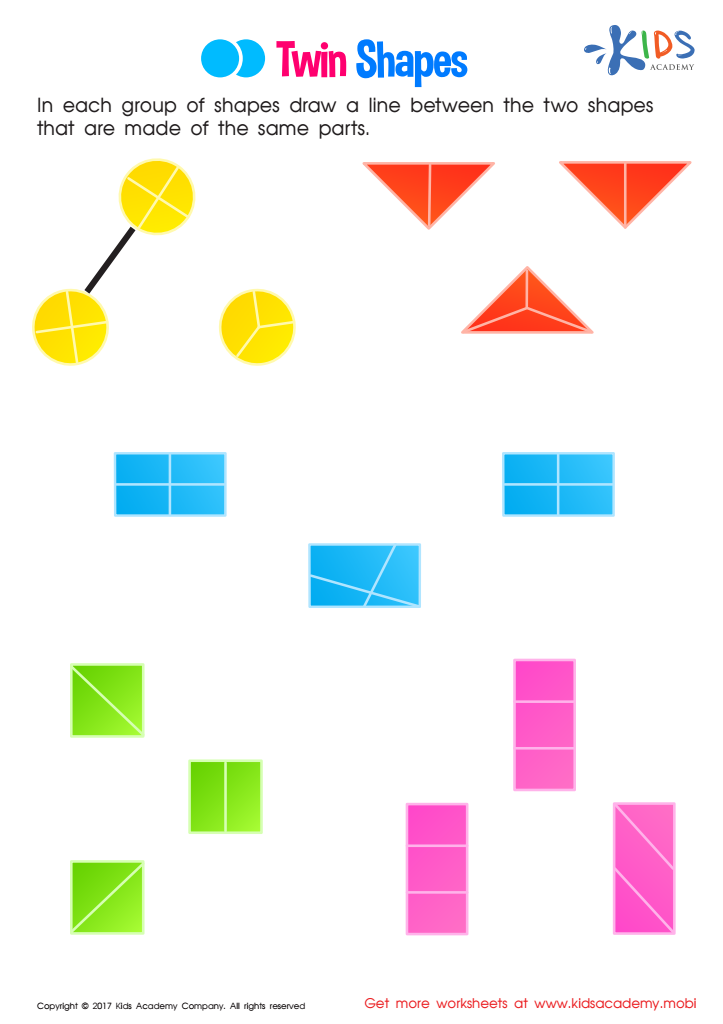
Twin Shapes Worksheet
Your students' goal in this worksheet is to find the twin shapes: drawing a line between two shapes made of the same parts. Likely, the first shapes encountered were circles, triangles, rectangles and squares - examples of which are seen frequently in everyday life. Encourage them to apply what they know and work out which is the twin shape!
 Assign to My Students
Twin Shapes Worksheet
Worksheet
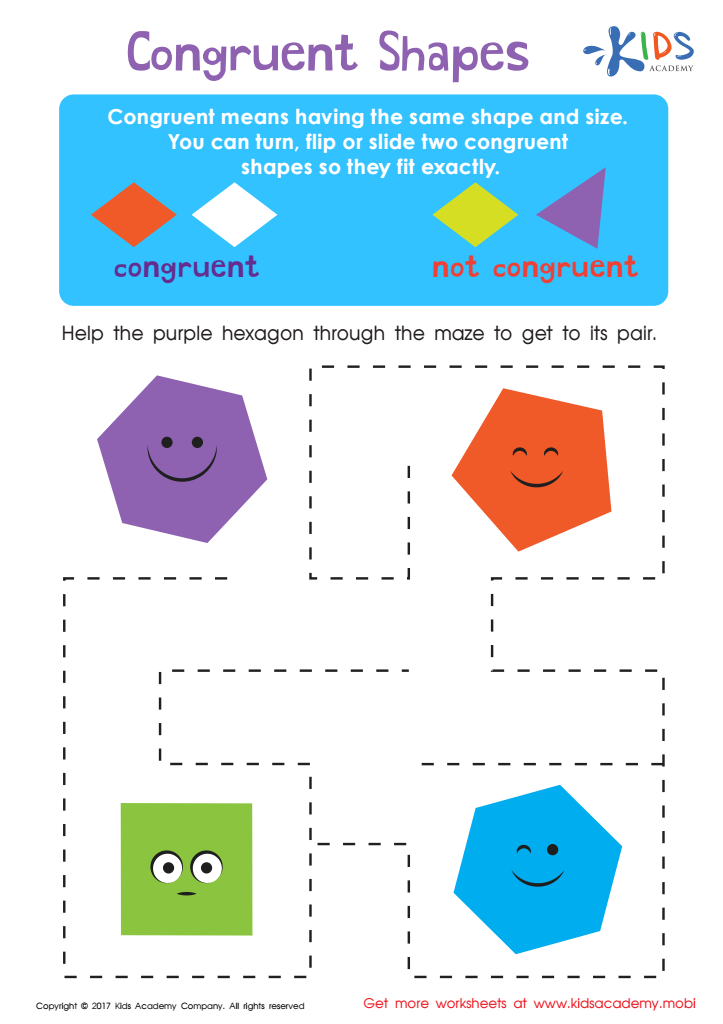
Congruent Shapes Worksheet
Help your child find the twin of the purple hexagon! This congruent shapes worksheet is great for increasing vocabulary while challenging mental rotation skills.
Congruent Shapes Worksheet
Worksheet
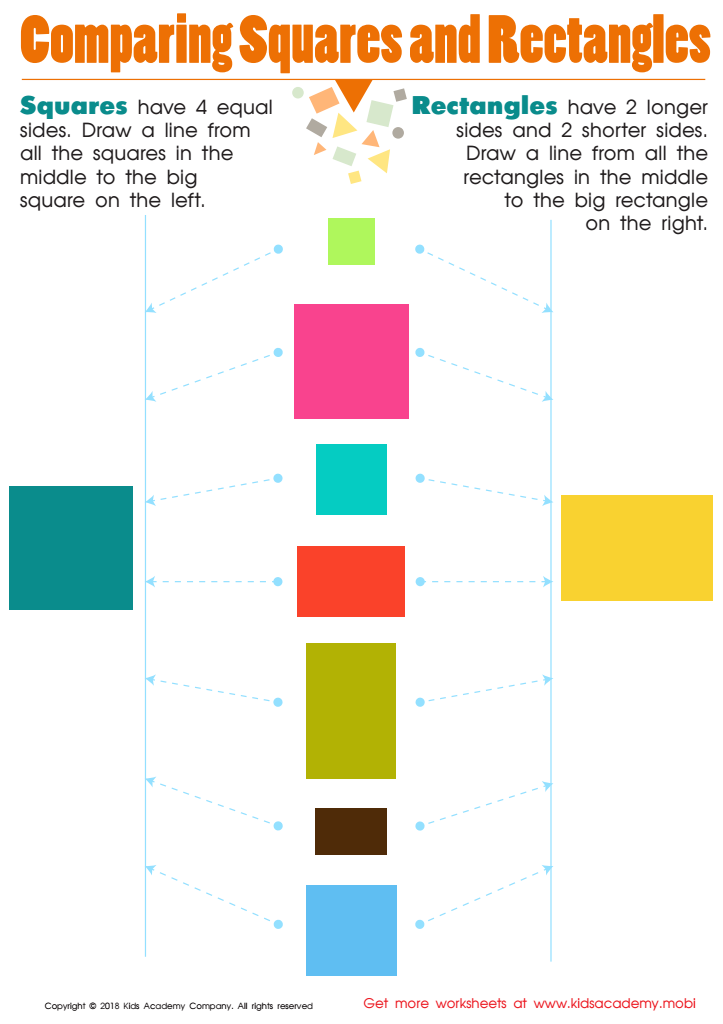
Comparing Squares Rectangles Worksheet
Help your little learner distinguish rectangles from squares with this fun geometry worksheet from Kids Academy! Read the definitions at the top, use the shapes on either side as a guide, then trace over the dotted line to match the rectangles and squares!
Comparing Squares Rectangles Worksheet
Worksheet
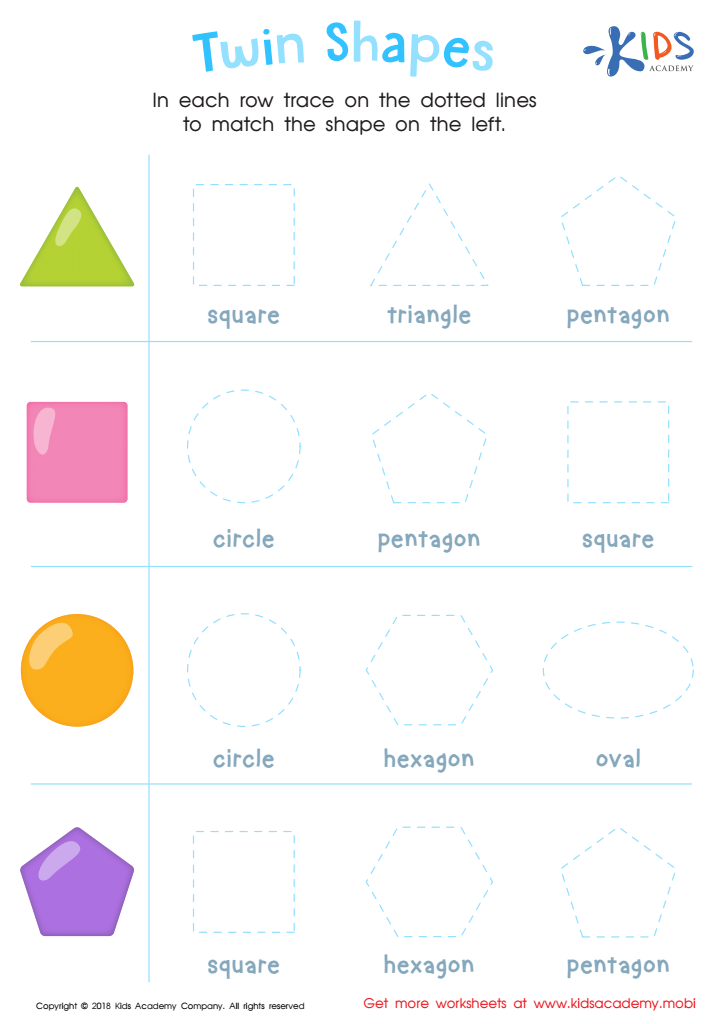
Twin Shapes Dot-to-Dot Worksheet
Test your child's ability to copy with this worksheet. Ask them to find and name the four shapes on the left. Then, they must match each with the dotted lines on the right. Help your child with all four shapes in this fun exercise.
Twin Shapes Dot-to-Dot Worksheet
Worksheet
Join Kids Academy for Free
Who is primarily going to use this learning content?



%20(1).jpg)




Comparing shapes is a fundamental mathematical skill that holds significant importance for children aged 6 to 9. First and foremost, understanding shapes lays the groundwork for more complex mathematical concepts, such as geometry, measurement, and spatial awareness. By exploring and comparing different shapes, students learn to distinguish properties such as sides, angles, and symmetry, which are crucial for problem-solving in math.
Moreover, engaging in shape comparisons enhances critical thinking skills. As children categorize shapes according to their attributes, they develop logical reasoning and analytical skills that extend beyond mathematics into everyday life. For example, recognizing the different shapes of everyday objects fosters observation skills and increases their ability to understand the world around them.
Additionally, shape comparison can be integrated into various subjects and activities, making learning interactive and fun. It encourages collaboration and discourse among peers, promoting social skills and communication.
For parents and teachers, emphasizing shape comparison serves as a major stepping stone in fostering a child's cognitive development, preparing them for higher learning and cultivating a lifelong love for mathematics. Ultimately, care for this aspect of learning not only supports academic achievement but nurtures well-rounded thinkers.








