
Solve word problems Math Worksheets for Ages 6-9
3 filtered results
Difficulty Level
Grade
Age
-
From - To
Subject
Activity
Standards
Enhance your child's math skills with our "Solve Word Problems" worksheets designed specifically for ages 6-9! These engaging and interactive worksheets help young learners develop critical thinking, comprehension, and problem-solving abilities through real-life scenarios. Our thoughtfully crafted word problems are tailored to keep students motivated while reinforcing essential mathematical concepts. Whether at home or in the classroom, these printable resources offer the perfect blend of fun and educational content. Watch your child gain confidence as they learn to read, understand, and solve various math problems. Explore our collection today and give your child the tools they need for success in math!
Favorites
With answer key
Interactive
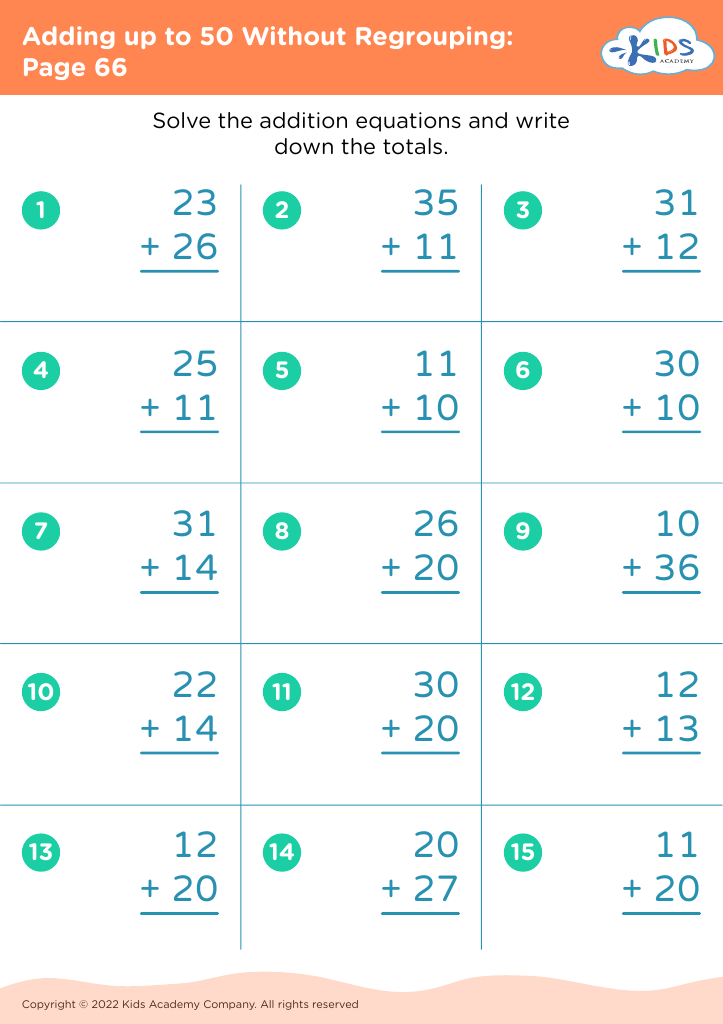
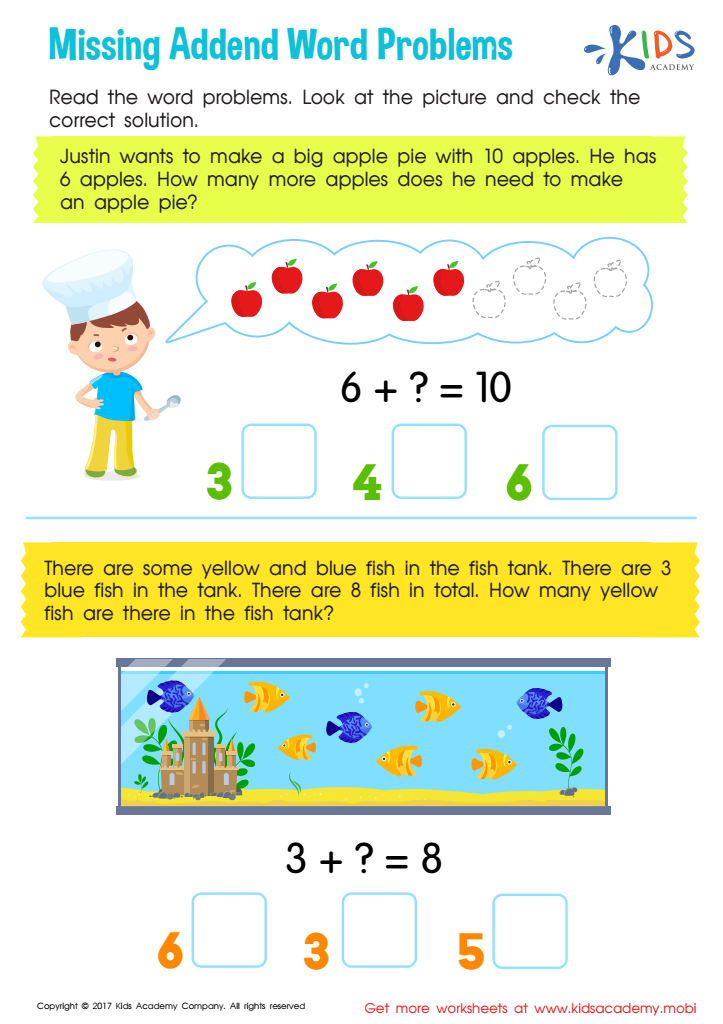
Missing Addend Word Problems Worksheet
Doing many addition and subtraction problems is key for fluency and mastery. Word problems can help kids understand how math works in everyday life. Our math worksheet uses fun scenarios and pictures to teach how to find the missing addend. It's the perfect tool to help kids understand math better!
 Assign to My Students
Missing Addend Word Problems Worksheet
Worksheet
Join Kids Academy for Free
Who is primarily going to use this learning content?








Parents and teachers should prioritize solving word problems in math for children aged 6-9 due to several critical reasons. First, word problems help develop essential critical thinking and problem-solving skills. They require children to analyze situations, extract relevant information, and apply mathematical concepts, fostering a deeper understanding of math's practical applications in real life.
Additionally, word problems encourage language development and comprehension skills. As children read and decipher the problems, they practice their reading abilities and learn to express mathematical ideas in their own words, bridging the gap between language and math.
Moreover, these problems promote persistence and resilience. Students learn that solving challenges may require multiple attempts and strategies, building a growth mindset that is beneficial not only in math but across all subjects and life situations.
Lastly, engaging with word problems cultivates a genuine interest in math. By relating mathematical concepts to everyday scenarios—like sharing candies or planning a party—children see the subject's relevance. Ultimately, fostering these skills and interests in young learners lays the foundation for their future academic success, confidence in math, and lifelong learning. Thus, supporting children in mastering word problems is essential for their holistic development.








