
Understanding fact families Addition Worksheets for 6-Year-Olds
3 filtered results
Difficulty Level
Grade
Age
-
From - To
Subject
Activity
Standards
Discover the world of fact families through our engaging addition worksheets specially designed for 6-year-olds. Kids will learn how numbers in a fact family are related, enhancing their math skills and fostering a solid understanding of basic addition. With vibrant illustrations and exciting exercises, these worksheets make learning fun and effective. Perfect for classroom or at-home practice, they help children grasp the concept of number relationships effortlessly. Boost your child's confidence in math with our expertly crafted, kid-friendly worksheets that turn learning into an enjoyable adventure. Make mastering addition a breeze for your little ones today!
Favorites
With answer key
Interactive
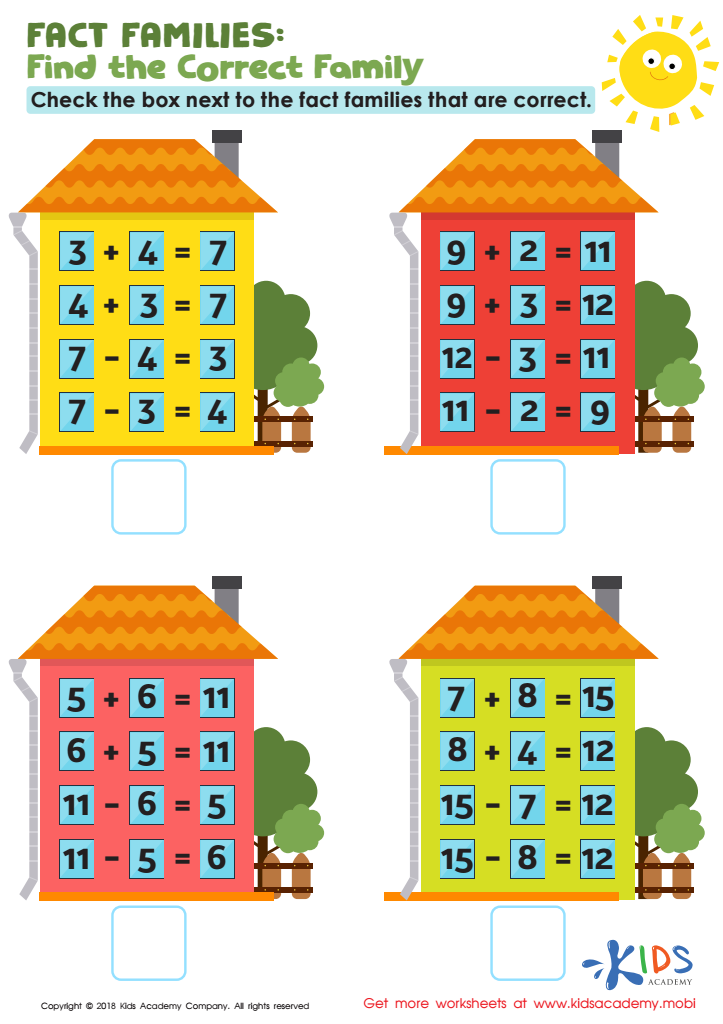
Fact Families: Find Correct Family Worksheet
Test your students' math and reasoning skills with this worksheet. It features 4 houses, each with a group of fact families on it. Some are correct, some are wrong - help students identify which are correct and circle the box next to them. This will help them progress in school.
 Assign to My Students
Fact Families: Find Correct Family Worksheet
Worksheet
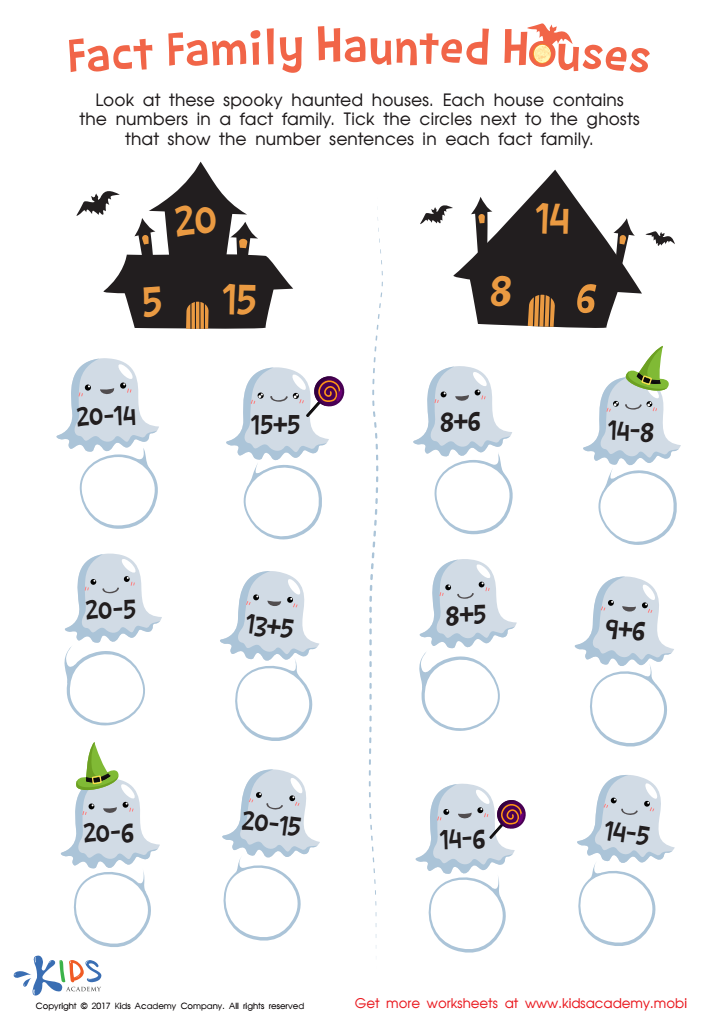
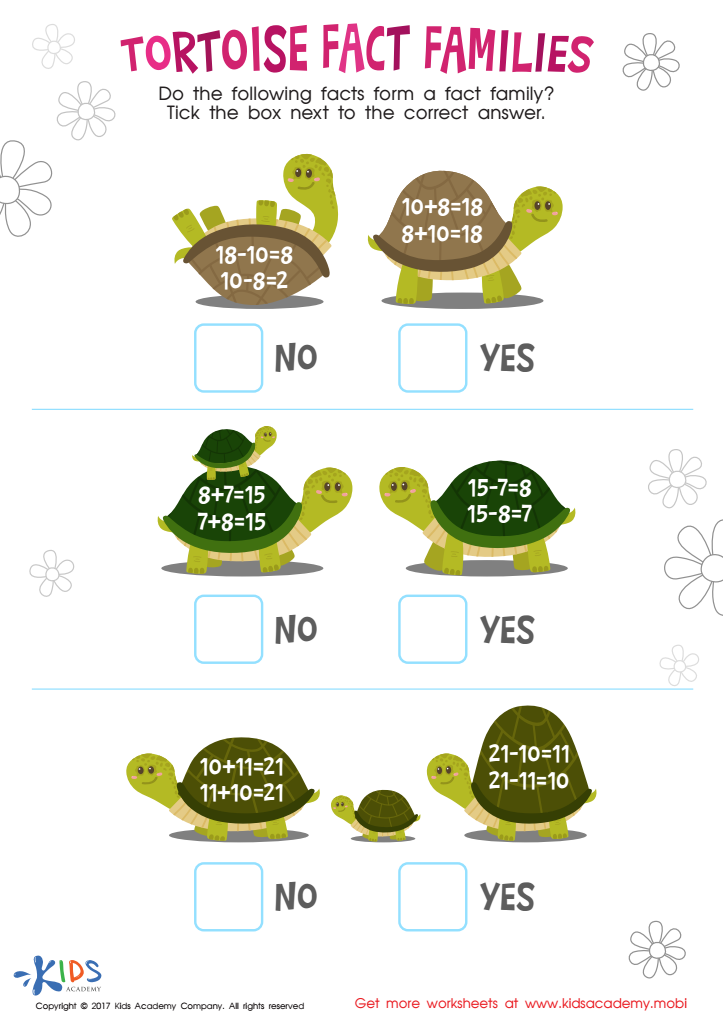
Tortoise Fact Families Printable
With 1st grade add & subtract tortoises, kids can improve their math understanding and skills. Enjoy fun, hands-on practice with fact families and strengthen logical reasoning and critical thinking!
Tortoise Fact Families Printable
Worksheet
Join Kids Academy for Free
Who is primarily going to use this learning content?








Fact families in addition are fundamental concepts for 6-year-olds because they help young learners grasp the relationship between numbers. Understanding these relationships builds a strong mathematical foundation. When children learn about fact families, they see the connection between addition and subtraction, which enhances their comprehension and helps them solve problems more effectively.
For example, in the fact family of 3, 4, and 7, a child learns that 3 + 4 = 7, 4 + 3 = 7, 7 - 3 = 4, and 7 - 4 = 3. Knowing these related facts makes arithmetic feel less daunting, and children become more confident in their math abilities. This understanding promotes critical thinking skills, encouraging kids to look for patterns and relationships, which is essential in mathematics and other areas of learning.
Moreover, focusing on fact families aids in the development of automaticity; knowing these facts by heart allows children to perform calculations faster and with greater ease. This fluency is important as they progress to more complex math concepts, where they need to rely on these basic skills without having to devote excessive mental energy to simple calculations. For parents and teachers, fostering an early mastery of such fundamental concepts will set children up for future success across a broad range of academic pursuits.








