
Reading proficiency Alphabet Worksheets for Ages 7-9
5 filtered results
Difficulty Level
Grade
Age
-
From - To
Subject
Activity
Standards
Unlock your child's reading potential with our engaging Alphabet Worksheets designed for ages 7-9! These printable resources focus on enhancing reading proficiency through fun, interactive activities. Your child will explore letter recognition, phonics, and vocabulary, all while building confidence in their reading skills. Our vibrant worksheets incorporate various exercises that cater to different learning styles, ensuring that every child can succeed. Perfect for home or school use, these materials support literacy development in a fun and stimulating way. Help your young reader thrive with our comprehensive collection of Alphabet Worksheets today! Click here to start their reading journey.
Favorites
With answer key
Interactive
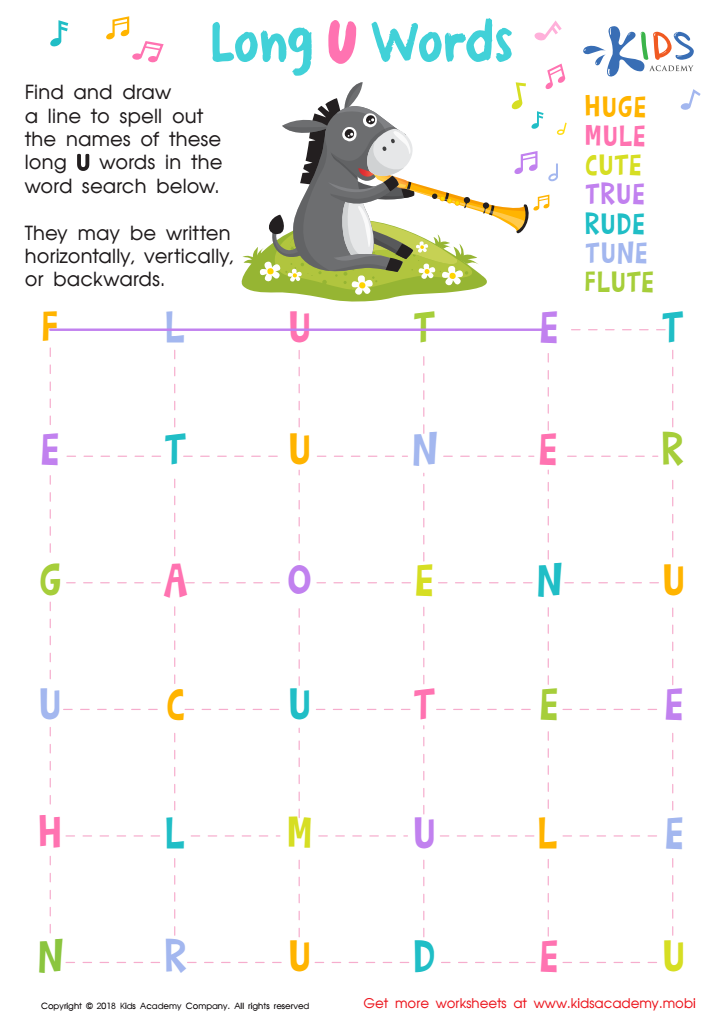
Long /u/ Words Worksheet
Your child needs to learn phonetics to enunciate and differentiate words. This fun worksheet encourages them to find and draw lines connecting the long 'U' words in the word search. Help them read the words on the right side of the picture, then look for them in the word search (horizontally, backwards or vertically).
Long /u/ Words Worksheet
Worksheet
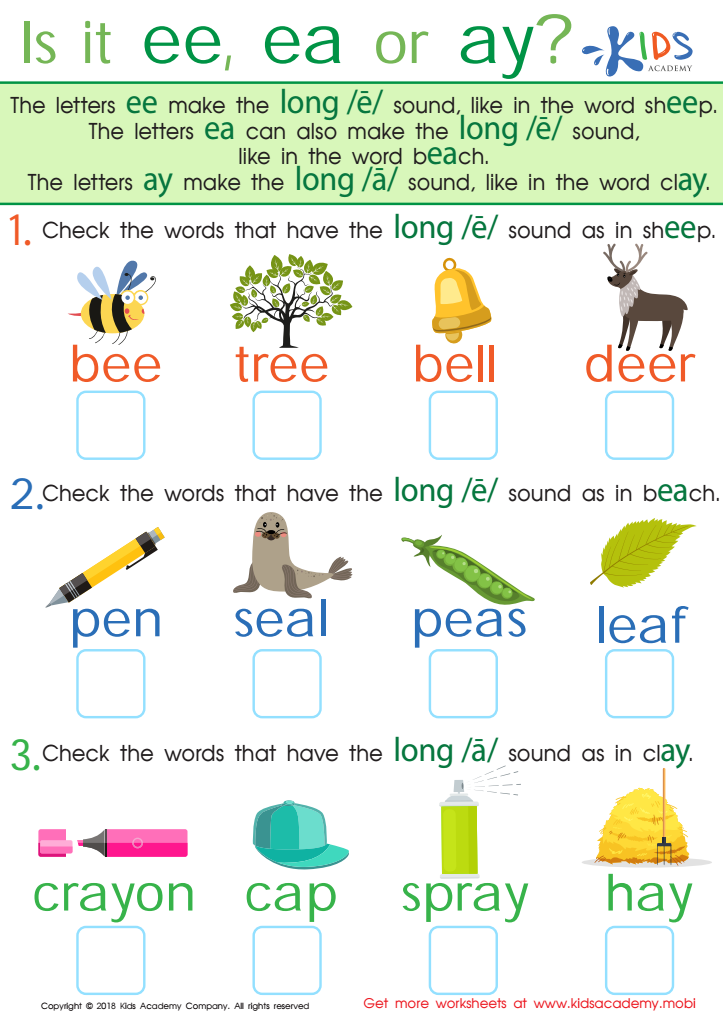
Is It EE, EA, or AY? Worksheet
When 'ee', 'ea' and 'ay' are in words, they usually make the long /e/ and /a/ sounds. Examples of words with 'ee' are "sheep", 'beach' and 'seat' with 'ea', and 'clay' and 'play' with 'ay'. Check this colourful worksheet with your kids; help them find the words that make the long /e/ sound like 'sheep'.
Is It EE, EA, or AY? Worksheet
Worksheet

Long and Short U Worksheet
Revised: Spice up your lesson on long and short vowels with this fun printout! Kids read the words "tube" and "tub," then reinforce the sound by coloring in the words and pictures. It's a great way to make phonics class enjoyable!
Download (PDF)
 Assign to My Students
Assign to My Students
Long and Short U Worksheet
Worksheet
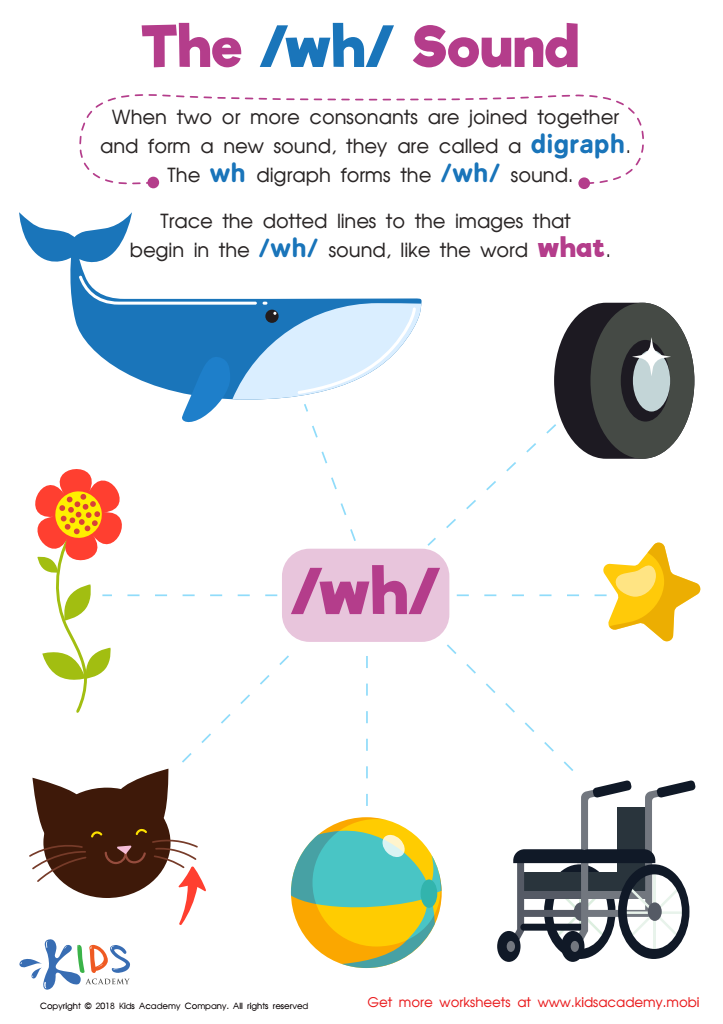
The /wh/ Sound Worksheet
Digraphs join two consonants to make a new sound, like /wh/. Give examples, like "whale", "when" and "why". Ask kids to name pictures in a worksheet and trace dotted lines to images beginning with the /wh/ sound; "what" is one example.
The /wh/ Sound Worksheet
Worksheet
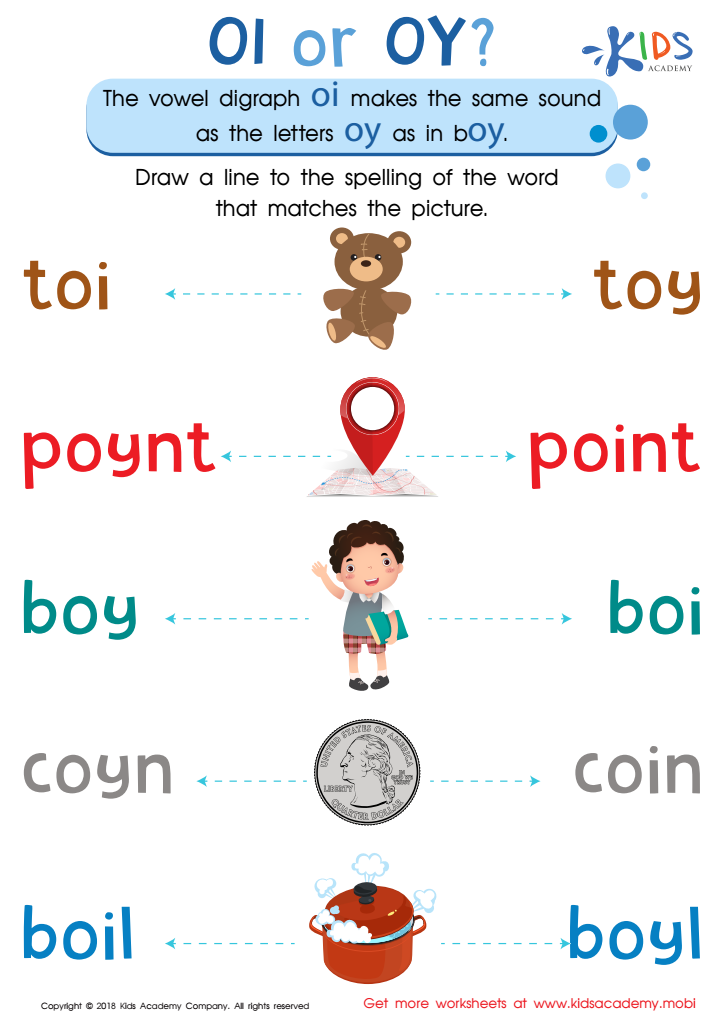
Reading: OI and OY Worksheet
Ask your students if they know the rule for words with /oi/ or /oy/ sound. If not, it's easy to learn! Rule: If /oy/ at end of word, spell with 'oy'; if /oi/ in middle of word, spell with 'oi'. Use this worksheet to help them master these digraphs and improve their ability to decode.
Reading: OI and OY Worksheet
Worksheet
Join Kids Academy for Free
Who is primarily going to use this learning content?






Reading proficiency for ages 7-9 is crucial as it lays the foundation for a child's future learning and overall academic success. At this age, children transition from learning to read to reading to learn, acquiring essential skills that will support their understanding of complex subjects in later grades. Proficient reading abilities empower children to decode words, comprehend texts, and build vocabularies, which are critical for effective communication and critical thinking.
Parents and teachers should care about reading proficiency during this developmental stage because children who struggle with reading often face challenges across various disciplines. Early intervention can prevent later academic difficulties, ensuring that children remain engaged and confident in their learning. Additionally, proficient readers are more likely to enjoy literature, fostering a lifelong love for books, and promoting better social and emotional development. Supportive reading environments, characterized by guidance and resources, significantly enhance children's linguistic capabilities.
Moreover, reading proficiency is linked to better academic performance, increased creativity, and higher self-esteem. By prioritizing reading development in this age group, parents and teachers create a nurturing foundation that equips children with vital skills necessary for success in school and beyond.







