
Visual representation Worksheets for Ages 7-9
3 filtered results
Difficulty Level
Grade
Age
-
From - To
Subject
Activity
Standards
Discover the benefits of Visual Representation Worksheets for Ages 7-9, provided by Kids Academy! These engaging worksheets are designed to enhance your child's learning skills through detailed visual representations, making abstract concepts easily understandable. Tailored for young minds, they offer a fun and interactive approach to learning math, reading, and science. With a diverse selection of activities, children can improve their critical thinking and problem-solving abilities. Perfect for both classroom and home use, these worksheets help build a strong foundation for future academic success. Visit Kids Academy today to explore our collection and give your child the tools they need to excel!
Favorites
With answer key
Interactive
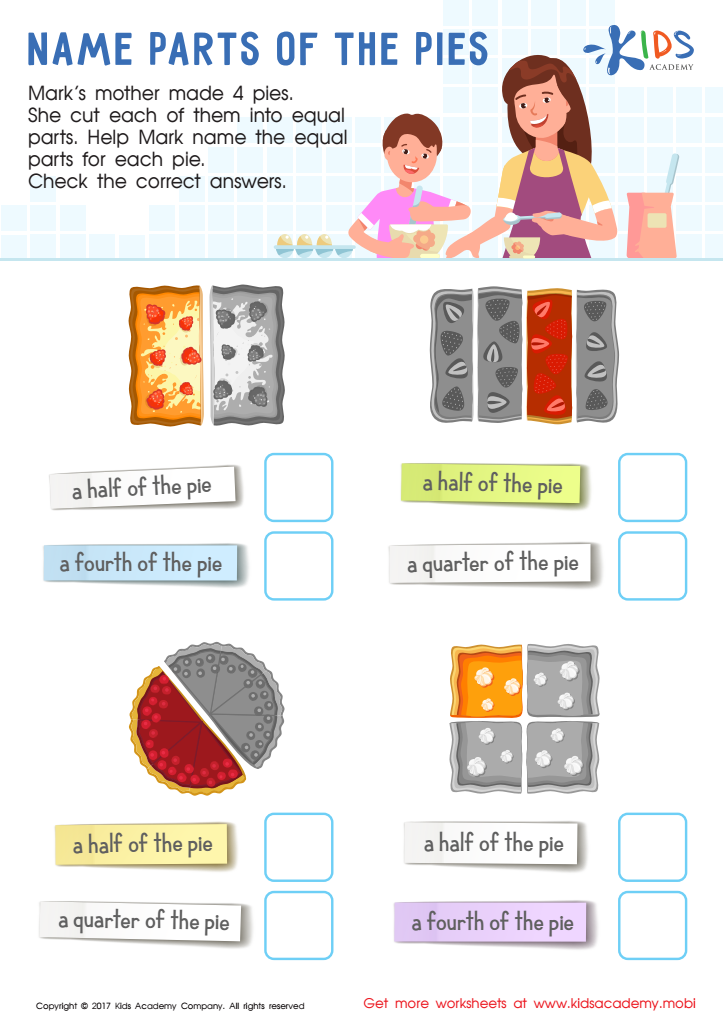
Name Parts of the Pies Worksheet
Mark and his mom are making pies. He's dividing them into equal parts and needs help to name them. Let your students aid him by checking the correct answer for each picture. Have them think of their own roles in the kitchen when they're done. How do they help their moms?
 Assign to My Students
Name Parts of the Pies Worksheet
Worksheet
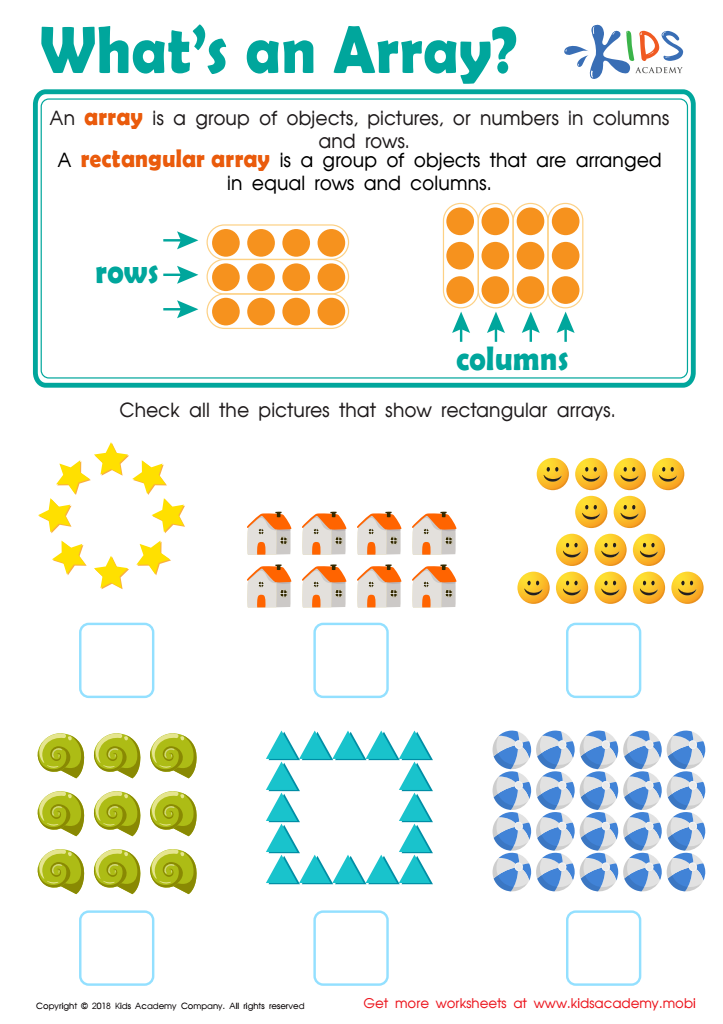
What's an Array? Worksheet
Explain to your child that an array is a group of objects, pictures, or numbers in columns and rows. Show them a rectangular array is a group of objects in equal rows and columns. Guide them to check the pictures in the worksheet to spot any rectangular arrays. Help them remember this concept.
What's an Array? Worksheet
Worksheet
Join Kids Academy for Free
Who is primarily going to use this learning content?






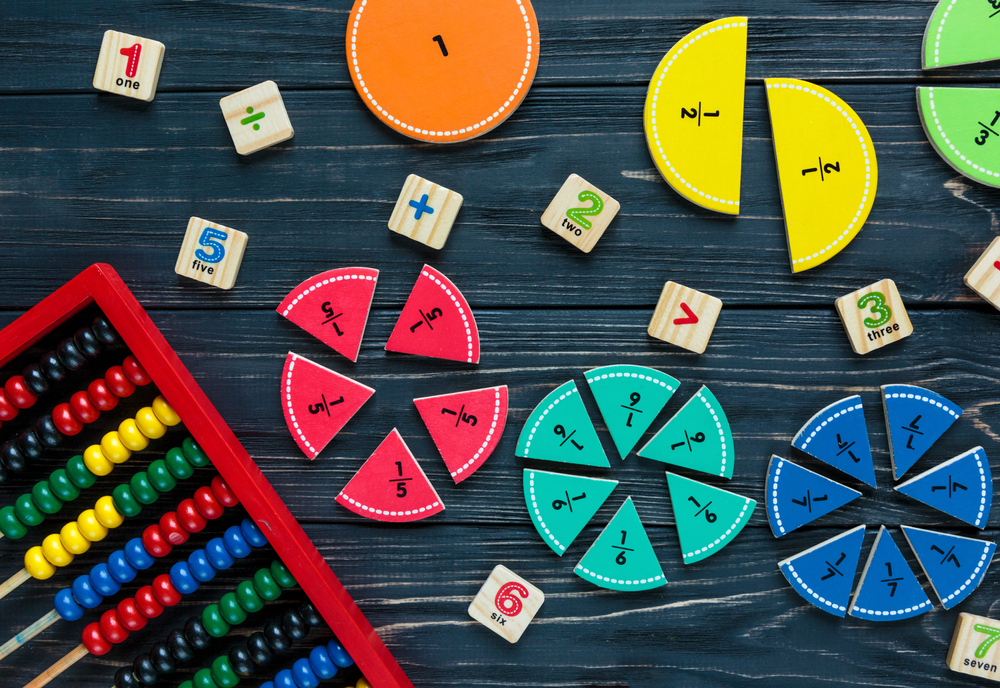

Visual representation is a critical educational tool for children aged 7-9 because it bridges the abstract and concrete understanding crucial at this developmental stage. At this age, kids transition from learning to read to reading to learn, and visual aids like charts, graphs, and illustrations can support this shift by making complex ideas more accessible.
Children's cognitive and visual processing skills are still developing, so using visual elements can significantly enhance comprehension and retention of information. For example, a bar graph can make mathematical data tangibly understandable, while story illustrations enable children to visualize narratives, aiding in reading comprehension. Visual learning also caters to different learning styles. While some children may understand concepts through text alone, others engage more effectively through images.
Passionate educators and parents recognize that engaging multiple senses can deepen learning. Diagrams in science, timelines in history, and illustrated storybooks can make learning more engaging and interactive. Visual representation also encourages critical thinking by helping children categorize and link ideas, fostering developmental skills such as sequencing and pattern recognition—essential stepping stones in overall academic achievement.
By integrating visual tools into educational experiences, parents and teachers empower children to develop a more comprehensive and engaging understanding of new information, laying a robust foundation for lifelong learning.








