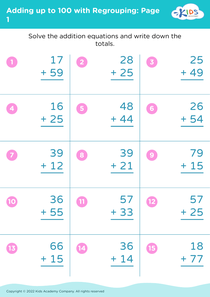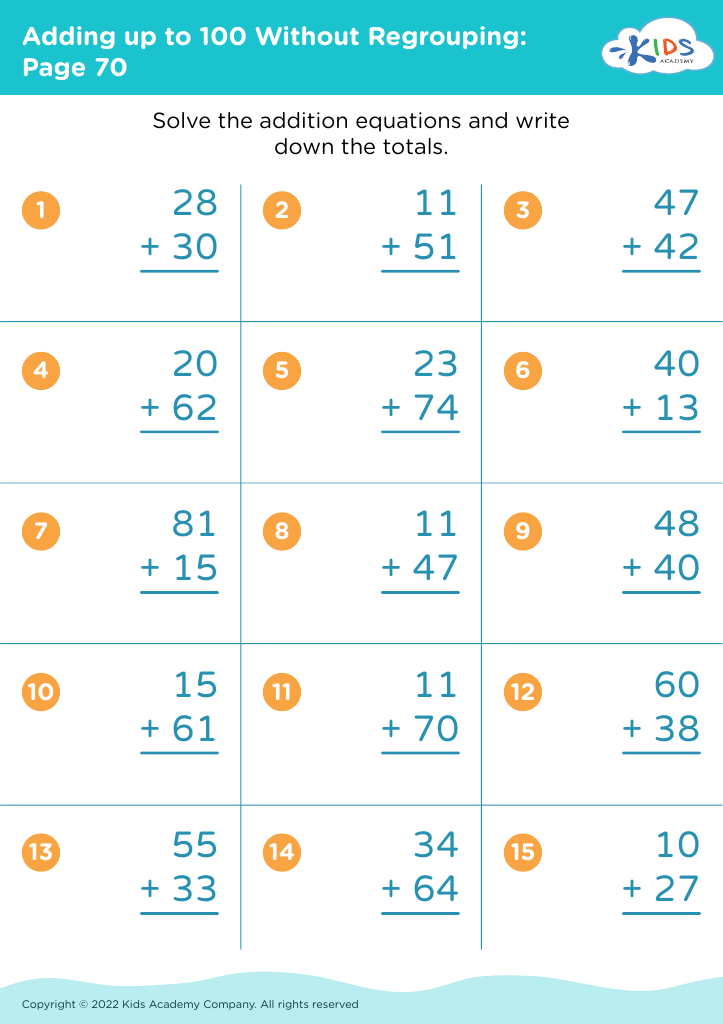





Adding up to 100 without regrouping is a critical mathematical skill for children aged 7-9 because it establishes a strong foundation for future mathematical concepts and everyday problem-solving. Mastering this skill allows students to develop a solid understanding of number sense, enabling them to recognize patterns, understand numerical relationships, and build confidence in their abilities. By avoiding the complexity of regrouping, children can focus on the essential counting and addition principles, making the learning process smoother and less intimidating.
For parents and teachers, fostering this ability aligns with age-appropriate developmental milestones typical for second and third-grade students. It demonstrates progress in their cognitive and fine motor skills, involving precise movements and mental calculations. Furthermore, proficiency in adding without regrouping can enhance a child’s ability to perform mental arithmetic, aiding in quick calculations that are useful in daily activities such as shopping, cooking, and time management.
Investing time and effort into teaching addition up to 100 without regrouping also builds a child's confidence and interest in mathematics. By experiencing success in manageable steps, students are more likely to develop a positive attitude toward learning math, paving the way for tackling more complex operations, such as addition with regrouping, multiplication, and division, later on.