
Fine motor skills development Numbers Worksheets for Ages 7-9
3 filtered results
Difficulty Level
Grade
Age
-
From - To
Subject
Activity
Standards
Fine Motor Skills Development Numbers Worksheets for Ages 7-9 are expertly crafted to enhance young learners' dexterity while making learning math fun and engaging. Tailored for children aged 7-9, these printable worksheets boost fine motor skills through number tracing, dot-to-dot activities, and advanced numeral exercises. Each worksheet combines visual, auditory, and tactile elements to foster precise hand movements and overall mathematical proficiency. Perfect for both classroom and at-home learning, these resources ensure kids develop strong fundamental skills necessary for writing and numerical comprehension. Start your child's journey to confident math and refined motor abilities today!
Favorites
With answer key
Interactive
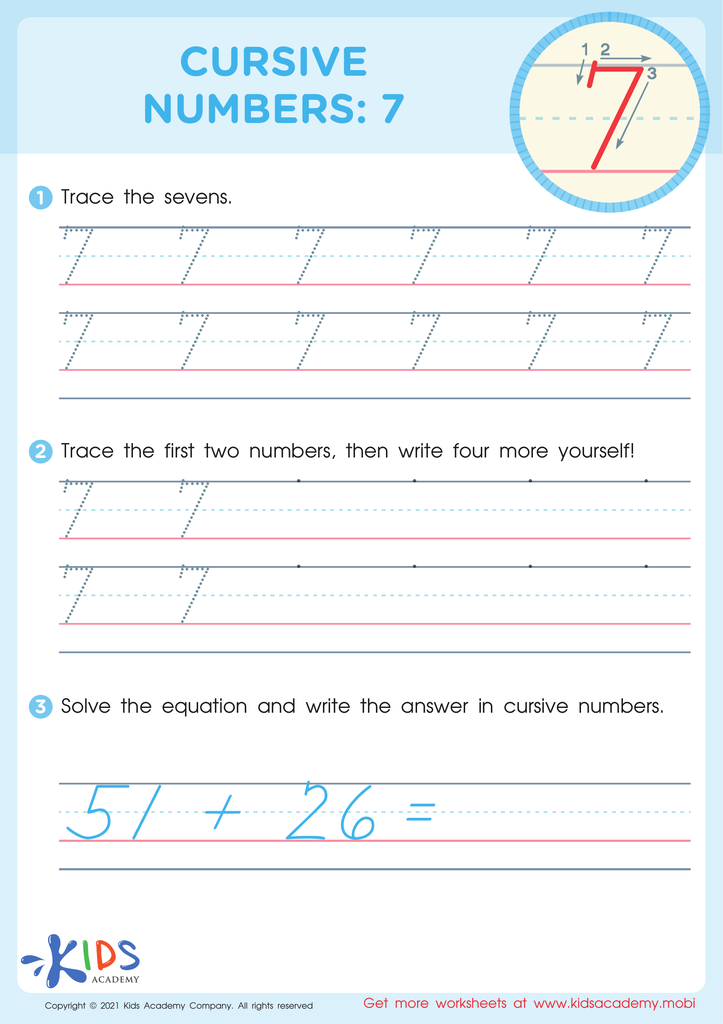
Cursive Numbers: 7 Worksheet
Kids learn best with engaging and easy-to-understand materials. This tracing worksheet is ideal for developing kids' writing skills, with two exercises to help them write the number 7. The first involves tracing the 6s provided and the second asking them to write four cursive 7s independently.
Cursive Numbers: 7 Worksheet
Worksheet
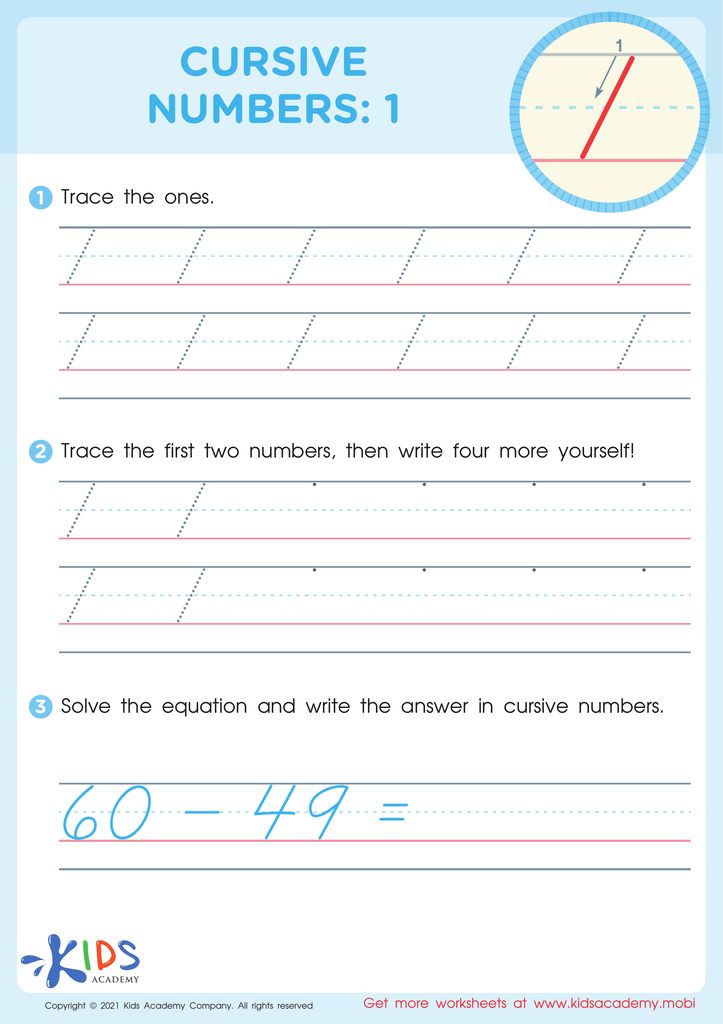
Cursive Numbers: 1 Worksheet
Math and handwriting are connected! Try these traceable worksheets to help your children learn cursive numbers. The tracing lines make it easy to follow, plus there's a simple subtraction exercise at the bottom for them to try. This is perfect for kids who struggle with handwriting and gives them a fun way to practice.
Cursive Numbers: 1 Worksheet
Worksheet
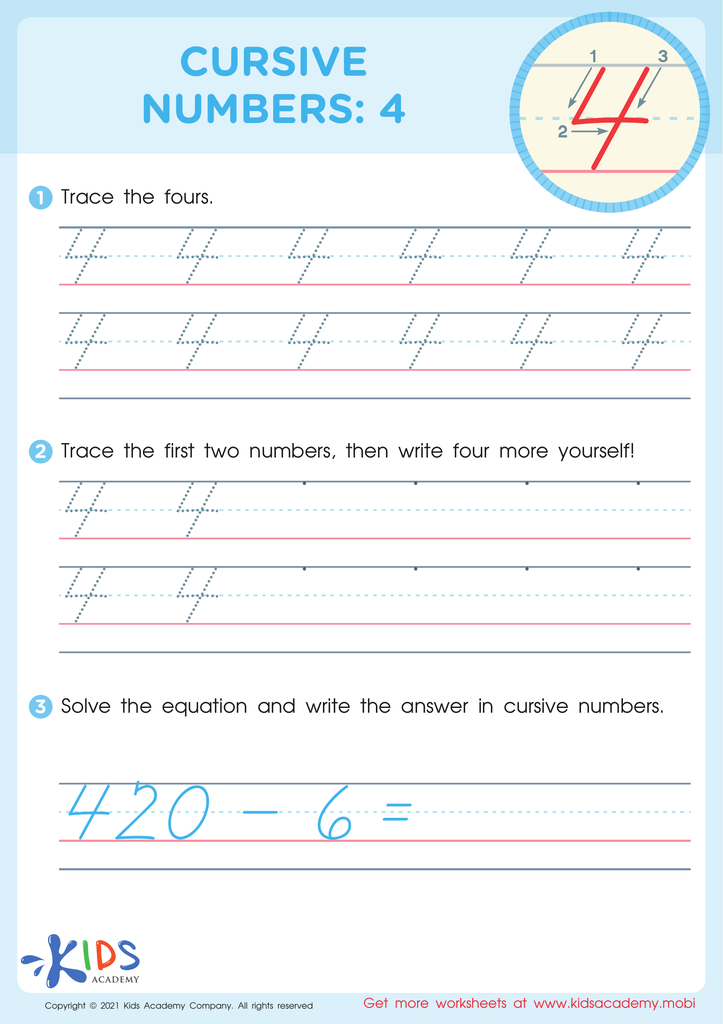
Cursive Numbers: 4 Worksheet
Math is challenging, and teaching cursive alongside it can be overwhelming. Make lessons enjoyable and your child will be more likely to stay engaged. Utilize worksheets to practice tracing the number 4 in cursive. With regular practice, your child can learn to write the number on their own.
Cursive Numbers: 4 Worksheet
Worksheet
Join Kids Academy for Free
Who is primarily going to use this learning content?








Fine motor skills development is crucial for children aged 7-9 as it directly impacts their academic performance and overall growth. These skills involve the coordination of small muscles in the hands and fingers, enabling activities like writing, drawing, cutting, and manipulating small objects. During these formative years, children refine their dexterity and control, which are foundational for classroom tasks. Well-developed fine motor skills lead to clearer handwriting, better artwork, and improved ability to use tools like scissors and rulers, enhancing their learning experience.
Investing in fine motor skills also boosts cognitive development. Activities that involve these skills require concentration, problem-solving, and sequential thinking, all of which are critical for academic success. Moreover, fine motor proficiency promotes independence in daily activities such as tying shoes, buttoning clothes, and opening lunch boxes.
From a social perspective, adeptness in fine motor tasks can boost a child’s self-esteem and confidence, as they feel competent in handling school and personal activities. Conversely, struggling with these tasks may lead to frustration and decreased motivation. Therefore, parents and teachers should foster fine motor skills development through engaging activities like crafts, puzzles, and play-dough, ensuring holistic growth and setting a strong foundation for future skill acquisition.








