
Comparing weights Math Worksheets for Ages 7-9
3 filtered results
Difficulty Level
Grade
Age
-
From - To
Subject
Activity
Standards
Boost your child's math skills with our "Comparing Weights Math Worksheets" designed for ages 7-9. These engaging worksheets help kids learn how to measure, compare, and understand weights using real-world objects. Your child will practice concepts like heavier, lighter, and equal weight while enhancing their analytical and problem-solving skills. Our tailored activities use vivid illustrations to make learning fun and effective. Suitable for both classroom and at-home use, these printable worksheets provide a solid foundation in weight measurement. Equip your young learner with the tools needed for math success while keeping them entertained and motivated.
Favorites
With answer key
Interactive
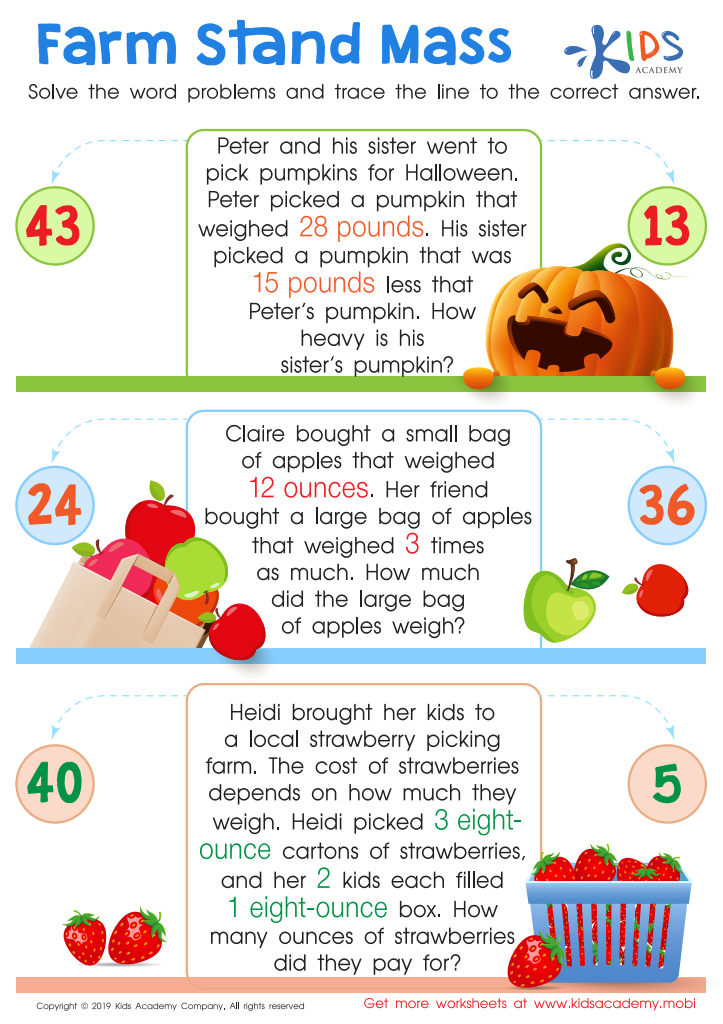
Farm Stand Mass Worksheet
Engage your kids in a fun learning adventure! Encourage them to practice what they learn in school using this worksheet. Look at the picture and read the problem together. Help them solve it and trace the line to the answer. Make learning enjoyable and your kids will be more motivated!
 Assign to My Students
Farm Stand Mass Worksheet
Worksheet
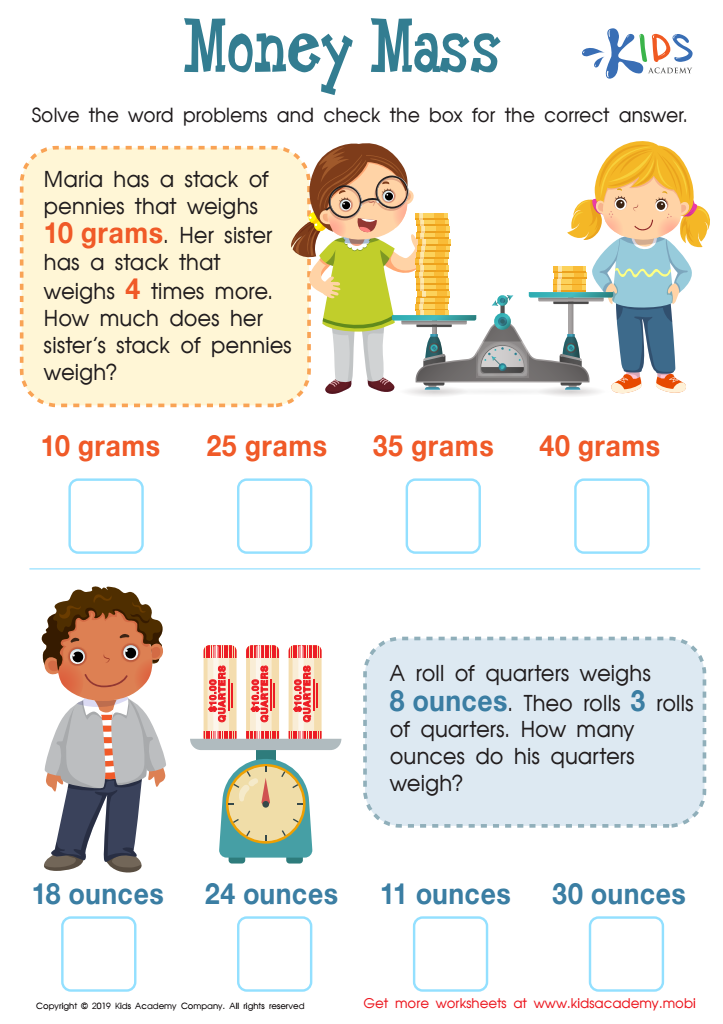
Money Mass Worksheet
By regularly working on math with your kids, they will become more confident. Ensure they understand the word problems in this printout, and help them solve it. Check the box for the correct answer of each to verify their work. With this practice, they will gradually get used to math and make progress.
Money Mass Worksheet
Worksheet
Join Kids Academy for Free
Who is primarily going to use this learning content?





Comparing weights is a fundamental mathematical skill that sets the foundation for critical thinking and problem-solving in children aged 7-9. For parents and teachers, emphasizing this concept is vital for several reasons. Firstly, it helps children develop an intuitive understanding of measurement and quantities, which is essential for grasping more complex mathematical ideas later on. They learn to make observations, estimations, and use tools like scales, which enhances their hands-on learning experiences.
Moreover, comparing weights ties into real-world applications, making math relatable and practical. For instance, children learn why certain objects are heavier or lighter and how this affects everyday choices, such as packing a school bag or cooking. Additionally, engaging in activities that involve weights promotes cognitive development. It strengthens their ability to compare, contrast, and process differences, contributing to logical reasoning skills.
Teachers and parents who pay attention to this aspect of math help foster a growth mindset. Children build confidence as they see their problem-solving abilities improve through tangible, interactive exercises. Lastly, integrating weight comparison lessons makes learning dynamic and fun, keeping young minds engaged and motivated to explore more. Investing in this foundational skill paves the way for academic success and lifelong learning enthusiasm.








