
Math problem-solving Reading Worksheets for Ages 7-9
6 filtered results
Difficulty Level
Grade
Age
-
From - To
Subject
Activity
Standards
Discover our engaging Math Problem-Solving Reading Worksheets designed for children aged 7-9! These worksheets blend reading comprehension with math challenges, helping young learners enhance their problem-solving skills while becoming proficient in interpreting mathematical concepts. Each activity encourages critical thinking and boosts confidence by presenting math in familiar, relatable contexts. Ideal for classroom or home use, these resources stimulate learning and foster a love for mathematics. Whether your child is tackling word problems or practicing logical reasoning, our worksheets provide a fun, interactive way to practice essential skills. Spark a passion for learning today with our thoughtfully crafted materials!
Favorites
With answer key
Interactive
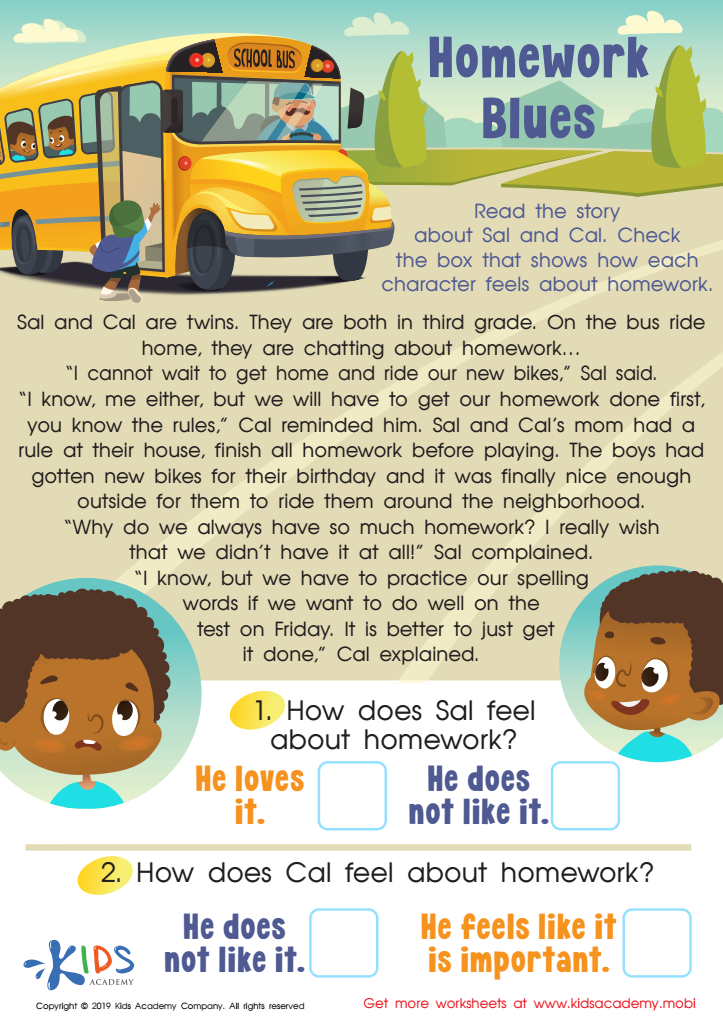
Homework Blues Worksheet
Cal and Sal don't love doing homework, just like your kids. Use this worksheet to help your children understand why homework is important. Read the passage together and then answer the questions at the bottom of the page. It's a fun way to learn together!
 Assign to My Students
Homework Blues Worksheet
Worksheet
Join Kids Academy for Free
Who is primarily going to use this learning content?








Parents and teachers should prioritize math problem-solving reading for children ages 7-9 because this foundational skill is essential for academic success and real-life applications. At this age, children transition from concrete understanding of numbers to more abstract concepts, making problem-solving strategies critical. Engaging in math-related reading helps students develop critical thinking and analytical skills, allowing them to interpret and solve problems effectively.
Moreover, this age group is crucial for building confidence in math. Encountering problems through complex narratives can reduce anxiety by framing math in relatable, everyday contexts. As children learn to decode word problems, they practice literacy skills alongside mathematical concepts, creating a dual benefit that enhances overall academic performance.
Further, fostering a positive attitude toward math in early years can influence long-term interests and achievements. Children who develop strong problem-solving skills are better prepared for advanced studies and future careers that rely on analytical reasoning, creativity, and perseverance. Encouraging math problem-solving reading also supports collaboration between parents and educators, forming a robust support system that reinforces learning both at home and in the classroom. In short, investing in this skill set now can yield lifelong benefits for children.








