
Reading proficiency Phonics Worksheets for 7-Year-Olds
5 filtered results
Difficulty Level
Grade
Age
-
From - To
Subject
Activity
Standards
Enhance your 7-year-old's reading skills with our engaging phonics worksheets designed specifically for building reading proficiency. Our resources focus on essential phonetic patterns and sounds, encouraging children to decode and understand words in an enjoyable way. Each worksheet is tailored to foster confidence and independence in reading through fun activities, games, and exercises. Perfect for both classroom use and homework, these printable materials promote interactive learning and reinforce essential literacy skills. Help your child become a confident reader and lay a strong foundation for their educational journey with our comprehensive phonics worksheets. Start exploring today!
Favorites
With answer key
Interactive
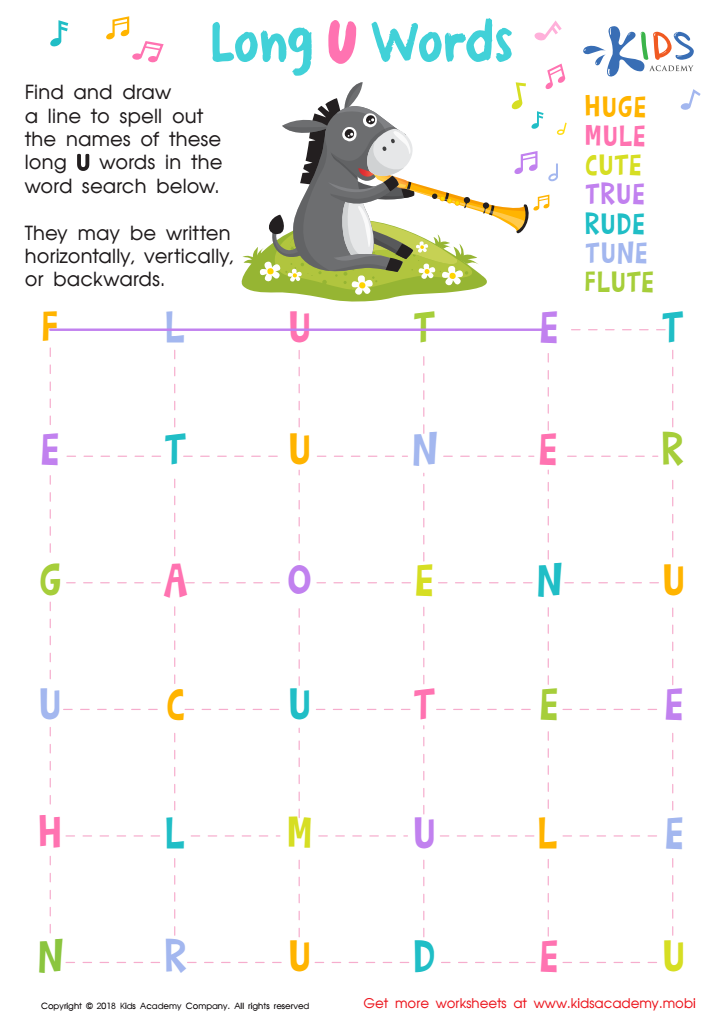
Long /u/ Words Worksheet
Your child needs to learn phonetics to enunciate and differentiate words. This fun worksheet encourages them to find and draw lines connecting the long 'U' words in the word search. Help them read the words on the right side of the picture, then look for them in the word search (horizontally, backwards or vertically).
Long /u/ Words Worksheet
Worksheet
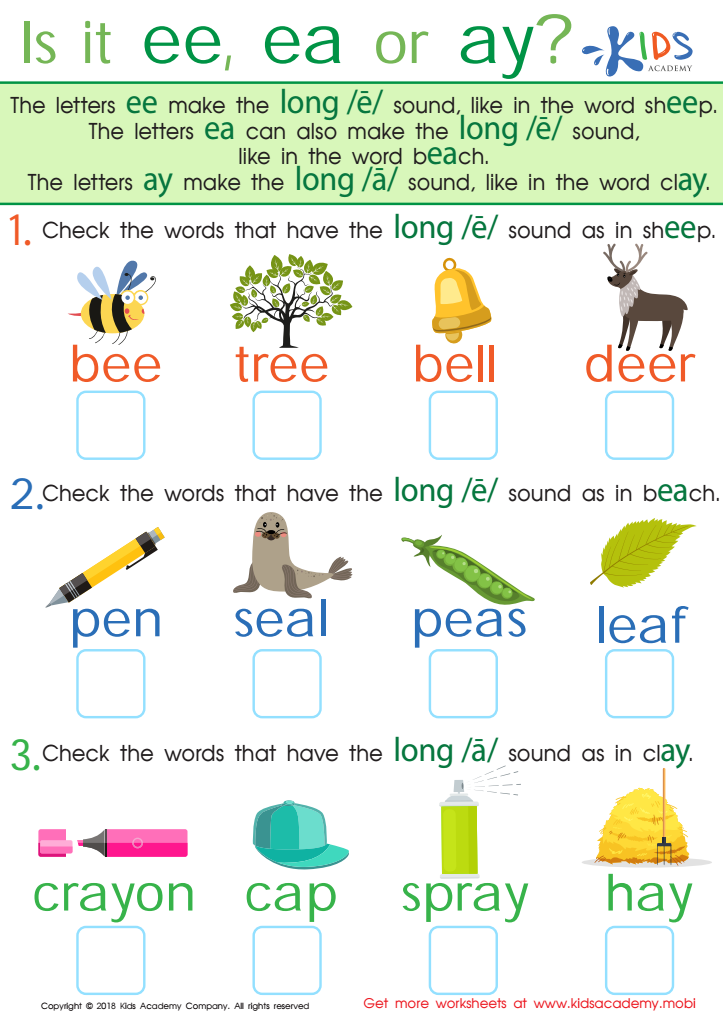
Is It EE, EA, or AY? Worksheet
When 'ee', 'ea' and 'ay' are in words, they usually make the long /e/ and /a/ sounds. Examples of words with 'ee' are "sheep", 'beach' and 'seat' with 'ea', and 'clay' and 'play' with 'ay'. Check this colourful worksheet with your kids; help them find the words that make the long /e/ sound like 'sheep'.
Is It EE, EA, or AY? Worksheet
Worksheet

Long and Short U Worksheet
Revised: Spice up your lesson on long and short vowels with this fun printout! Kids read the words "tube" and "tub," then reinforce the sound by coloring in the words and pictures. It's a great way to make phonics class enjoyable!
Download (PDF)
 Assign to My Students
Assign to My Students
Long and Short U Worksheet
Worksheet
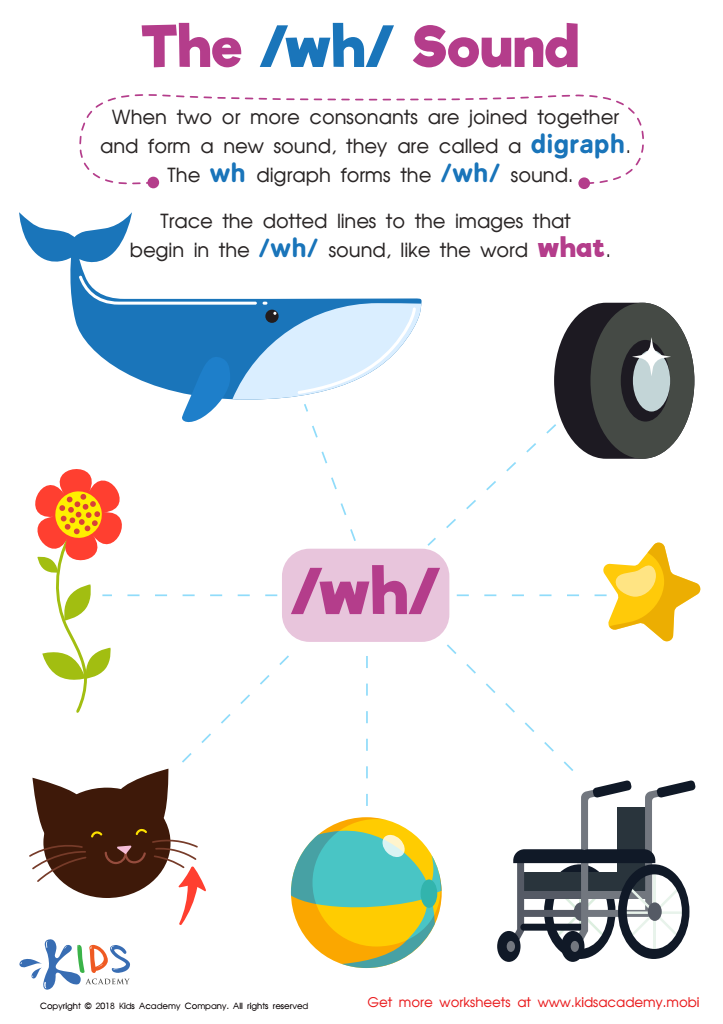
The /wh/ Sound Worksheet
Digraphs join two consonants to make a new sound, like /wh/. Give examples, like "whale", "when" and "why". Ask kids to name pictures in a worksheet and trace dotted lines to images beginning with the /wh/ sound; "what" is one example.
The /wh/ Sound Worksheet
Worksheet
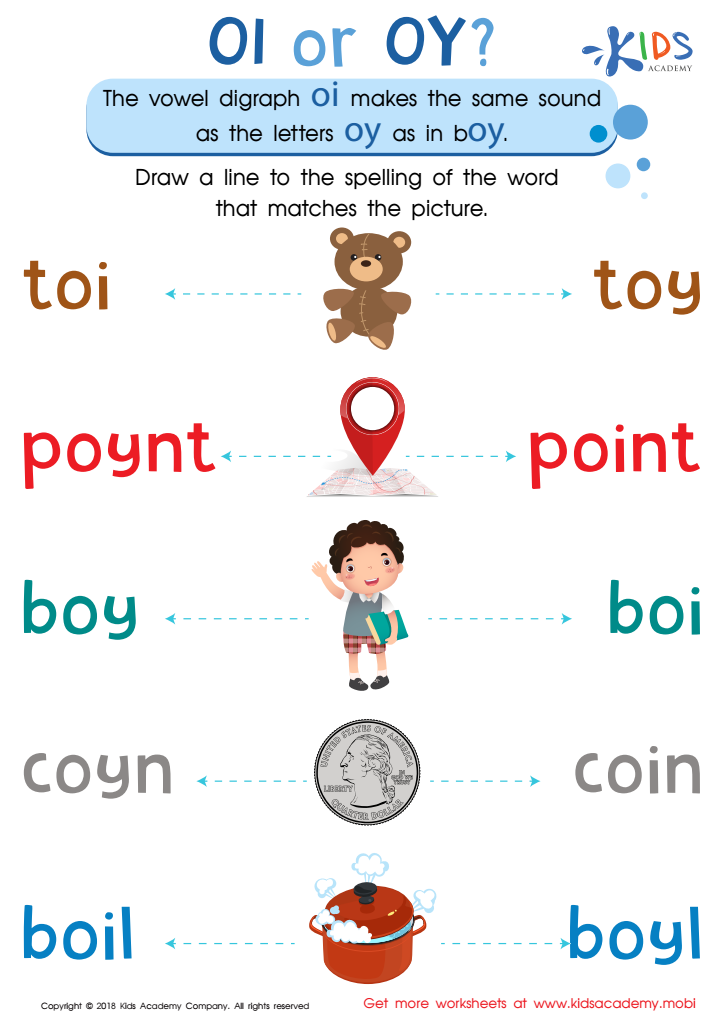
Reading: OI and OY Worksheet
Ask your students if they know the rule for words with /oi/ or /oy/ sound. If not, it's easy to learn! Rule: If /oy/ at end of word, spell with 'oy'; if /oi/ in middle of word, spell with 'oi'. Use this worksheet to help them master these digraphs and improve their ability to decode.
Reading: OI and OY Worksheet
Worksheet
Join Kids Academy for Free
Who is primarily going to use this learning content?








Reading proficiency and phonics are crucial for 7-year-olds as they form the foundation of literacy skills essential for academic success and lifelong learning. At this age, children transition from learning to read to reading to learn. A strong grasp of phonics—understanding the relationship between letters and their sounds—enables them to decode words, improving their reading fluency and comprehension.
Parents and teachers should prioritize phonics instruction because research shows that phonics-based approaches are among the most effective methods for teaching children to read. When children understand phonics, they can tackle unfamiliar words, boosting their confidence and motivation. This foundational skill impacts their ability to succeed in other subjects, where reading is integral.
Moreover, reading proficiency influences overall cognitive development, critical thinking, and communication skills. Children who struggle with reading may experience difficulties in school, potentially leading to long-term challenges such as poor academic performance and reduced self-esteem.
By investing time and resources into phonics and reading proficiency, parents and teachers empower children to become skilled readers and lifelong learners, setting them up for success both in and out of the classroom. Cultivating a love for reading at this stage can profoundly impact children's future educational journeys and personal growth.







