Introduce your 7-year-old to the world of strategic thinking through our engaging and interactive Chess Worksheets! Specifically designed to captivate young minds, these printable worksheets make learning the fundamentals of chess fun and accessible. Each sheet is thoughtfully created to bolster crucial skills such as problem-solving, critical thinking, and forward planning. Perfect for beginners, they expertly balance instructional content with hands-on practice, ensuring kids build confidence and proficiency in chess. Start your child's journey towards becoming a strategic thinker while they enjoy every move they make on the board. Enhance their analytical abilities and foster a love for one of the world's most renowned games today!

Check out this FREE Trial Lesson on Chess for age 7!

Rook

Favorites
With answer key
Interactive
  • 7
  • Strategic thinking development
  • Chess
Chess Pieces Quest Worksheet

Chess Pieces Quest Worksheet

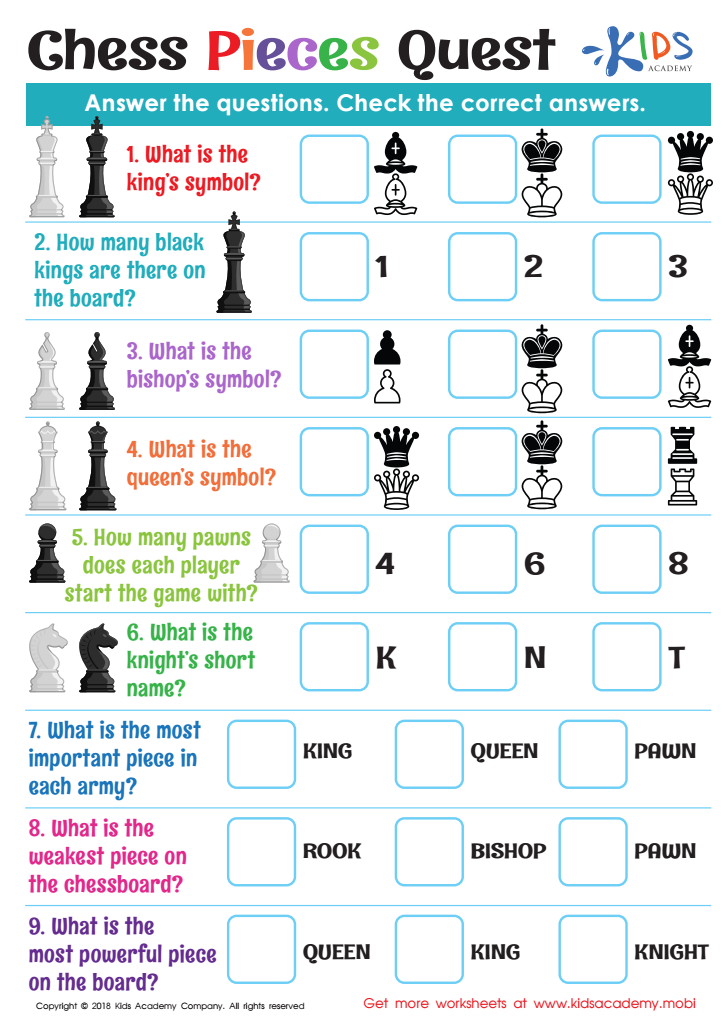
Help your child prepare for the chess quest by refreshing their knowledge of the symbols and characteristics of each chess piece. Then, have them try the 9 questions on this worksheet. These questions will assess their understanding of the symbols and how many pieces each player starts with.
Chess Pieces Quest Worksheet
Worksheet
Notation of Moves Writing it Down Worksheet

Notation of Moves Writing it Down Worksheet

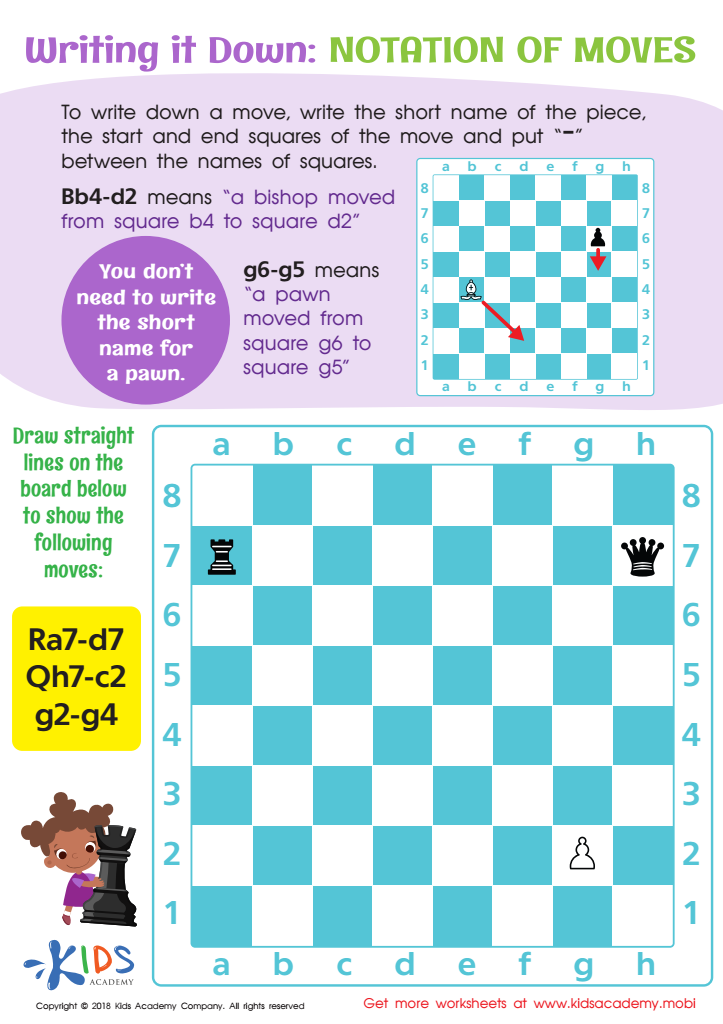
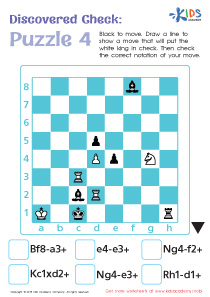
Notating chess moves can be tricky for kids to learn. This worksheet will help them better understand it. To notate a move, write the piece's short name, start and end squares, and separate them with a "-". For instance, Bd4-d2 means a bishop moved from b4 to d2. No need to write pawns' short names.
Notation of Moves Writing it Down Worksheet
Worksheet
How Rooks Capture Worksheet

How Rooks Capture Worksheet

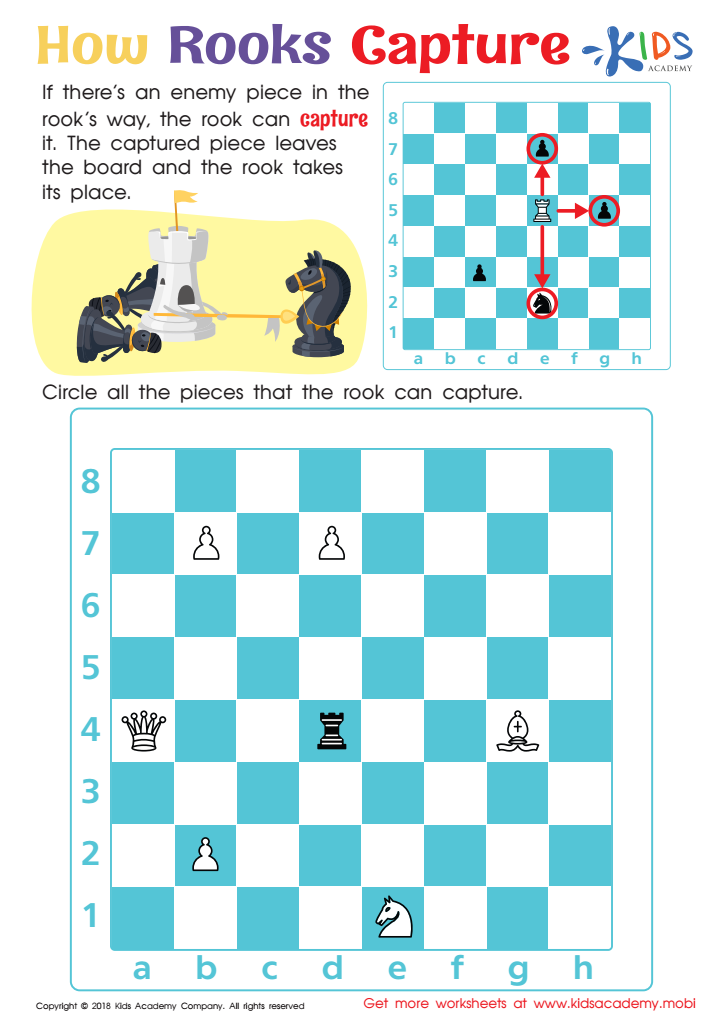
Chess is a game that requires skill, concentration and planning. Players must move their chess pieces strategically to capture pieces from their opponent. Do your kids know how to use the rook to capture pieces? Go through the worksheet with them and circle the pieces the rook can capture.
How Rooks Capture Worksheet
Worksheet
How Queen Captures Worksheet

How Queen Captures Worksheet

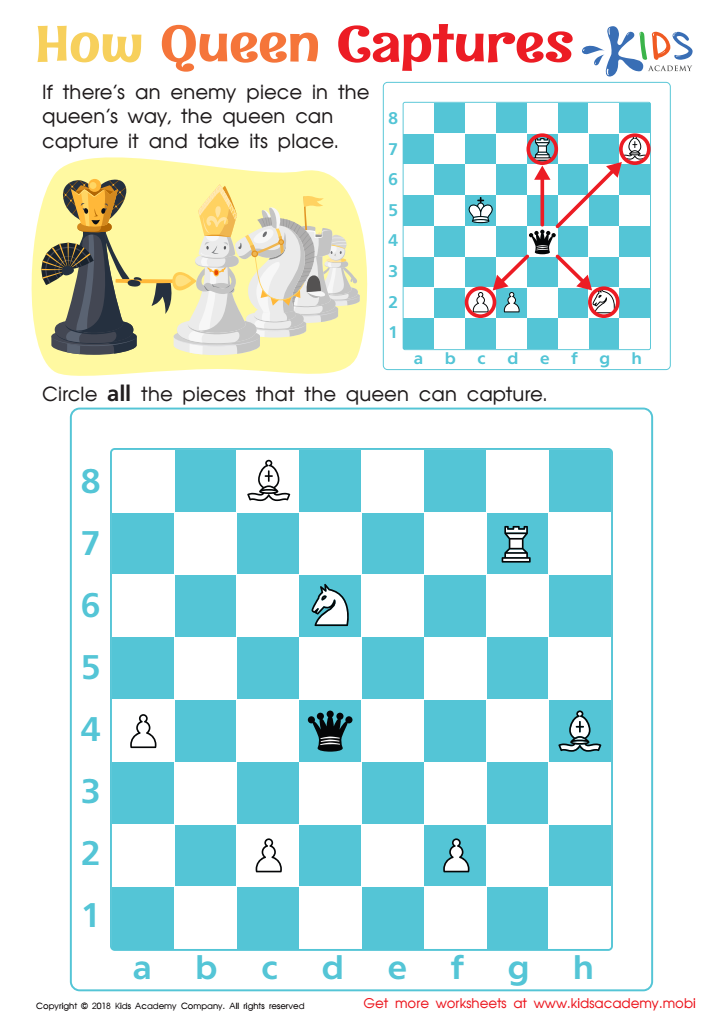
Chess is a great game for sharpening math skills, strategic thinking, and knowledge of how each piece moves. If your child is interested, introduce them with this worksheet. It demonstrates how the queen can capture opposing pieces, such as another queen, and take their place.
How Queen Captures Worksheet
Worksheet
Short Notation of Moves Worksheet

Short Notation of Moves Worksheet

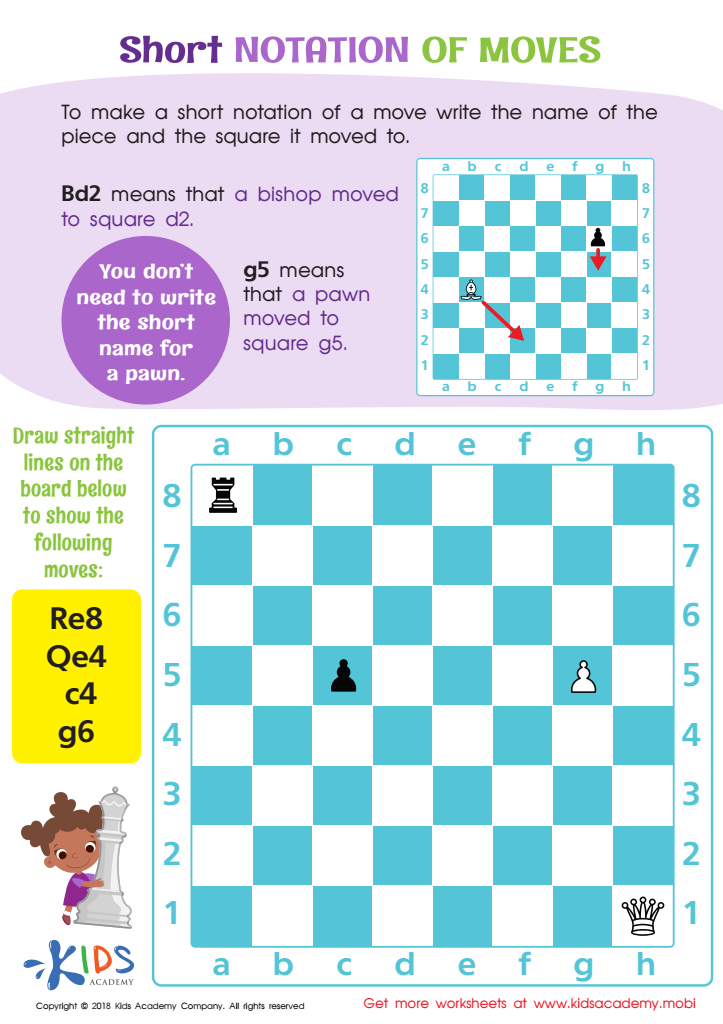
To master chess, you need more than just knowing the pieces and their moves - you need to be able to make notations of your moves. To make a short notation, write the piece name and square it moved to; for example, Bd2 for bishop on d2. Pawns don't need the piece name, just the square; e.g. g5. Show your kids how to draw lines to the board for the moves given.
Short Notation of Moves Worksheet
Worksheet
One Move Checkmates: Puzzle 2 Worksheet

One Move Checkmates: Puzzle 2 Worksheet

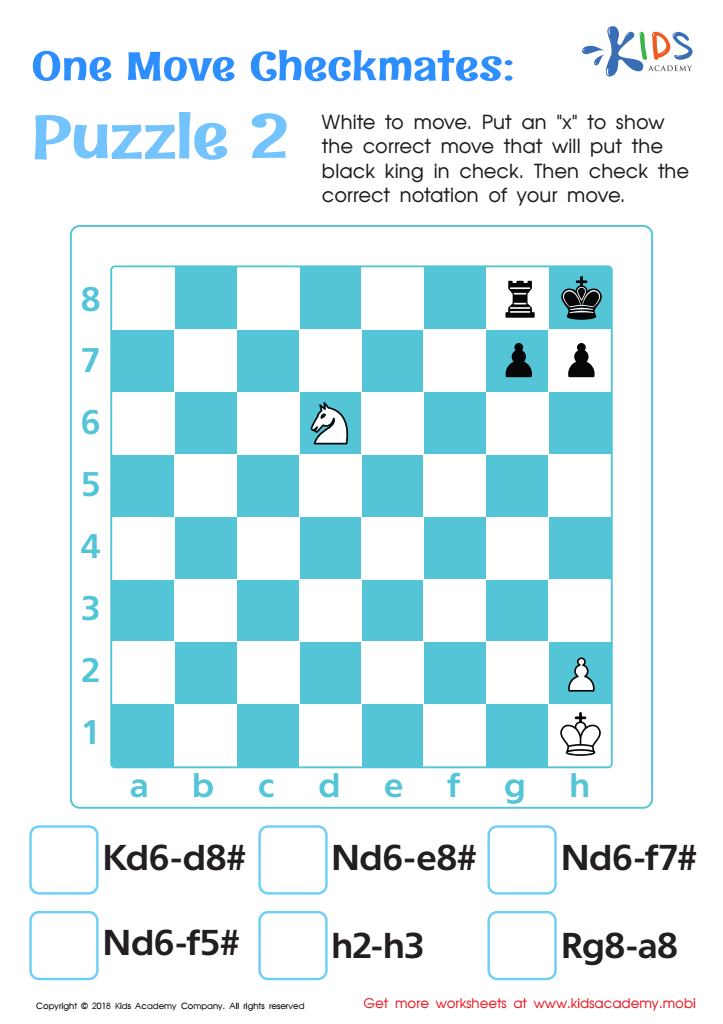
Fine-tuning logic and critical thinking skills can be tricky but this free PDF offers a fun way for little logisticians to practice visual-spatial relationships and strategizing to checkmate the black king. It also boosts directional and reading skills which makes it a great brain-building puzzle.
One Move Checkmates: Puzzle 2 Worksheet
Worksheet
Chess Manners Worksheet

Chess Manners Worksheet

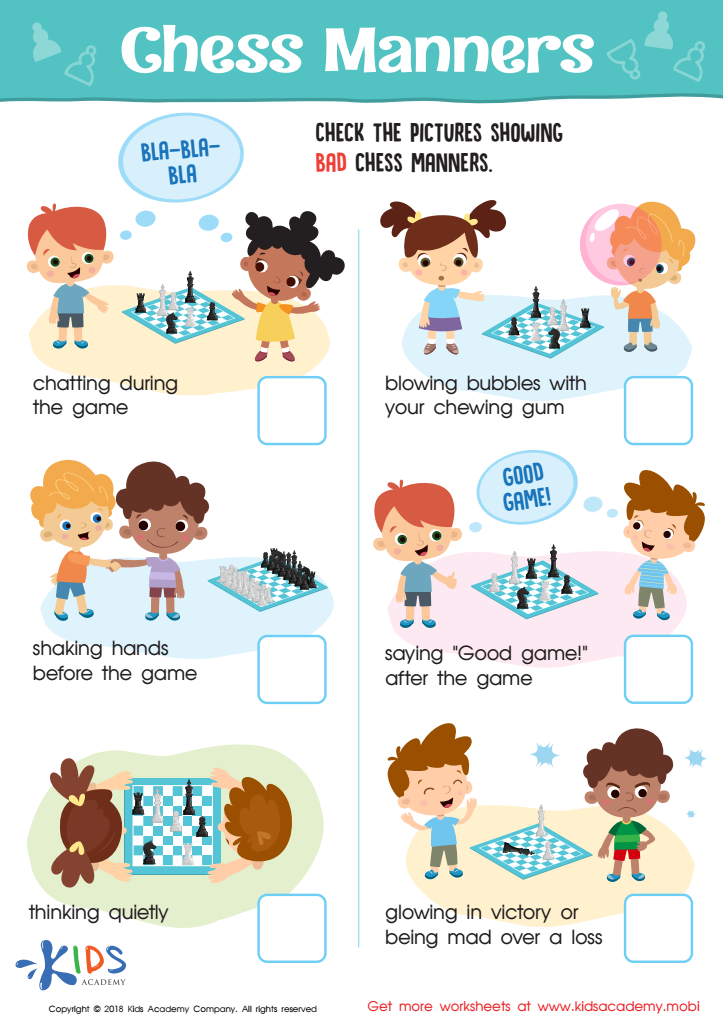
Teach your child chess manners in addition to table and social ones. Chess has clear rules and etiquette which must be followed for a proper game. Review this worksheet with your kid and discuss the pictures that show inappropriate behaviours. This will help them understand how to play the game correctly and with good manners.
Chess Manners Worksheet
Worksheet
Moves Notation Bingo Worksheet

Moves Notation Bingo Worksheet

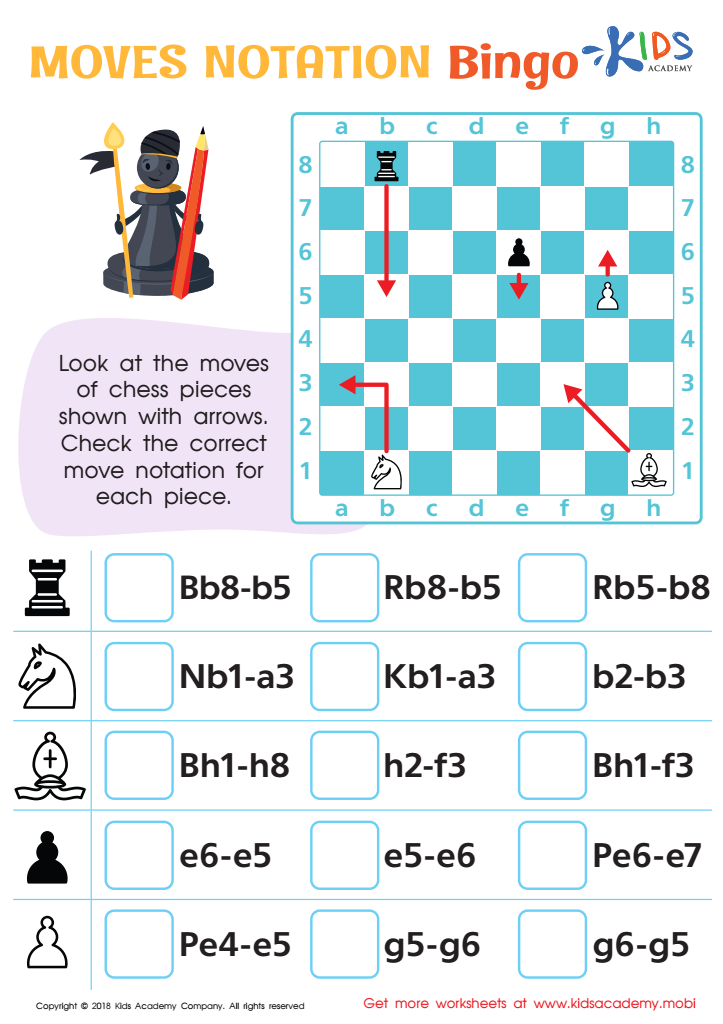
Test your child's chess notation skills with this simple worksheet. Download the PDF which shows a chess board and arrows pointing to pieces. Ask your child to identify the moves and note them down correctly. The notations needed are for bishop, pawn, rook and knight. Up to 80 words.
Moves Notation Bingo Worksheet
Worksheet
Castling No - no's: Part 2 Worksheet

Castling No - no's: Part 2 Worksheet

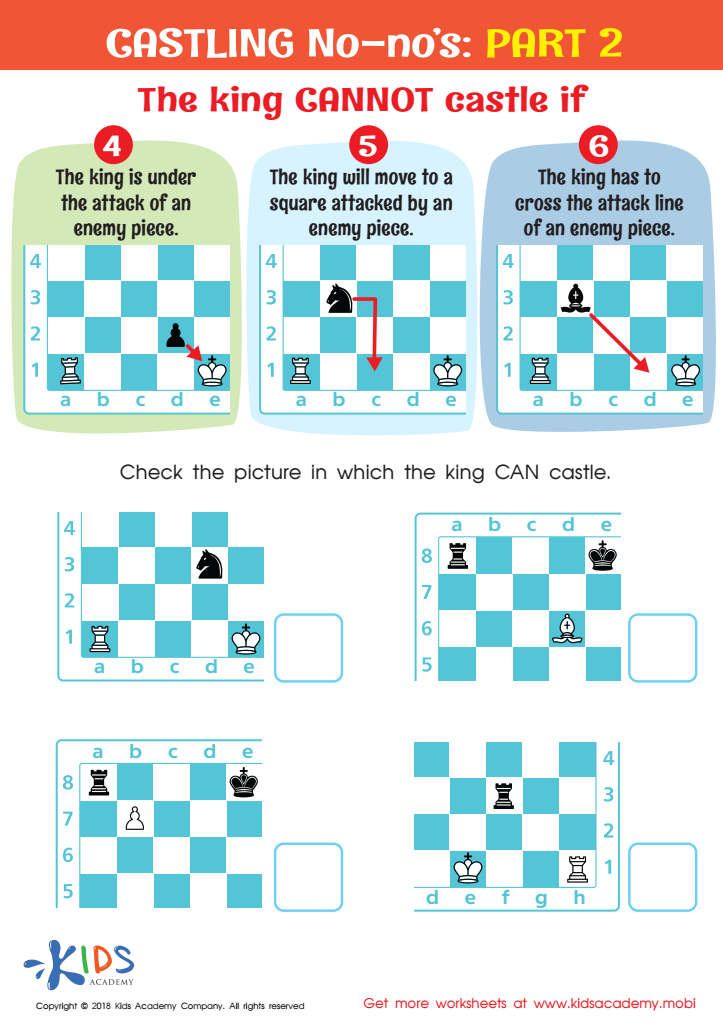
Teach your child the rules of castling: no castling if the king is under attack or will move onto an attacked square, or cross an attack line. To prepare for a game of chess, help your child complete the exercise of identifying when the king can castle – check the pictures.
Castling No - no's: Part 2 Worksheet
Worksheet
How Bishops Move Worksheet

How Bishops Move Worksheet

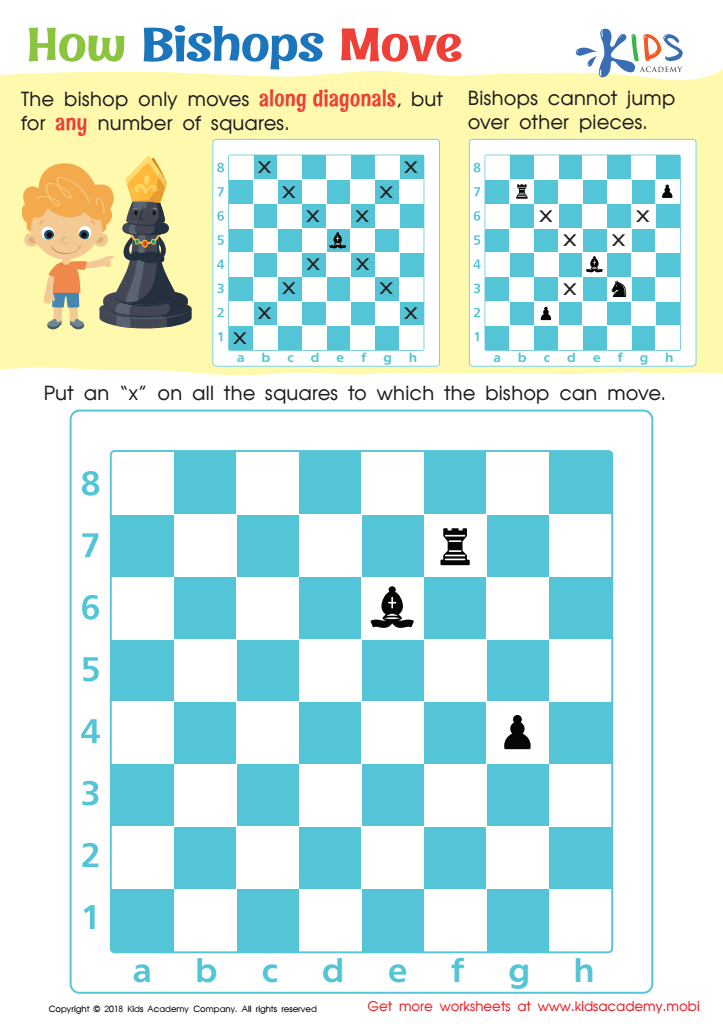
There is no such thing as too much sharpening of skills. Encourage your child to learn more about chess technicalities with this simple worksheet. It shows them how a bishop moves: along diagonals any number of squares, but it can't jump over other pieces.
How Bishops Move Worksheet
Worksheet


Strategic thinking is a vital cognitive skill, and chess is an excellent medium to nurture it, especially in 7-year-olds. At this developmental stage, children are like sponges, absorbing information readily, and games offer an engaging way to cultivate essential mental faculties. Chess inherently promotes problem-solving skills, forethought, and the ability to evaluate consequences – qualities that translate well into everyday decision-making and academic success.

Firstly, chess teaches kids to think ahead. Awareness of the opponent's potential moves necessitates planning and strategic foresight. This habit of anticipating outcomes and preparing for future events is beneficial in both academic and social contexts. For example, a child who can foresee different scenarios during a classroom activity is likely to perform better and react more adaptively to new challenges.

Additionally, playing chess involves analyzing patterns and developing structured thinking, enhancing mathematical and logical abilities. These skills are foundational in STEM education. Furthermore, beating an opponent or overcoming a difficult position builds resilience and confidence, key emotional and social attributes.

Equally important, chess fosters patience, focus, and following rules – traits that are essential not just in school but in life. Through regular play, children learn the value of sustained attention and thoughtful analysis, rather than relying on quick, impulsive decisions. In essence, introducing chess propels children into a world of strategic thinking, nurturing an array of attributes pivotal for holistic growth.