Comparing Fractions Geometry Worksheets for 7-Year-Olds
5 filtered results
-
From - To
Enhance your child’s learning with our exciting "Comparing Fractions Geometry Worksheets for 7-Year-Olds." These worksheets offer a dynamic blend of fun and education, focusing on developing essential skills in both geometry and fractions. Tailored specifically for young learners, the activities involve comparing and contrasting fractions in the context of geometric shapes, providing a visual and intuitive approach to math. By integrating shapes and fractions, kids not only grasp foundational math concepts but also enjoy an engaging educational experience. Perfect for reinforcing classroom lessons or aspiring young mathematicians at home. Explore now and ignite a love for numbers and shapes!
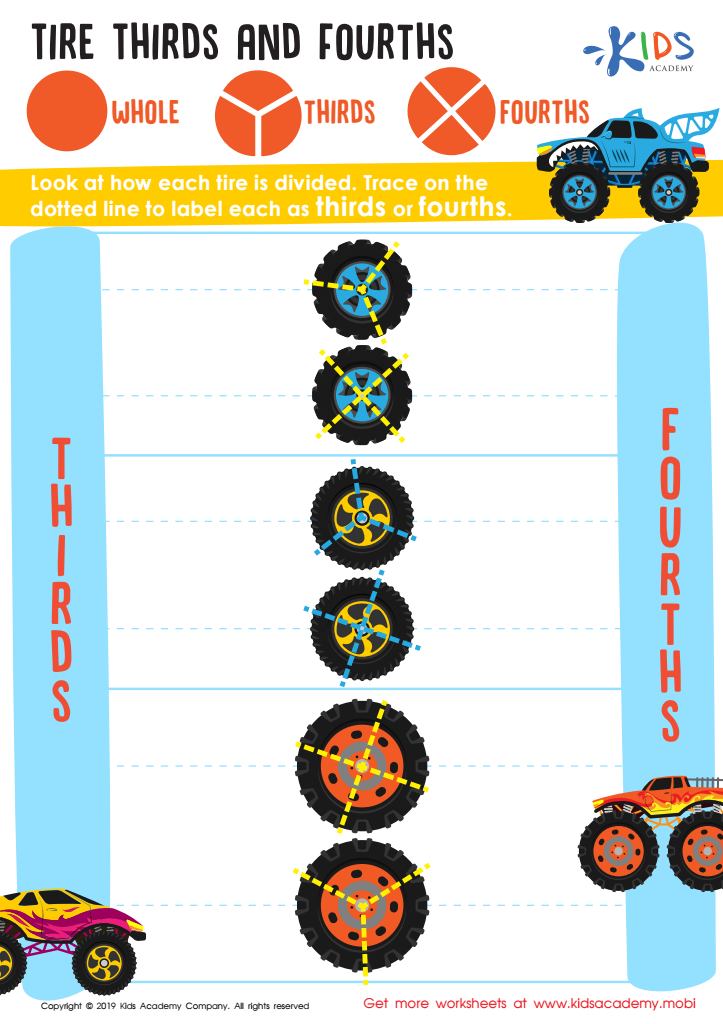
Tire Thirds and Fourths Worksheet
 Assign to My Students











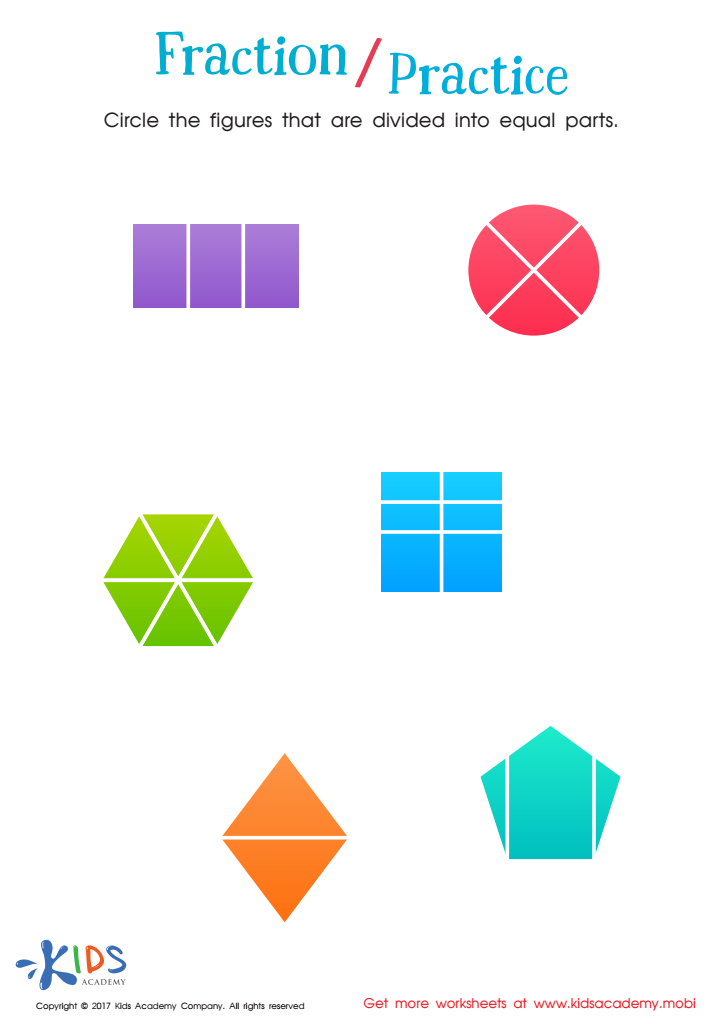
Fractions: Shapes Worksheet
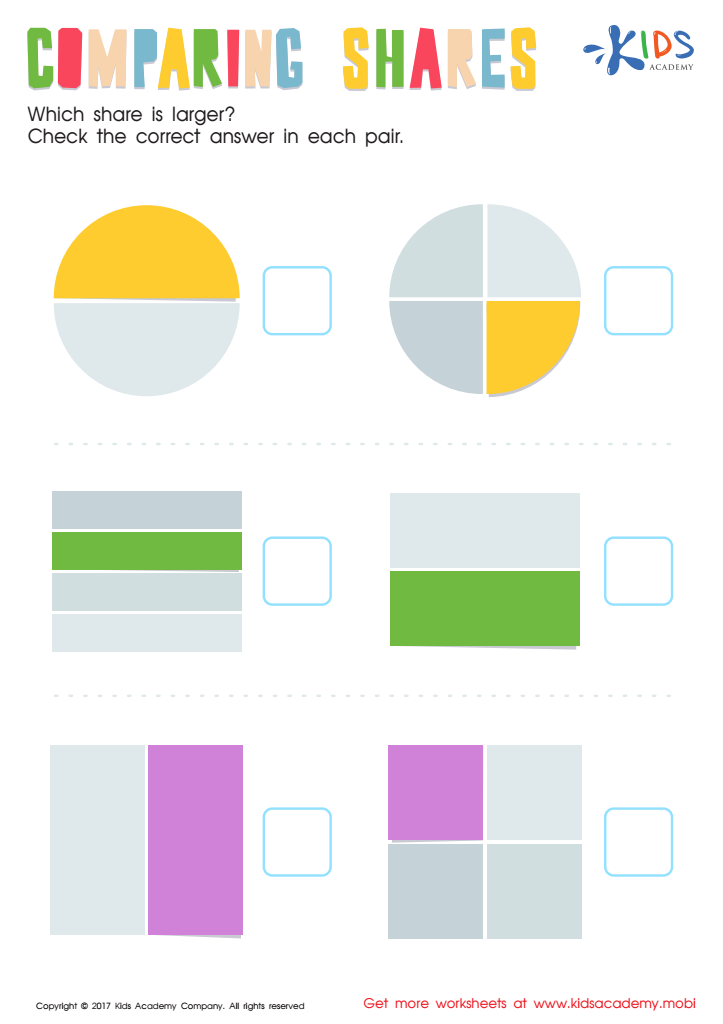
Comparing Shares Worksheet
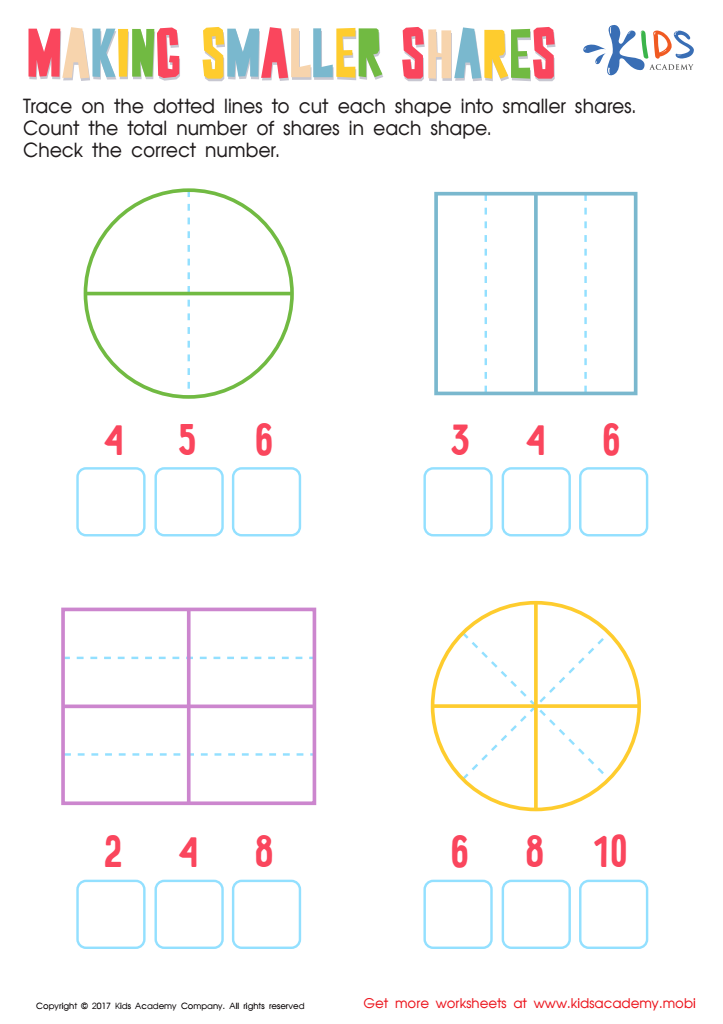
Making Smaller Shares Worksheet
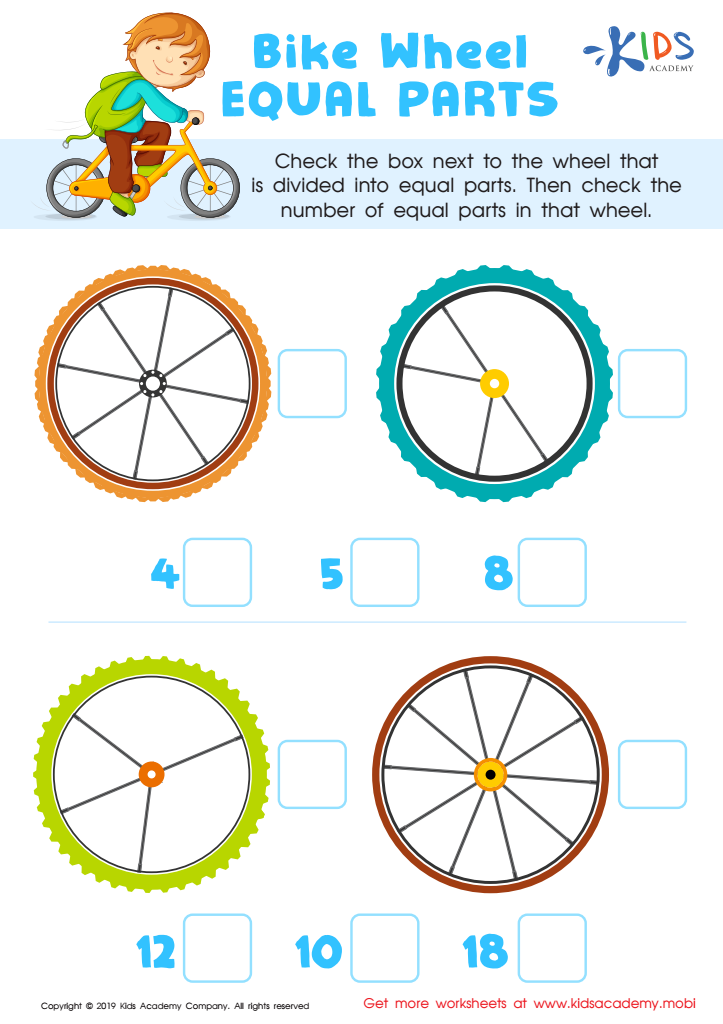
Bike Wheel Equal Parts Worksheet








Understanding and comparing fractions at an early age is fundamental for building a strong mathematical foundation. For 7-year-olds, delving into the concept of fractions and their geometric representations helps demystify abstract ideas and makes them more tangible. Parents and teachers should care about this for several reasons:
-
Foundational Skill Development: Learning fractions helps children understand parts of a whole, laying the groundwork for more advanced math topics, such as ratios, percentages, and algebraic reasoning.
-
Critical Thinking: Comparing fractions enhances a child's analytical skills. It requires recognizing the size of different parts and understanding equivalence, improving their numerical reasoning.
-
Visual Learning: Using geometric shapes to teach fractions appeals to young children’s visual and spatial intelligence. It helps them visualize math concepts and see how fractions represent parts of a whole.
-
Real-world Applications: Fractions are used in everyday life, from cooking to dividing goods. Early familiarity helps children understand practical applications, making them more confident in their mathematical abilities.
-
Academic Success: A solid grasp of fractions and geometry at an early age correlates with better performance in higher-level math. It cultivates a positive attitude towards math, reducing math anxiety.
By investing time in teaching fractions through geometry, parents and teachers ensure that children develop essential skills that will benefit their academic journey and everyday life.








