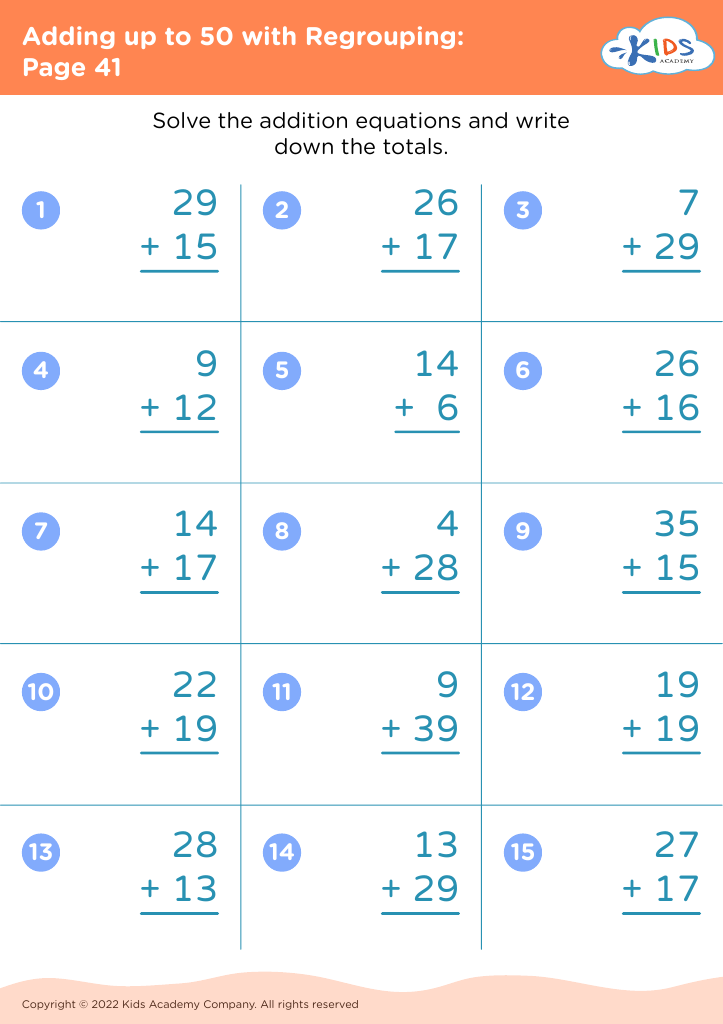








Parents and teachers should prioritize addition skills for children aged 8-9 because these foundational skills are crucial for overall mathematical proficiency and daily problem-solving. At this age, children typically transition from basic arithmetic to more complex mathematical concepts, including subtraction, multiplication, and even introductory geometry. Strong addition skills enable them to grasp these concepts more readily, leading to better academic performance.
Moreover, mastering addition helps develop critical thinking and analytical abilities essential for real-life situations, including budgeting and time management. As children engage in activities like shopping or cooking, having a solid command of addition aids in understanding prices, measurements, and quantities.
Furthermore, proficiency in addition boosts children's confidence in their mathematical abilities. This confidence often translates into a positive learning attitude, encouraging them to tackle challenges rather than shy away from them. It also fosters a love for learning, as they experience success and can recognize patterns in numbers.
Overall, focusing on addition skills equips children not only with academic tools but also with life skills that enhance their cognitive development and problem-solving abilities. Thus, reinforcing addition at this crucial age can lead to lasting benefits beyond the classroom.








