Understanding geometry Geometry Worksheets for Ages 8-9
3 filtered results
-
From - To
Discover the joy of learning geometry with our expertly crafted worksheets designed for children aged 8-9. These engaging resources from Kids Academy build foundational skills in understanding shapes, spatial awareness, and geometric properties. Each worksheet is tailored to develop critical thinking through fun exercises, enabling young learners to confidently explore concepts like angles, symmetry, and transformations. With vibrant visuals and tailored challenges, our geometry worksheets turn complex ideas into accessible and enjoyable activities. Empower your child’s mathematical journey – explore our comprehensive collection of worksheets dedicated to nurturing geometric proficiency and cultivating a love for math.
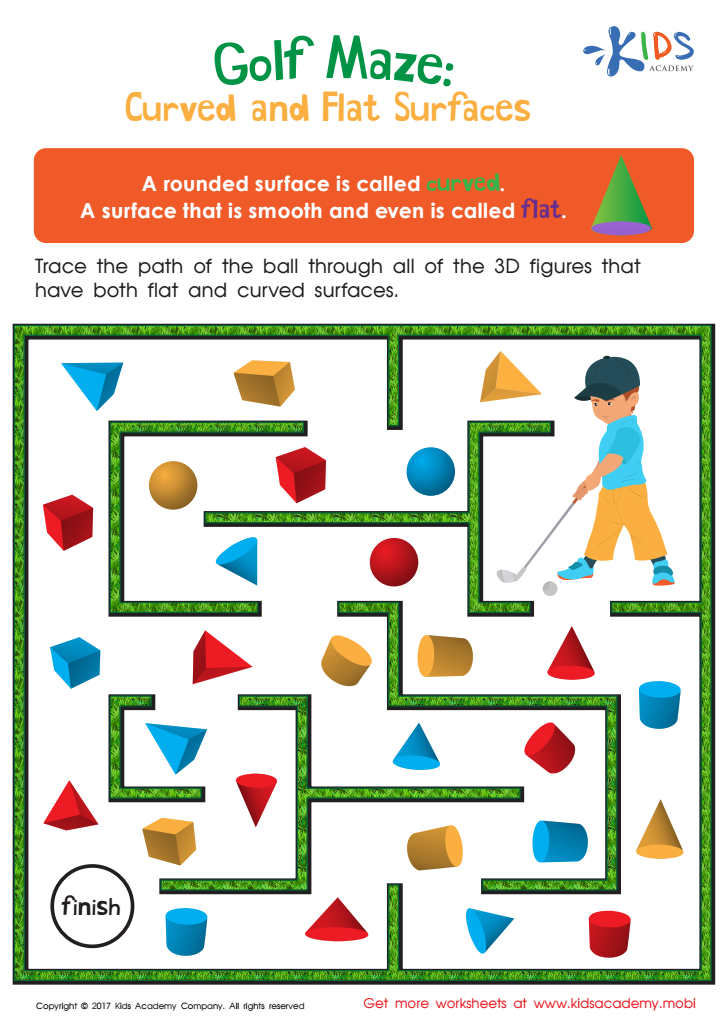
Golf Maze: Curved and Flat Surfaces Worksheet
 Assign to My Students











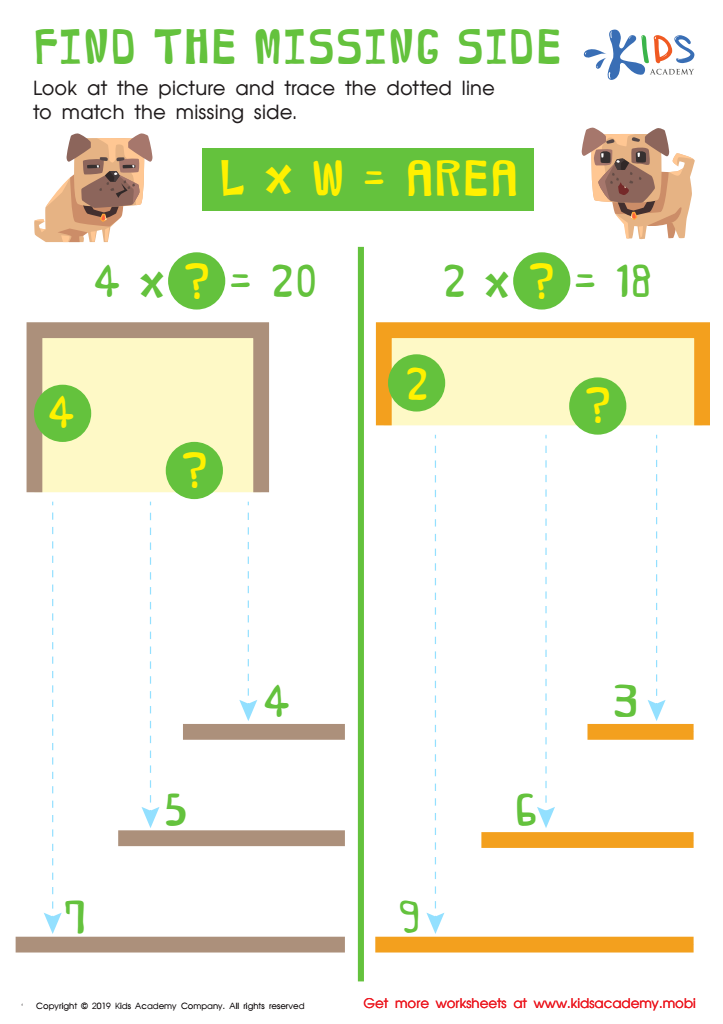
Find the Missing Side Worksheet
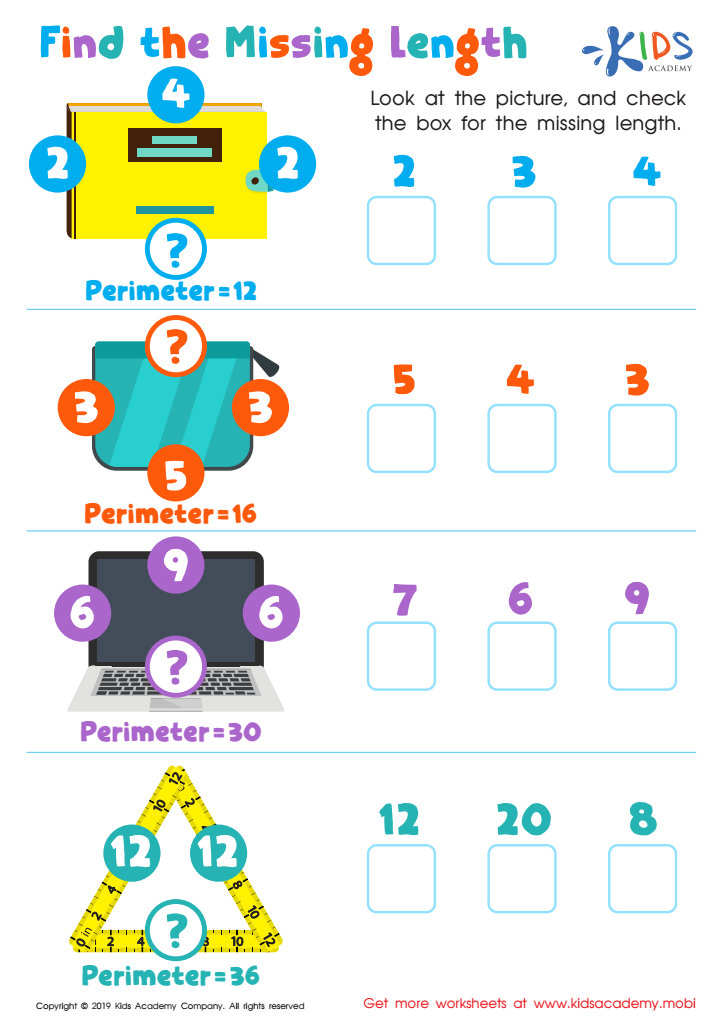
Find the Missing Length Worksheet








Understanding geometry at ages 8-9 is crucial for several reasons, and parents and teachers play a vital role in this developmental stage. Firstly, it promotes critical thinking and problem-solving skills. Geometry encourages children to visualize, analyze, and manipulate shapes, helping them develop spatial awareness and reasoning. These skills are fundamental in many fields, from science and technology to architecture and everyday problem-solving.
Secondly, geometry helps solidify mathematical foundations. Basic geometric concepts like recognizing shapes, understanding symmetry, and grasping spatial relationships provide a basis for more advanced math topics. Children who excel in geometry often find it easier to grasp complex concepts in algebra, calculus, and beyond.
Moreover, understanding geometry enhances a child's ability to interpret and interact with their environment. It enables them to relate to physical spaces and objects, improving their navigation skills and their understanding of measurements and dimensions.
Lastly, introducing geometry in a fun and engaging way at an early age can stimulate a lifelong interest in mathematics and the sciences. Through hands-on activities, games, and interactive lessons, parents and teachers can make geometry both enjoyable and educational.
In essence, a robust understanding of geometry equips children with essential cognitive tools and lays the groundwork for future academic and personal successes. Parents and teachers should actively support and encourage learning in this area.








