
Visual discrimination Geometry Worksheets for Ages 8-9
3 filtered results
Difficulty Level
Grade
Age
-
From - To
Subject
Activity
Standards
Unlock the wonders of geometry with our Visual Discrimination Geometry Worksheets for Ages 8-9! These engaging and interactive worksheets are designed to enhance essential visual understanding skills, such as recognizing shapes, patterns, and spatial relationships. Perfect for young learners, our worksheets promote critical thinking and strengthen problem-solving abilities in a fun, educational manner. Each activity encourages exploration and creativity, making geometry accessible and enjoyable. Ideal for both classroom and at-home learning, our resources are easy to use, ensuring that children develop a solid foundation in geometric concepts. Dive into our collection today and help your child discover the beauty of geometry!
Favorites
With answer key
Interactive
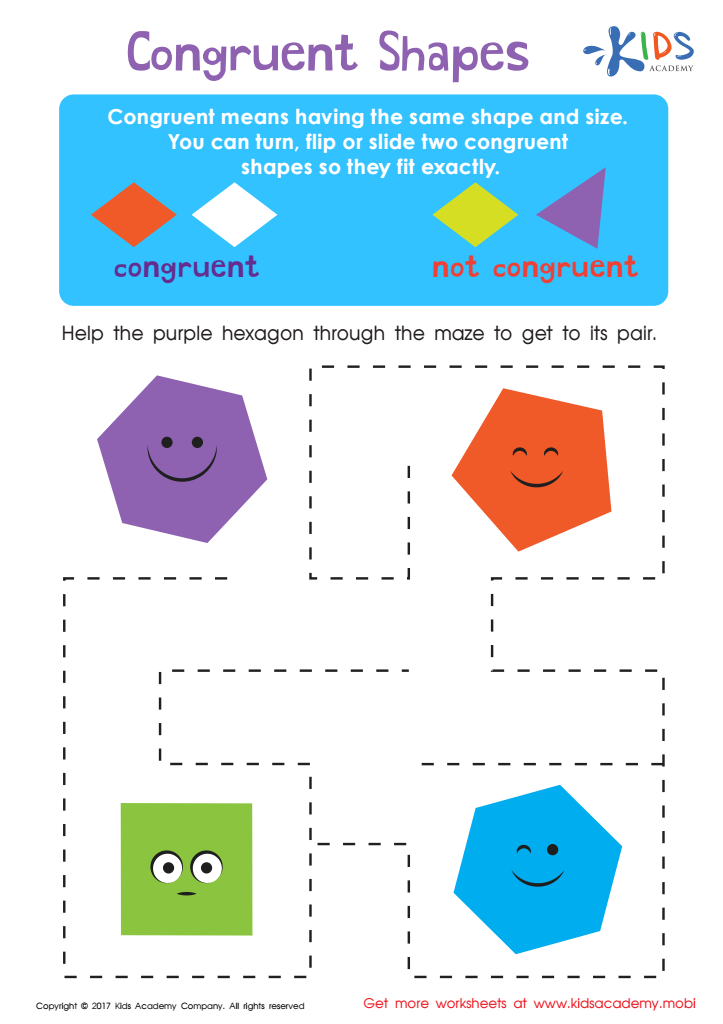
Congruent Shapes Worksheet
Help your child find the twin of the purple hexagon! This congruent shapes worksheet is great for increasing vocabulary while challenging mental rotation skills.
 Assign to My Students
Congruent Shapes Worksheet
Worksheet











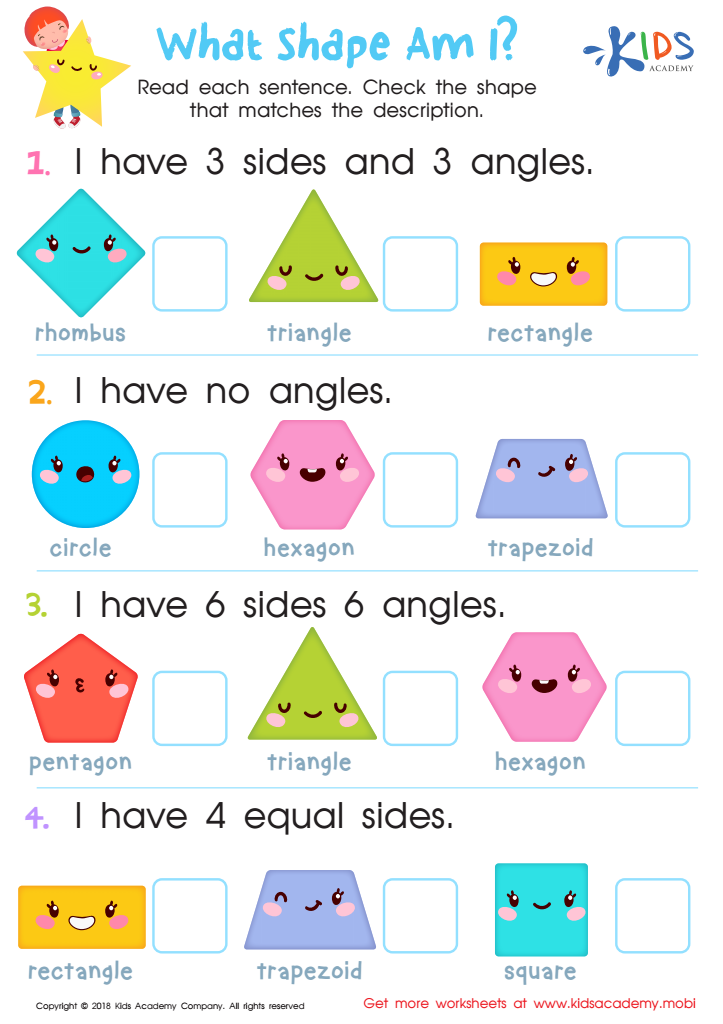
What Shape Am I? Worksheet
Help your child read each sentence in this colorful worksheet. Have them identify the shapes described and check the boxes. To prepare, ask simple questions like "How many sides does a triangle have?" and "Which shape has 4 equal sides?" Your child will become more skilled at shapes by the end of this activity.
What Shape Am I? Worksheet
Worksheet
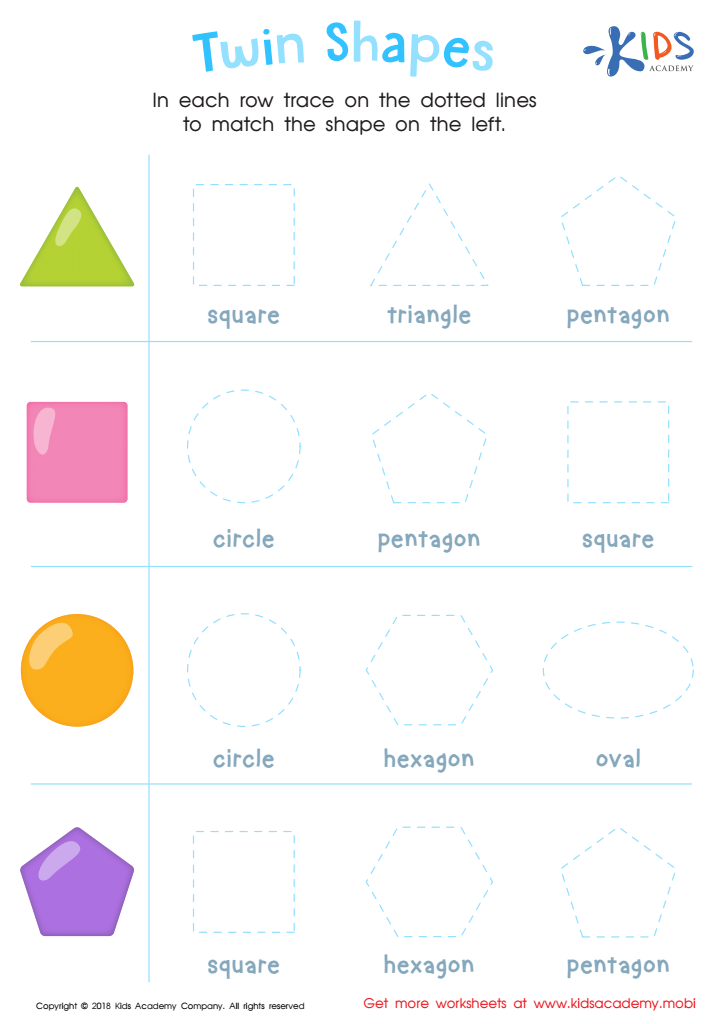
Twin Shapes Dot-to-Dot Worksheet
Test your child's ability to copy with this worksheet. Ask them to find and name the four shapes on the left. Then, they must match each with the dotted lines on the right. Help your child with all four shapes in this fun exercise.
Twin Shapes Dot-to-Dot Worksheet
Worksheet
Join Kids Academy for Free
Who is primarily going to use this learning content?








Visual discrimination in geometry is crucial for children aged 8-9 as it forms the foundation for their understanding of spatial relationships and logical reasoning. At this age, students are transitioning from concrete to more abstract thinking, making it essential for them to recognize, visualize, and differentiate between shapes, sizes, and spatial orientations.
Developing strong visual discrimination skills enhances problem-solving abilities and improves mathematical proficiency. When children can clearly identify geometric properties, they are better equipped to understand concepts such as symmetry, congruence, and angles. This skillset not only boosts their confidence in math but also applies to other subjects, including science, art, and even reading.
Moreover, these skills pave the way for more advanced topics in geometry and critical thinking that they will encounter in later grades. Awareness of visual patterns and shapes contributes to cognitive development and helps cultivate creativity, allowing children to explore their surroundings in a meaningful way.
For parents and teachers, investing time in engaging activities that foster visual discrimination—like puzzles, shape sorting, and drawing—can significantly enrich children’s educational experience, setting them up for future academic success and improving their overall learning capabilities.








