
Rhyme recognition Songs Worksheets for Ages 8-9
3 filtered results
Difficulty Level
Grade
Age
-
From - To
Subject
Activity
Standards
Our Rhyme Recognition Songs Worksheets for Ages 8-9 provide a fun and engaging way for children to enhance their phonemic awareness. Designed to strengthen reading skills, these worksheets incorporate delightful songs that help kids identify and produce rhyming words. Through interactive activities and sing-along sessions, learners will enjoy mastering this essential literacy skill. Ideal for both classroom and home use, these printable resources offer a blend of entertainment and education, promoting a love of language and reading. Unlock your child's potential with our comprehensive and enjoyable rhyme recognition practice.
Favorites
With answer key
Interactive
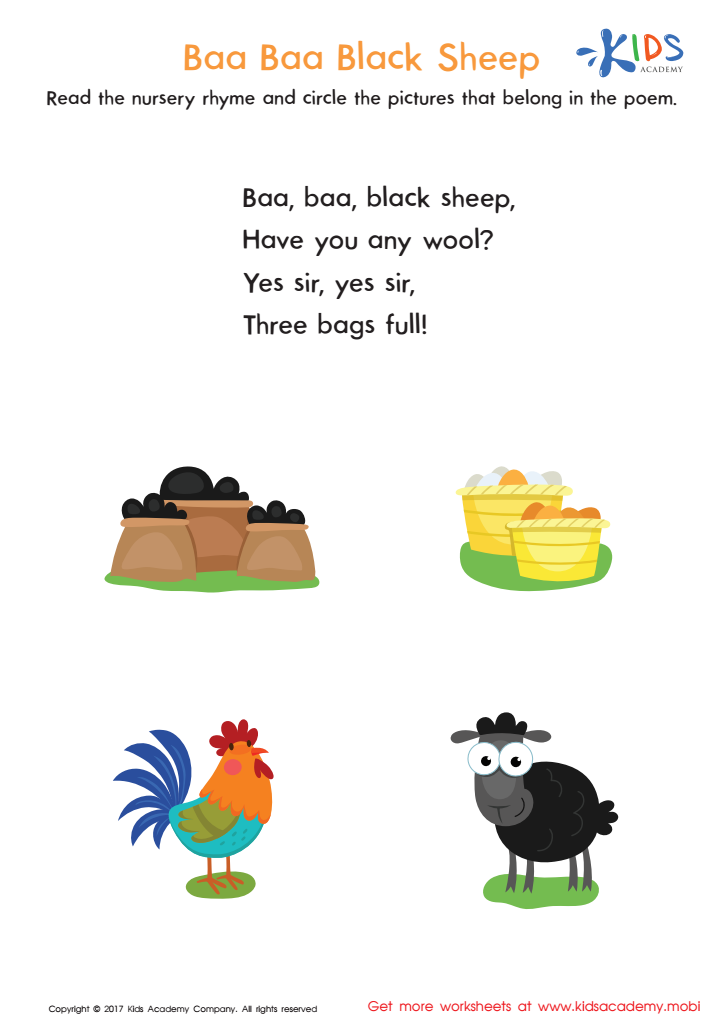
Baa Baa Black Sheep Printable
Jumpstart your child's reading skills with this printable Baa Baa Black Sheep worksheet! Recite the lines with them, then have them select the pictures associated with the poem to test comprehension. Fun and educational!
 Assign to My Students
Baa Baa Black Sheep Printable
Worksheet
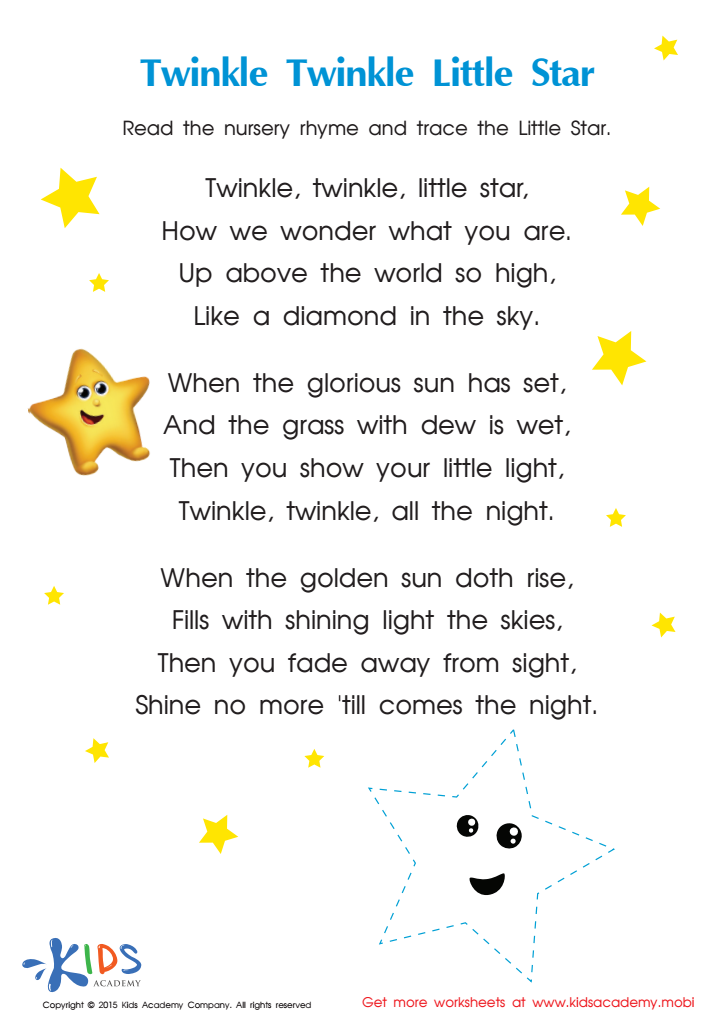
Nursery Rhymes: Twinkle Little Star Worksheet
Introduce your kindergartener to nursery rhymes using this printable worksheet. Sing Twinkle Little Star with your child and incorporate some simple actions. Even as a lullaby, it's a great way to teach letters and counting - have your child find and count all the letter 'S's in the song. For extra fun, try the Twinkle Little Star coloring page.
Nursery Rhymes: Twinkle Little Star Worksheet
Worksheet
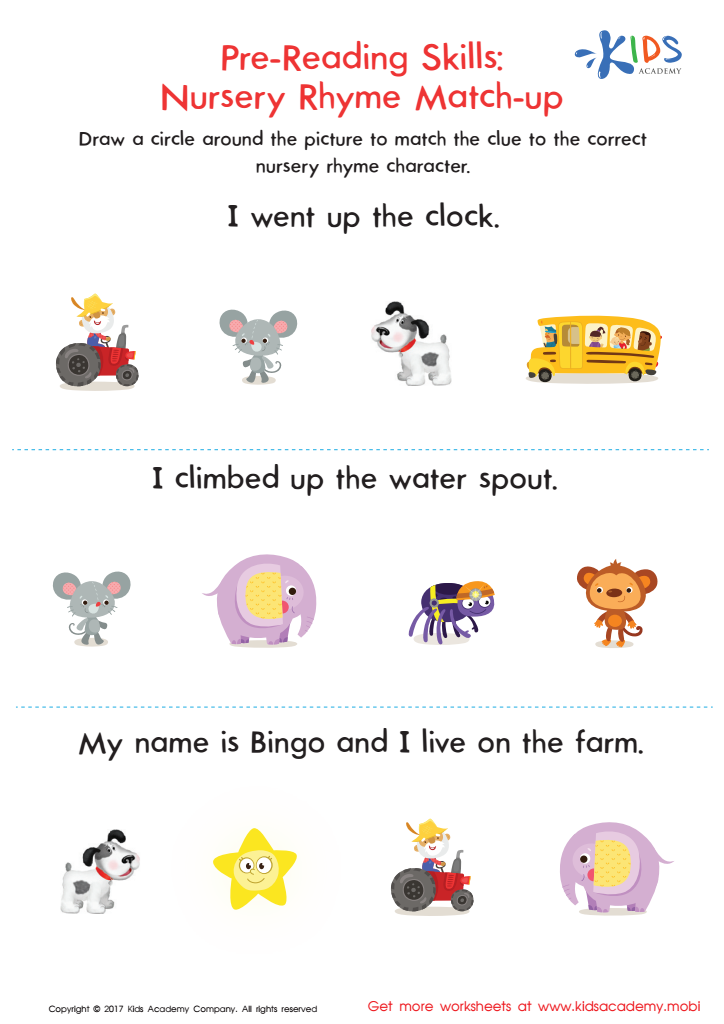
Nursery Rhyme Match–Up Worksheet
This worksheet helps kids build pre-reading skills using stories they know and love! By connecting with prior knowledge, kids can develop ideas about characters and set the stage for reading strategies.
Nursery Rhyme Match–Up Worksheet
Worksheet
Join Kids Academy for Free
Who is primarily going to use this learning content?








Parents and teachers should deeply care about rhyme recognition songs for children aged 8-9 because these musical tools play a crucial role in the development of literacy skills. At this age, children are honing their reading and spelling abilities, and rhyme recognition significantly accelerates this process. By listening to and engaging with rhymes, kids boost their phonemic awareness, which is the ability to hear and manipulate individual sounds in words. This awareness is foundational for proficient reading and writing.
Furthermore, rhyming songs make learning interactive and enjoyable, thereby increasing a child's motivation to participate. They typically feature repetitive and predictable patterns, which help young learners anticipate and decode new words with relative ease. These predictions and patterns aid memory, enhance vocabulary, and establish connections between sounds and letters.
Rhyme recognition also enhances cognitive and auditory skills. When children discern rhymes, they practice critical listening and sound discrimination, which are integral to effective communication and learning. Additionally, these songs often introduce rhythm and melody, making the learning experience multisensory and engaging different areas of the brain.
Overall, parents and teachers should embrace rhyme recognition songs as they support fundamental literacy skills, foster an enjoyable learning environment, and cater to holistic child development.








